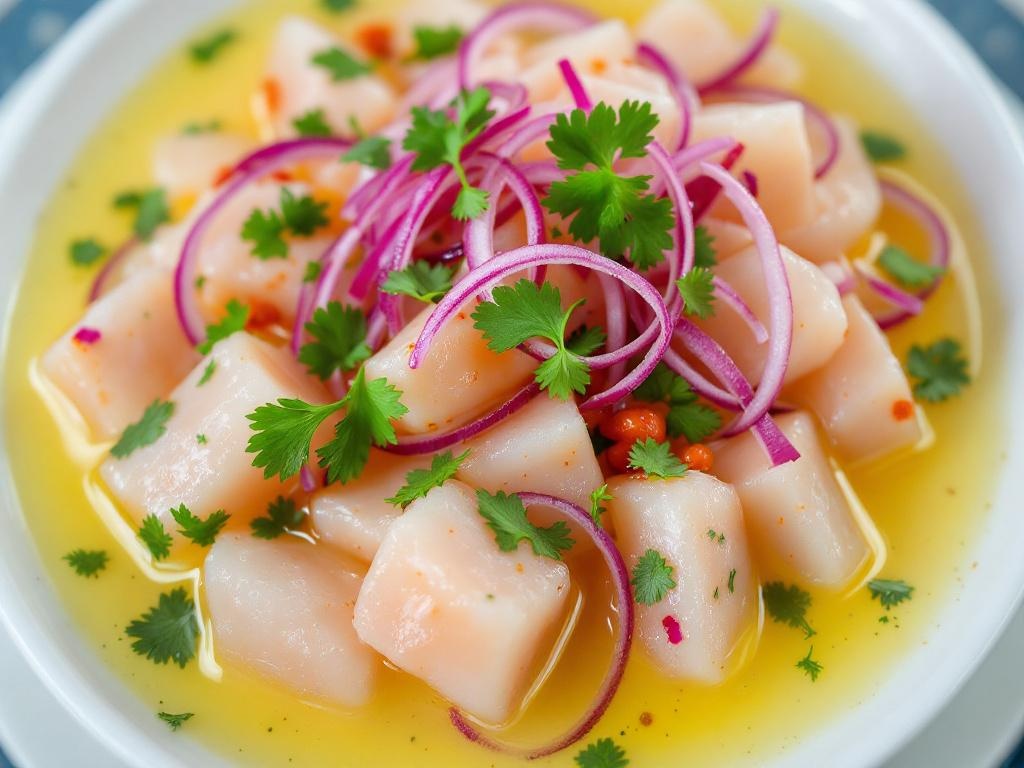
Latin-American
Ceviche
Pillar I
Ingredients
Serves
4
500 g
firm white fish
180 ml
fresh lime juice
2 tbsp
ají amarillo paste
1 large
red onion
15 g
fresh ginger
2 cloves
garlic
large handful
coriander (cilantro)
1 stalk
celery
50 ml
fish or prawn stock
to taste
sea salt
200 g
cancha (toasted corn nuts)
1
sweet potato
Pillar II
Method
6 steps
1.
Make the leche de tigre: blend lime juice, ají amarillo, ginger, garlic, celery, half the coriander, and stock until smooth. Strain through a fine sieve. Season aggressively with salt — it will temper when combined with the fish.
Technique — Leche de tigre ('tiger's milk') is more than a marinade — it is the signature element that distinguishes Peruvian ceviche from every other acid-cured fish preparation globally. The blending creates an emulsified, aromatic liquid that penetrates the fish more effectively than straight lime juice. Aggressive pre-seasoning is essential: the fish releases water during curing, diluting the marinade. Season to the point it tastes too sharp and salty alone.
2.
Cut fish into 2cm cubes or bite-sized irregular pieces. Do not slice too thin or it will cure unevenly.
Technique — The cut size controls the cure rate. At 2cm, the acid takes 3–5 minutes to penetrate the centre; smaller pieces cure in under 90 seconds and over-cure before assembly is complete. The cut must be decisive and clean — sawing creates torn edges that cure faster than the interior, leading to a rubbery exterior and raw centre. A sharp knife and a cold fish (nearly frozen) make this easier.
3.
Combine fish and red onion slices in a non-reactive bowl. Pour leche de tigre over — fish should be well covered.
Technique — Non-reactive means glass, ceramic, or high-quality stainless steel — reactive metals (aluminium, copper) react with citric acid to produce metallic off-notes. The onion is rinsed before use to remove the harshest volatile sulphur compounds. The fish must be submerged — any exposed surface will cure unevenly, creating a mixed-texture result.
4.
Let cure 2–3 minutes for soft-textured fish, 5–8 minutes for denser fish. Watch for the colour change from translucent to opaque — this is the cure point. Do not over-marinate.
Technique — The colour change from translucent to opaque is driven by acid denaturing the proteins — the same process as heat cooking, achieved through chemistry rather than temperature. Over-cured fish undergoes excessive protein denaturation: the texture becomes dry, rubbery, and squeaky. The difference between perfect and over-cured is approximately 2 minutes for delicate white fish. Once the fish is opaque throughout, remove from the marinade immediately.
5.
Taste and adjust — the ceviche should be intensely sharp, bright, and hot in equal measure. Add remaining coriander leaves.
Technique — Ceviche is adjusted by taste, not recipe. Lime acidity varies by season and variety; the fish's water content varies by species and freshness; personal tolerance for sourness varies. The correct final balance should trigger immediate salivation — that acute acid response is the sensory signature of great ceviche and the test that separates it from under-seasoned versions.
6.
Serve immediately in chilled bowls alongside cancha corn and boiled sweet potato. The remaining leche de tigre can be served as a shot.
Technique — In Lima, the leftover leche de tigre is considered medicinal — a cure for hangovers and a source of strength, hence 'tiger's milk'. It is often served as a shot alongside the ceviche, or sipped from the bowl after the fish is finished. The three-temperature contrast — cold cured fish, crunchy cancha (room temperature), starchy sweet potato — creates variety that makes the dish more than the sum of its parts.
Pillar III
Quality Hierarchy
Library+
Open The Kitchen to start using this.
Open The KitchenPillar IV
Sensory Tests
No sensory tests recorded yet.
Pillar V
Cross-Cuisine Parallels
Library+ for full grid
No cross-cuisine parallels recorded yet.
Pillar VI
Beverage Pairings
Library+ for named producers
No beverage pairings recorded yet.
Pillar VII
Origin & Lineage
Peru — the Moche civilisation on Peru's northern coast used tumbo fruit and salt to cure fish 2,000 years before the Spanish arrived. The lime came with colonisation in the 16th century and sharpened the technique. Lima's current style — pure, minimal leche de tigre — is a distinct expression from Peruvian regional variants, and from Mexican ceviche, which uses tomato, coriander, and onion in a fundamentally different register.
Sourcing
Where to find these ingredients
Region: global
Fujiya
Vancouver, BC, CA
Shochu — Imo (Sweet Potato)
Fukuya Foods
Vancouver, BC, CA
Shochu — Imo (Sweet Potato)
Tools & Compliance
The working layer
Profession+ for HACCP and Cost