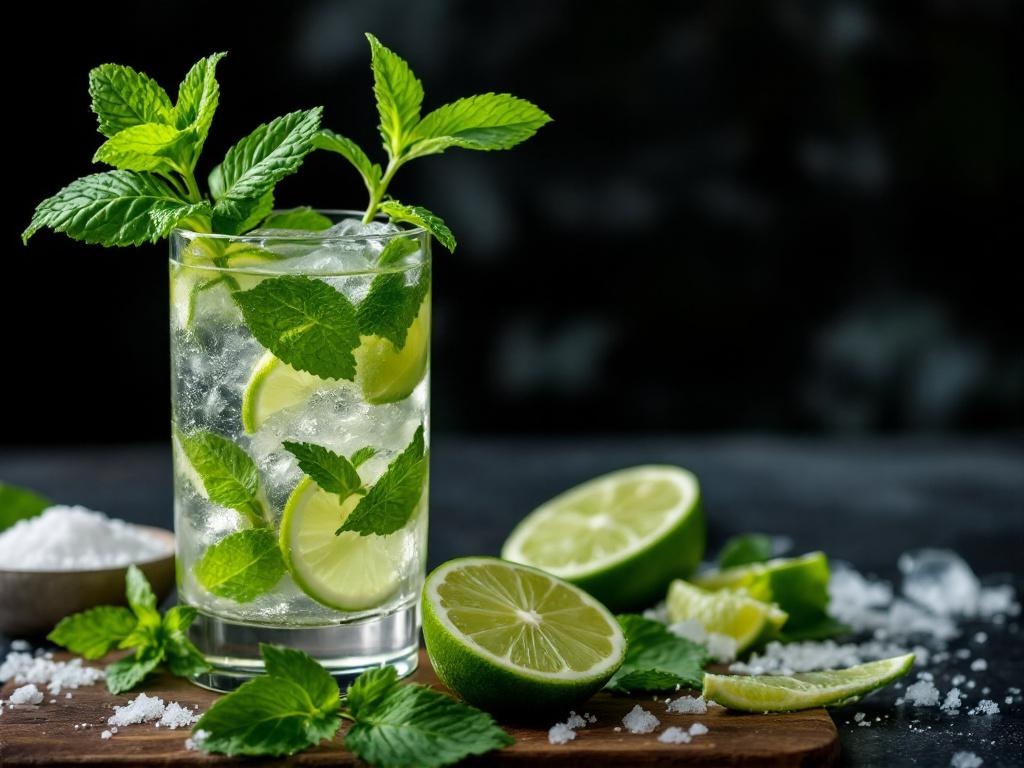
Latin-American
Mojito
Pillar I
Ingredients
Serves
1
50 ml
white rum
25 ml
fresh lime juice
15 ml
caster sugar or simple syrup
8 sprigs
fresh spearmint
60 ml
soda water
to fill
crushed ice
Pillar II
Method
5 steps
1.
Place 6 mint sprigs in a highball glass. Add sugar (or syrup) and lime juice.
Technique — The sugar and lime juice are added before muddling to act as a medium — the granular sugar provides light abrasion against the mint cell walls, and the lime juice's acids help extract the water-soluble aromatic compounds. The sequence matters: mint first, then sugar and lime, then muddle.
2.
Muddle lightly — 3–4 firm presses only. You want the oils from the leaves and stems, not the plant pulped. Over-muddling creates bitter chlorophyll tones.
Technique — Over-muddling is the most common mojito mistake. The aromatic compounds in mint — primarily menthol, carvone, and limonene — are concentrated in the leaf's oil glands and stem tissue. Light pressing ruptures these glands and releases the oils. Vigorous pounding ruptures the leaf cells themselves, releasing chlorophyll (bitter, grassy) and destroying the delicate aromatic esters. The correct technique is closer to pressing than pounding.
3.
Add rum. Fill glass with crushed ice, stir briefly with a bar spoon to combine and chill.
Technique — White rum at 40% ABV serves as a solvent carrier for the mint and lime aromatics — ethanol dissolves fat-soluble aromatic compounds that would not dissolve in water alone. The crushed ice provides maximum surface area contact between the drink and the cold source, chilling rapidly. The brief stir integrates the sugar-lime-mint mixture with the rum before the soda is added.
4.
Top with chilled soda water. One final gentle stir.
Technique — The soda water must be cold and highly carbonated. The carbonation does more than provide texture — it drives lime and mint aromas upward through the liquid, delivering them to the nose with each sip. Flat or warm soda produces a diluted, texturally dead version of the drink. Pour gently down the inside of the glass to preserve carbonation.
5.
Garnish with remaining 2 mint sprigs, slapped against your palm first. Add a lime wheel if desired. Serve with a straw.
Technique — The slapping technique releases additional essential oils from the surface cells of the mint leaves — a quick, decisive impact against the palm is sufficient. The straw height is set so the drinker's nose is level with the mint garnish — the aromatic delivery of the garnish is part of the designed experience, not decoration.
Pillar III
Quality Hierarchy
Library+
Open The Kitchen to start using this.
Open The KitchenPillar IV
Sensory Tests
No sensory tests recorded yet.
Pillar V
Cross-Cuisine Parallels
Library+ for full grid
No cross-cuisine parallels recorded yet.
Pillar VI
Beverage Pairings
Library+ for named producers
No beverage pairings recorded yet.
Pillar VII
Origin & Lineage
Havana, Cuba. La Bodeguita del Medio and El Floridita both claim it. The precursor, El Draque, dates to the 1580s — Sir Francis Drake's physician used aguardiente, wild mint, lime, and sugar as a scurvy remedy for the crew. The Mojito arrived in its modern form when Bacardi Carta Blanca replaced aguardiente in the late 19th century and the drink moved from necessity to pleasure.
Tools & Compliance
The working layer
Profession+ for HACCP and Cost