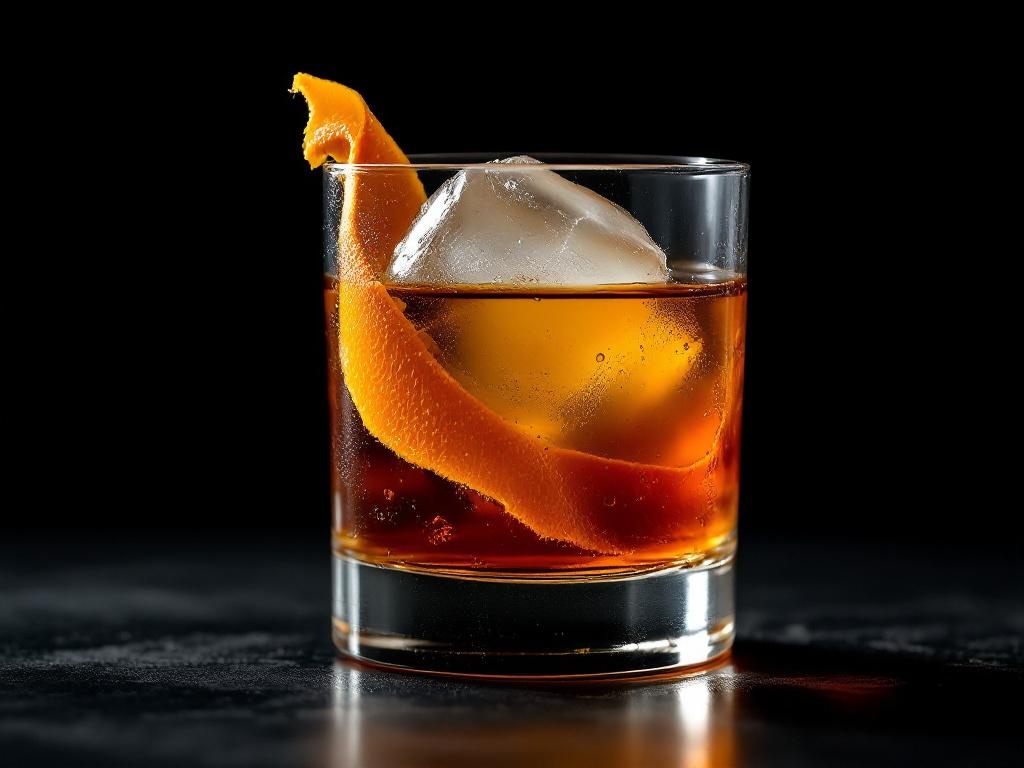
American
Old Fashioned
Pillar I
Ingredients
Serves
1
60 ml
bourbon or rye whiskey
2 dashes
Angostura bitters
1 dash
orange bitters
10 ml
Demerara sugar syrup (2:1)
1
large ice cube
1 strip
orange peel
1
Luxardo maraschino cherry
Pillar II
Method
6 steps
1.
Place a large ice cube in a heavy rocks glass.
Technique — The Old Fashioned is one of the few cocktails built entirely in the serving glass — the 'old fashioned' in the name refers to this technique, which predates the cocktail shaker. Building directly in the glass eliminates transfer-related dilution and keeps the whiskey's contact with ice controlled from the first moment.
2.
Add Demerara syrup (or dissolved sugar cube) directly to the glass.
Technique — Demerara syrup is preferred over simple syrup because unrefined cane sugar retains trace molasses compounds that complement the barrel-aged caramel and vanilla notes in bourbon or rye. A 2:1 syrup (2 parts sugar, 1 part water) adds less water dilution than a 1:1 simple syrup while delivering the same sweetness. The sugar is added before the bitters so the bitters distribute evenly rather than pooling.
3.
Add Angostura and orange bitters.
Technique — Angostura bitters has been made to essentially the same formula since 1824. Two dashes is approximately 1ml — a small volume, but one that adds a complex herbal and spice profile (gentian, cinchona bark, various botanicals) that makes the drink multidimensional rather than simply sweet whiskey. Orange bitters adds a brighter citrus counterpoint to the darker, more herbal Angostura.
4.
Pour whiskey over the ice. Stir gently — approximately 20 revolutions — until well-chilled. The Old Fashioned is built in the glass and stirred, not mixed separately.
Technique — The 20-revolution stir in the serving glass provides less dilution than the cocktail shaker's mixing ice. This is intentional — the Old Fashioned is designed to evolve over the course of drinking, becoming more diluted and slightly sweeter as the ice melts. The first sip should be strong and warming; the last should be lighter and softer. The drinking time is part of the recipe.
5.
Express orange peel over the drink. Rub the peel around the rim, place it on the ice.
Technique — See Negroni technique note for the expression mechanics. The Old Fashioned orange expression complements the vanilla and caramel notes from the barrel aging — the terpenes in the orange peel bridge the fruit and wood notes in whiskey. The peel is placed in the glass (not on the rim) so its oils continue to contribute as the ice slowly melts.
6.
Add a Luxardo cherry if desired. Serve without a straw — the drinker should bring the glass to their nose first.
Technique — The Luxardo maraschino cherry is preserved in marasca cherry syrup — its bitter almond and cherry notes balance the sweetness of the whiskey. The neon red cocktail cherry (dyed in artificial colouring, preserved in corn syrup) is a purely decorative substitute with no flavour merit. Serving without a straw ensures the nose-to-palate sequence — the orange oil aromas arrive with every sip.
Pillar III
Quality Hierarchy
Library+
Open The Kitchen to start using this.
Open The KitchenPillar IV
Sensory Tests
No sensory tests recorded yet.
Pillar V
Cross-Cuisine Parallels
Library+ for full grid
No cross-cuisine parallels recorded yet.
Pillar VI
Beverage Pairings
Library+ for named producers
No beverage pairings recorded yet.
Pillar VII
Origin & Lineage
Pendennis Club, Louisville, Kentucky, 1880s. Colonel James E. Pepper brought the recipe to the Waldorf-Astoria. The 'improved whiskey cocktail' that preceded it appears in Jerry Thomas's 1862 Bartender's Guide, which added Curaçao, absinthe, and cherry brandy to the base. When drinkers rejected the improvements, they ordered their whiskey cocktail the 'old-fashioned' way. The name stuck and became the thing.
Tools & Compliance
The working layer
Profession+ for HACCP and Cost