Thai
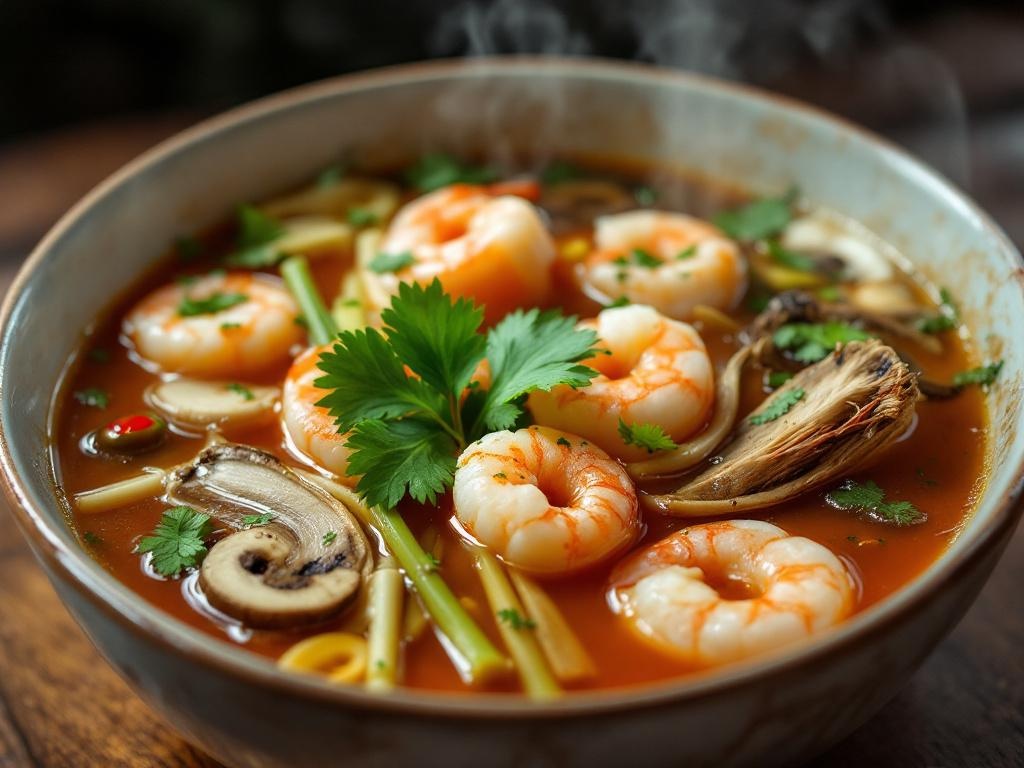
Tom Yum Goong
Pillar I
Ingredients
Serves
4
500 g
large prawns
3
lemongrass stalks
30 g
galangal
8
kaffir lime leaves (makrut)
8
Thai bird's eye chillies
3 tbsp
fish sauce
3 tbsp
fresh lime juice
2 tbsp
nam prik pao (Thai roasted chilli paste)
200 ml
full-fat coconut milk
200 g
straw or oyster mushrooms
8
cherry tomatoes
1 litre
chicken stock or water
large handful
coriander leaves
Pillar II
Method
7 steps
1.
Peel prawns, reserving shells and heads. Sauté shells and heads in a little oil until pink and aromatic. Add stock or water, bring to boil, simmer 15 minutes, strain.
Technique — Prawn heads contain the tomally — the hepatopancreas — which is the most concentrated source of prawn flavour. The sautéing step before adding water creates a Maillard-flavoured base rather than a simple water extraction. Five minutes of sautéing builds flavour that an hour of simmering alone cannot replicate. The shells release chitin-bound proteins that contribute to the characteristic orange-pink colour of the stock.
2.
Return prawn stock to heat. Add bruised lemongrass, galangal, kaffir lime leaves, and bird's eye chillies. Simmer 5 minutes to infuse.
Technique — The aromatic trio of Thai cooking — lemongrass, galangal, kaffir lime — are delivery systems for essential oils, not ingredients to be eaten. They are bruised before entering the pot to rupture the cell walls and release these oils into the stock. Five minutes of simmering is sufficient; longer begins to extract bitter tannins from the woody lemongrass base. These aromatics are moved aside before eating — they are fibrous and flavourless after their oils have been extracted.
3.
Add mushrooms and cherry tomatoes. Cook 2 minutes until softened.
Technique — Straw mushrooms hold their shape in liquid where button mushrooms would soften into mush. Cherry tomatoes are added at this stage — not with the aromatics — to preserve their structure and fresh acid contribution. They provide a different, brighter sourness than the lemongrass and kaffir lime, adding depth to the soup's acid profile.
4.
Add peeled prawns. Cook 1–2 minutes until just pink. Do not overcook.
Technique — Prawns provide a clear visual doneness signal: they curl into a C-shape and turn uniformly pink-orange. A perfect prawn curves to a loose C — fully pink with no grey. An overcooked prawn forms an O shape (fully curled) with a rubbery texture. The difference in time between a loose C and a tight O is approximately 45 seconds. Remove from heat at the loose C stage — the residual heat of the broth will finish them.
5.
For creamy version: stir in nam prik pao and coconut milk, bring back to heat but do not boil.
Technique — Nam prik pao (Thai roasted chilli paste) adds smokiness, sweetness from caramelised shrimp paste, and complex bitterness from the roasted chillies. Full-fat coconut milk is essential — the fat creates the emulsified creamy texture. Boiling after adding coconut milk causes the fat to separate and rise to the surface, breaking the emulsion and leaving an oily, unappetising appearance.
6.
Remove from heat. Season with fish sauce (salty) and lime juice (sour) — add in small increments, tasting constantly.
Technique — Lime juice is added off heat because its key aromatic compounds — citric acid esters and volatile terpenes — begin degrading above 70°C, leaving flat sourness without the floral brightness. Fish sauce similarly changes character when boiled, intensifying in saltiness and losing its more delicate umami notes. Both are finishing seasonings, not cooking ingredients. Add in small increments — there is no correcting over-seasoning in a broth.
7.
Serve in deep bowls with coriander. Provide extra lime, fish sauce, and sugar at the table.
Technique — Thai condiment philosophy acknowledges that taste is subjective. The chef balances the soup as a template; the diner perfects it. The table condiments are not a hedge against under-seasoning — they are a cultural acknowledgement that no fixed recipe can account for individual preference. The correct sequence: taste first, add what is needed. In Thailand, the first adjustment is almost always more lime.
Pillar III
Quality Hierarchy
Library+
Open The Kitchen to start using this.
Open The KitchenPillar IV
Sensory Tests
No sensory tests recorded yet.
Pillar V
Cross-Cuisine Parallels
Library+ for full grid
No cross-cuisine parallels recorded yet.
Pillar VI
Beverage Pairings
Library+ for named producers
No beverage pairings recorded yet.
Pillar VII
Origin & Lineage
Central Thailand. Tom means boiling, yum means mixed or seasoned. The goong (prawn) version became the global export dish, but early versions used freshwater fish or wild river prawns. During the 1997 Asian financial crisis, Thai economists named their recovery the 'Tom Yum Economy' after this dish's combination of heat, acidity, and resilience. The dish has carried its country's identity farther than any other Thai export.
Sourcing
Where to find these ingredients
Region: global
San Francisco, CA, US
Fish Sauce — Megachef (Thai) · Nam Pla Wan — Thai Sweet Fish Sauce
SGC Food Distributors
Vancouver, BC, CA
Fish Sauce — Megachef (Thai) · Galangal — Thai (Kha) · Nam Pla Wan — Thai...
Vancouver, BC, CA
Fish Sauce — Megachef (Thai) · Galangal — Thai (Kha) · Nam Pla Wan — Thai...
Tools & Compliance
The working layer
Profession+ for HACCP and Cost