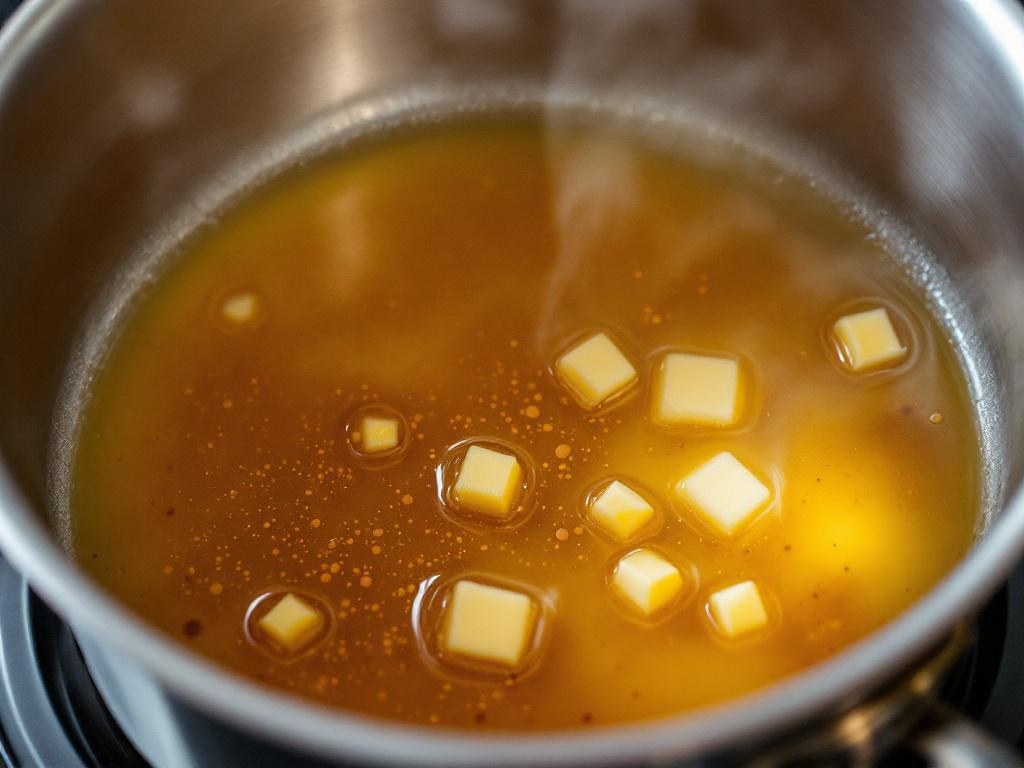
Beurre Noisette (Brown Butter — Milk Solids, Nutty Point)
One of 44 entries · Provenance 1000 — Pantry
A classical French preparation, established as a culinary technique in the professional kitchen of the 19th century. The name references the hazelnut-like aroma produced by the Maillard reaction in the milk solids.
Beurre noisette — 'hazelnut butter' — is one of cooking's most transformative techniques: heat applied to butter until the water evaporates, the milk solids brown through the Maillard reaction, and the fat becomes suffused with a deep, nutty aroma that smells precisely like roasted hazelnuts. It is not simply browned butter; it is a specific stage of caramelisation that, if passed, becomes beurre noir (black butter) — and if seriously overshot, burned and acrid. The technique is simple in description but demands attention in execution. Butter is placed in a pale-coloured saucepan (so you can see the colour change clearly — dark pans make this treacherous) over medium heat. It melts, then foams as water steams off, then the foam subsides and the milk solids begin to colour. The butter goes from yellow to golden to amber to deep hazelnut brown — this last stage is beurre noisette. The pan must come off the heat immediately and the butter should be poured into a cold container or used at once, because residual heat in the pan will continue to cook it. The applications are vast. Beurre noisette is the finishing sauce for skate (raie au beurre noisette with capers), the fat for madeleine batter, the enrichment for financiers, the sauce drizzled over pan-cooked fish fillets, the dressing for cauliflower, gnocchi, or brown butter vinaigrette. In pastry, it adds depth that plain melted butter cannot approach. In savoury cooking, it bridges richness with nuttiness in a way that makes even simple vegetables taste complete. Adding acid (lemon juice, capers, vinegar) to beurre noisette arrests the cooking instantly and transforms it into a sauce — the combination of browned butter and acid is one of the most reliable finishing moves in professional cooking.
Nutty, caramel-rich, deeply aromatic — butter transformed by heat into something with the character of roasted hazelnuts
Use a pale or stainless saucepan — you must see the colour of the milk solids Watch from the moment the foam subsides — the window between noisette and noir is seconds Remove from heat when the colour reaches deep amber and the smell is nutty, not bitter Pour immediately into a cold bowl to arrest cooking — residual pan heat continues browning For a sauce, add acid (lemon, capers) immediately off the heat to stop the process and balance
Using a dark-coloured pan — prevents accurate colour monitoring and causes burning Leaving the butter on the heat too long — beurre noir is intentional; beyond that it's ruined Not having the cold bowl or next step ready — a second of inattention passes the window Forcing the heat too high — burning the milk solids before the water evaporates Using salted butter — the salt can interfere with even browning and add unpredictable flavour
Kitchen membership opens the full Library.
olfactory: Nutty aroma rises as foam subsides and milk solids shift to deep amber in a pale pan — the…
Nutty aroma rises as foam subsides and milk solids shift to deep amber in a pale pan — the moment the smell turns bitter, you've…
- 250 g unsalted butter
- Salt and black pepper to taste
- Optional: 5 ml fresh lemon juice or 2 g fleur de sel
3 ingredients · 10 steps
Common Questions
Why does Beurre Noisette (Brown Butter — Milk Solids, Nutty Point) taste the way it does?
Nutty, caramel-rich, deeply aromatic — butter transformed by heat into something with the character of roasted hazelnuts
What are common mistakes when making Beurre Noisette (Brown Butter — Milk Solids, Nutty Point)?
Using a dark-coloured pan — prevents accurate colour monitoring and causes burning Leaving the butter on the heat too long — beurre noir is intentional; beyond that it's ruined Not having the cold bowl or next step ready — a second of inattention passes the window Forcing the heat too high — burning the milk solids before the water evaporates Using salted butter — the salt can interfere with even browning and add unpredictable flavour