British
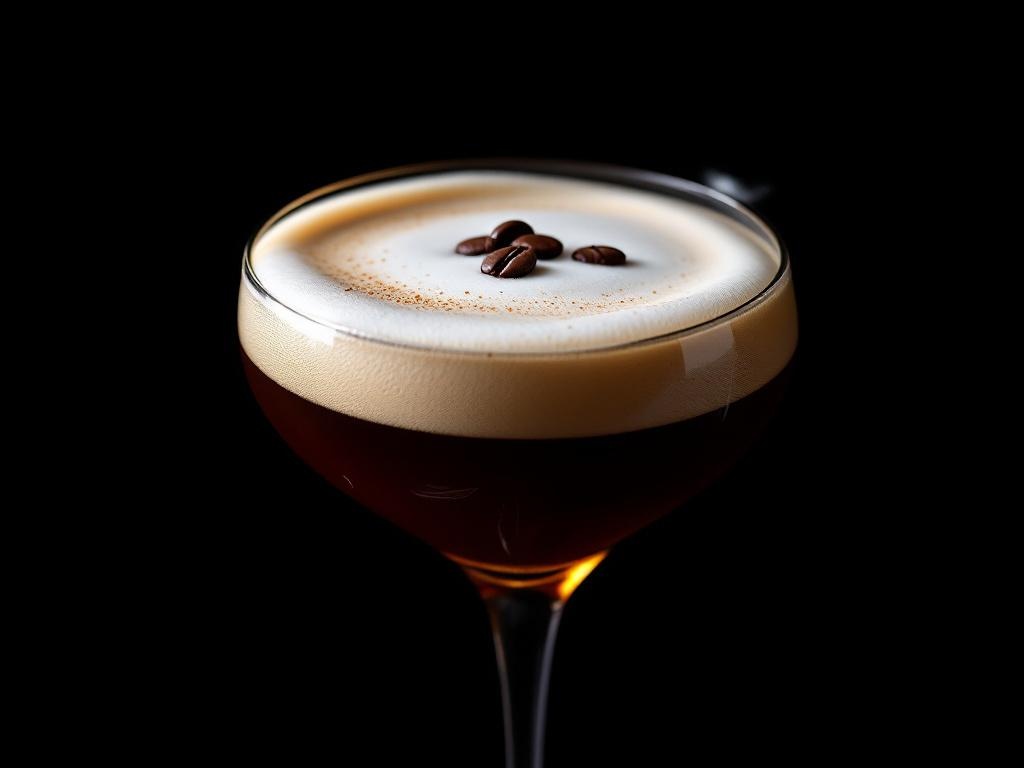
Espresso Martini
Pillar I
Ingredients
Serves
1
30 ml
fresh espresso
40 ml
vodka
20 ml
coffee liqueur
10 ml
simple syrup
plenty
ice
3
coffee beans
Pillar II
Method
6 steps
1.
Pull a fresh espresso and allow to cool to room temperature, 10–15 minutes. This is non-negotiable — hot espresso melts the ice and the drink will be warm and diluted.
Technique — A quality espresso has three layers: crema (reddish-brown emulsified CO2 and coffee oils), body (dark liquid), and heart (very dark, concentrated liquid). The crema should be intact but the espresso must be at room temperature before shaking. The cooling process concentrates the oils slightly and allows the CO2 to partially off-gas — this dissolved CO2 is what creates the thick, persistent foam in the finished cocktail. Refrigerating the espresso causes the oils to separate and the foam potential decreases.
2.
Chill a martini or coupe glass in the freezer.
Technique — A frozen glass (−18°C) versus a room-temperature glass (20°C) is the difference between foam that holds for 8–10 minutes and foam that collapses in 60 seconds. The extreme chill sets the espresso oil foam on contact — the rapid temperature drop stabilises the air-liquid interface in the foam structure. This single step separates a technically correct espresso martini from a mediocre one.
3.
Combine espresso, vodka, coffee liqueur, and simple syrup in a cocktail shaker.
Technique — The ratio of espresso to spirits determines whether this is a coffee drink with alcohol or an alcohol drink with coffee. At 30ml espresso to 60ml combined spirits, coffee dominates the flavour. Mr Black (40% ABV, very coffee-forward) produces a drier, more bitter, coffee-centric result. Kahlúa (20% ABV, sweeter, with vanilla notes) produces a more balanced, dessert-leaning result. The simple syrup may be omitted entirely when using Kahlúa.
4.
Add plenty of ice. Shake vigorously for a full 15 seconds — longer than you think. The vigour creates the foam.
Technique — The vigorous shaking simultaneously chills the liquid, creates micro-emulsification, and mechanically generates the foam. The espresso contains proteins (primarily chlorogenic acid complexes) and lipids that behave like egg white proteins when agitated — they unfold and form a stable air-liquid interface under mechanical force. 15 seconds is the minimum; 20 seconds produces a measurably superior foam. The shaking force should be maximal, not moderate.
5.
Double-strain immediately into the chilled coupe: use both the shaker strainer and a fine mesh strainer.
Technique — The cocktail shaker strainer alone cannot remove ice chips smaller than 2–3mm. Fine mesh straining removes all chips, which would otherwise puncture the foam surface as they melt. The double-strain pours the cold liquid through the fine sieve at the last moment, so the foam arrives at the glass surface intact rather than broken by the filter. Speed matters — the foam begins to degrade within 30 seconds of leaving the shaker.
6.
The foam should be thick and persistent. Garnish with three coffee beans in a triangle. Serve immediately.
Technique — The three-bean arrangement traces back to Venetian custom, where three grains of coffee represent salute (health), soldi (money), and fortuna (luck). The beans must be placed on the foam without breaking the surface — place gently, do not drop from height. The foam has a finite life; serve within 2 minutes. A thick, caramel-coloured, persistent foam that holds the weight of three coffee beans is the quality standard.
Pillar III
Quality Hierarchy
Library+
Open The Kitchen to start using this.
Open The KitchenPillar IV
Sensory Tests
No sensory tests recorded yet.
Pillar V
Cross-Cuisine Parallels
Library+ for full grid
No cross-cuisine parallels recorded yet.
Pillar VI
Beverage Pairings
Library+ for named producers
No beverage pairings recorded yet.
Pillar VII
Origin & Lineage
London, 1983. Dick Bradsell at The Soho Brasserie on Old Compton Street. A model sat at the bar and asked for something to 'wake me up and f*** me up.' Bradsell combined fresh espresso, vodka, Kahlúa, and sugar syrup in a shaker and pulled it hard. The three-bean foam that formed defined the drink. It spread through London bar culture in the 1990s and became one of the most-ordered cocktails in the world by the 2020s.
Sourcing
Where to find these ingredients
Region: global
New York, NY, US
Fresh-As Yuzu Juice Flakes · Mahlab (Cherry Kernel Spice) · Ras el Hanout...
Tools & Compliance
The working layer
Profession+ for HACCP and Cost