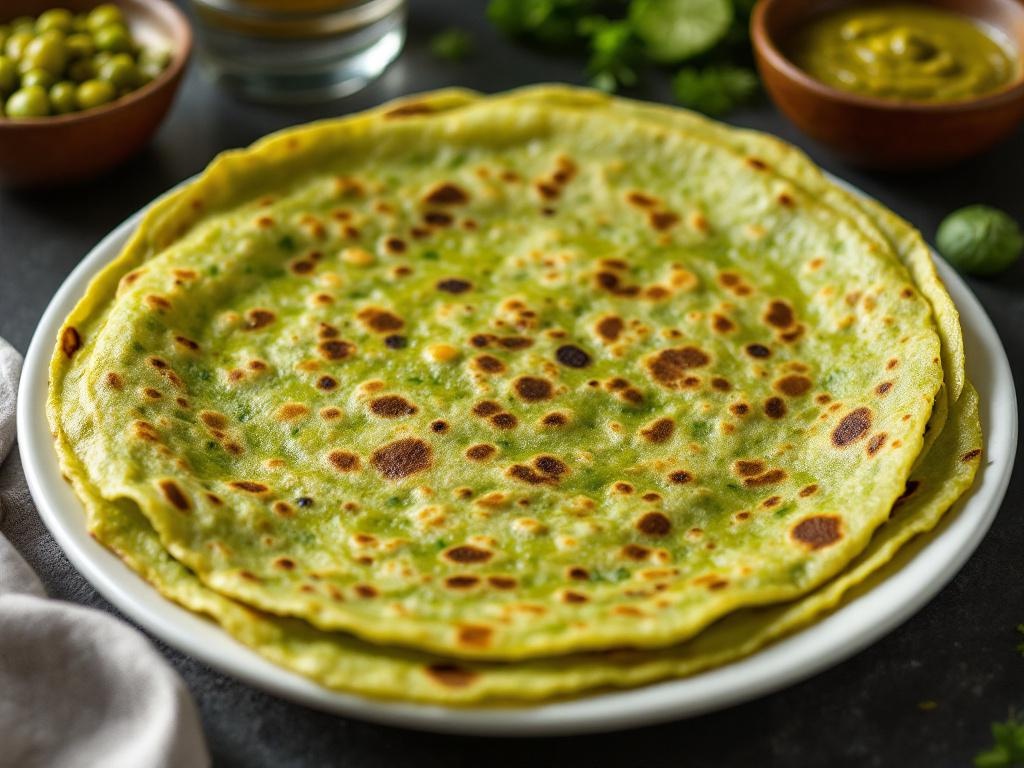
Andhra Pesarattu
One of 60 entries · Provenance 1000 — Indian
Andhra Pradesh, India — particularly popular in Krishna and Guntur districts
Pesarattu is Andhra Pradesh's breakfast crepe — a thin, crisp pancake made entirely from whole green moong dal (mung beans), ground to a batter without any fermentation. This makes it unique among South Indian flatbreads: it requires no soaking time beyond the overnight soak of the mung beans, and the batter needs no fermentation at all. The result is ready in hours, not days. Whole green moong is soaked overnight, then ground with green chillies, ginger, and cumin into a pourable batter. Unlike dosa batter, which must be silky smooth, pesarattu batter can retain a little texture from the mung skins — this produces a slightly more rustic, nutty crepe. Some cooks add a handful of raw rice to the grind for extra crispness. The batter is poured onto a hot griddle (tawa), spread thin, and cooked on one side only — the protein in the mung dal sets quickly, and the crepe is sturdy enough to fold without flipping. The top surface remains slightly moist and the bottom develops a satisfying crisp. Pesarattu is typically served with upma — a savory semolina preparation — stuffed inside the crepe for MLA Pesarattu, a beloved Andhra preparation named after the politicians who supposedly popularised it at the state assembly canteen. The most common accompaniment is ginger chutney and allam (ginger) pachadi. Nutritionally, mung beans are among the most protein-rich legumes, making pesarattu a genuinely complete breakfast in one dish.
Crisp, mildly spiced, nutty from green mung — earthy and direct
Soak whole green moong for at least 8 hours — longer soaking produces a smoother grind Grind to a pourable consistency — too thick and it won't spread; too thin and it won't crisp Heat the griddle properly before pouring — a drop of water should evaporate immediately on contact Spread quickly and thinly with the back of a ladle in concentric circles from centre outward Cook on medium-high heat on one side only — the moong protein sets fast
Not soaking long enough — under-soaked mung grinds unevenly and produces a lumpy batter Pouring too thick — a thick pesarattu is chewy rather than crisp Flipping too early — the edges must lift naturally before the crepe can be moved Using split yellow moong instead of whole green moong — the skin adds colour, texture, and a slightly nutty flavour Not heating the griddle adequately — the batter will stick and tear
Kitchen membership opens the full Library.
visual: Water droplet evaporates instantly on the griddle; batter spreads thin and even in concentric circles without resistance.
Batter spreads thin and even in concentric circles without resistance — too thick pours like cake batter and yields chewy crepe instead of crisp.
- 200g moong dal (split mung beans), soaked 6 hours and drained
- 100g onion, finely diced
- 20g ginger, minced
11 ingredients · 12 steps
Common Questions
Why does Andhra Pesarattu taste the way it does?
Crisp, mildly spiced, nutty from green mung — earthy and direct
What are common mistakes when making Andhra Pesarattu?
Not soaking long enough — under-soaked mung grinds unevenly and produces a lumpy batter Pouring too thick — a thick pesarattu is chewy rather than crisp Flipping too early — the edges must lift naturally before the crepe can be moved Using split yellow moong instead of whole green moong — the skin adds colour, texture, and a slightly nutty flavour Not heating the griddle adequately — the batter will stick and tear