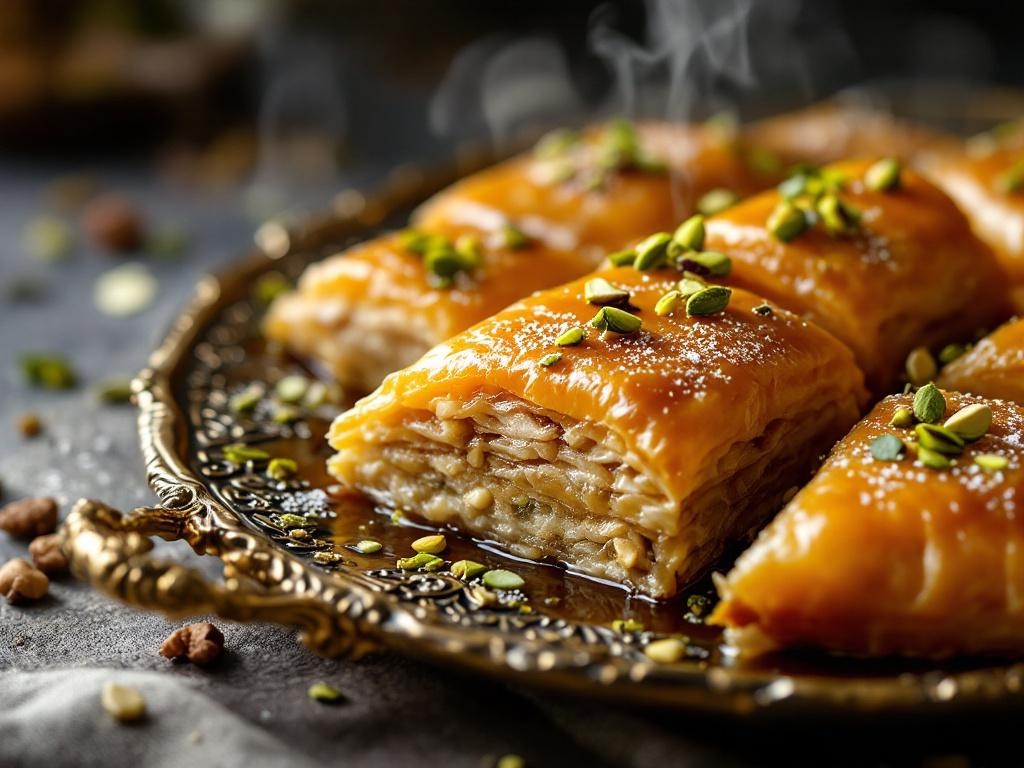
Baklava
One of 10 entries · Provenance 1000 — Greek and Levantine
Ottoman Empire. Baklava is documented in the Ottoman imperial palace kitchen records from the 15th century. It was made specifically for the Janissaries (elite Ottoman soldiers) on the 15th of Ramadan. The dish spread throughout the Ottoman Empire and is claimed by Greece, Turkey, Lebanon, and many other countries — all correct, as it was the empire's dessert.
Baklava is layers of paper-thin phyllo pastry, brushed with clarified butter, filled with finely chopped pistachios or walnuts, baked golden, and immediately drenched in sugar syrup while still hot. The contrast of temperatures — hot pastry and cold syrup — is the defining technique: it creates crispiness at the pastry layers and ensures the syrup penetrates rather than pooling on the surface. Turkish baklava (pistachio, lighter syrup) and Greek baklava (walnut, honey, spiced syrup) represent the two primary traditions.
- Moroccan bastilla (phyllo pastry with spiced filling — the North African phyllo tradition); Persian shole zard (saffron rice pudding — the Persian equivalent sweet); Indian jalebi (crispy fried spirals in syrup — the South Asian fried-and-syrup-soaked sweet).
Turkish tea (çay — black tea in a tulip glass) alongside baklava — the standard Turkish pairing. Or strong Arabic coffee (cardamom-spiced) in the Levantine tradition. The bitter, aromatic coffee against the sweet, rich baklava is one of the great pairings in dessert culture.
Phyllo: fresh or thawed frozen. Layer sheets with clarified butter brushed between each — not regular butter, which contains water that makes the layers soggy Clarified butter: melt butter, skim the foam, strain off the milk solids. The pure butter fat is what makes phyllo crisp and golden The nut layer: finely chopped (not ground) pistachios or walnuts, combined with a pinch of cinnamon and a small amount of sugar Scoring before baking: cut the baklava into diamond or square shapes before putting in the oven — cutting afterwards breaks the fragile, crispy layers Bake at 160C for 45-50 minutes: low temperature prevents the phyllo from browning too quickly before the interior layers have crisped The syrup drench: make the syrup (sugar, water, honey, and flavouring — orange blossom water for Lebanese/Greek, rose water for Turkish). Pour cold syrup over hot baklava — or hot syrup over cold. The temperature differential is what creates the crispy-and-absorbed result
Using regular butter (not clarified): water in the butter steams the phyllo and produces a soft, rather than crispy, result Pouring hot syrup on hot baklava: the syrup runs off and pools at the base rather than being absorbed Not scoring before baking: scoring after baking shatters the brittle phyllo
Kitchen membership opens the full Library.
- 16 sheets phyllo dough (thawed if frozen)
- 150g unsalted butter, melted
- 200g raw shelled pistachios, roughly chopped
8 ingredients · 15 steps
Common Questions
Why does Baklava taste the way it does?
Turkish tea (çay — black tea in a tulip glass) alongside baklava — the standard Turkish pairing. Or strong Arabic coffee (cardamom-spiced) in the Levantine tradition. The bitter, aromatic coffee against the sweet, rich baklava is one of the great pairings in dessert culture.
What are common mistakes when making Baklava?
Using regular butter (not clarified): water in the butter steams the phyllo and produces a soft, rather than crispy, result Pouring hot syrup on hot baklava: the syrup runs off and pools at the base rather than being absorbed Not scoring before baking: scoring after baking shatters the brittle phyllo
What dishes are similar to Baklava?
Moroccan bastilla (phyllo pastry with spiced filling — the North African phyllo tradition); Persian shole zard (saffron rice pudding — the Persian equivalent sweet); Indian jalebi (crispy fried spirals in syrup — the South Asian fried-and-syrup-soaked sweet).