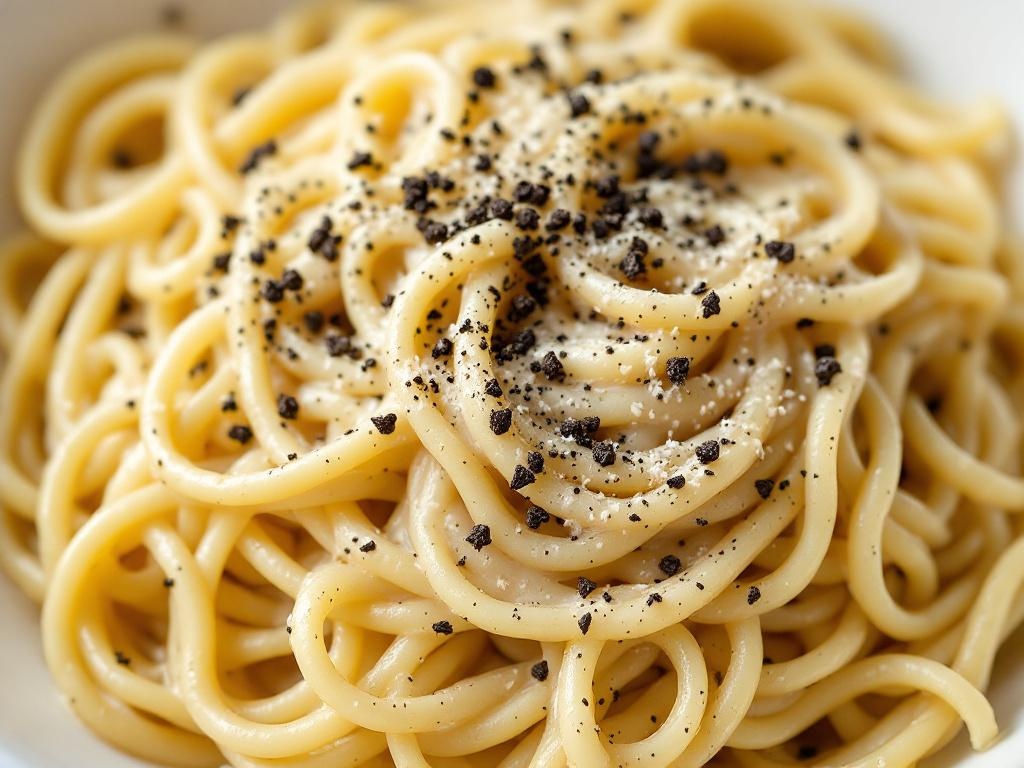
Cacio e Pepe (Roman — The Emulsion Method)
One of 70 entries · Provenance 1000 — Italian
Roman campagna and Testaccio, Rome — pastoral origins with shepherds of the Lazio region; refined in Roman trattorias through the 20th century
Cacio e Pepe is the intellectual apex of Roman pasta cookery — a dish of three ingredients (pasta, Pecorino Romano, black pepper) that demands precise technique to achieve its defining characteristic: a smooth, creamy sauce that coats every strand without a single lump of clumped cheese. It is a dish that appears simple and punishes arrogance. The dish originates with the shepherds of the Roman campagna, who would carry dried pasta, aged sheep's cheese, and pepper on their transhumance — seasonal migrations between summer and winter grazing grounds. These were the most shelf-stable and high-calorie provisions available. The combination, heated with a little pasta water, produced nourishment in any weather. Its modern Roman form developed in the trattorias of Testaccio and Trastevere in the 20th century, refined from rustic simplicity into a technically demanding restaurant preparation. The emulsion technique is the entire challenge. Pecorino Romano, aged and intensely salty, is grated extremely finely — almost to a powder — and combined with a small amount of cold water to form a paste before any heat is applied. This hydrates the cheese proteins and begins to loosen them. Black pepper is toasted whole in a dry pan until aromatic, then cracked coarsely — size matters, as fine powder disappears and coarse chunks are too aggressive. The pasta (tonnarelli or spaghetti) is cooked in less water than usual to concentrate the starch content of the cooking water. The critical moment: pasta is transferred to the pan with toasted pepper (no oil), a ladleful of hot starchy cooking water added, and the heat killed or reduced to barely warm. The cheese paste is then worked in, adding cooking water teaspoon by teaspoon, and the pasta is agitated — tossed or stirred — continuously until the sauce emulsifies into a glossy, flowing cream. If the pan is too hot when cheese is added, the proteins seize into hard granules. The result, when correctly executed, should sheet off the back of a spoon as a thin, creamy, perfectly uniform sauce.
Assertively saline, peppery heat, and creamy — a minimalist dish of maximum intensity
Grate Pecorino Romano to a very fine powder — coarse grating will not emulsify smoothly Hydrate the cheese in a small amount of cold water before cooking begins — this critical step prevents lumping Use extra-starchy pasta water — cook in less water than usual, or reserve water from early in the cook Kill or reduce heat before adding the cheese paste — direct high heat causes the proteins to seize Agitate constantly while building the emulsion — tossing rather than stirring distributes heat more evenly
Adding grated cheese directly to a hot pan — the result is a clumped, stringy mass rather than a cream Using Parmigiano instead of or in addition to Pecorino — it changes both the flavour profile and the emulsification behaviour Adding oil — this is not a Roman tradition and alters the texture of the sauce Under-toasting the pepper — raw pepper tastes sharp and aggressive rather than warm and aromatic Using too little starch water — the emulsion has nothing to bind it and breaks instantly
Kitchen membership opens the full Library.
visual: Cheese powder hydrated in cold water turns slick and glossy before heat — visual signal the emulsion is ready…
Direct high heat on cheese causes proteins to seize into clumps; kill or reduce heat before adding the paste.
- 200g Parmigiano Reggiano DOP aged 24 months — finely grated (use microplane)
- 50g Pecorino Romano DOP — finely grated
- 200g tonnarelli (or spaghetti if unavailable)
6 ingredients · 11 steps
Common Questions
Why does Cacio e Pepe (Roman — The Emulsion Method) taste the way it does?
Assertively saline, peppery heat, and creamy — a minimalist dish of maximum intensity
What are common mistakes when making Cacio e Pepe (Roman — The Emulsion Method)?
Adding grated cheese directly to a hot pan — the result is a clumped, stringy mass rather than a cream Using Parmigiano instead of or in addition to Pecorino — it changes both the flavour profile and the emulsification behaviour Adding oil — this is not a Roman tradition and alters the texture of the sauce Under-toasting the pepper — raw pepper tastes sharp and aggressive rather than warm and aromatic Using too little starch water — the emulsion has nothing to bind it and breaks instantly