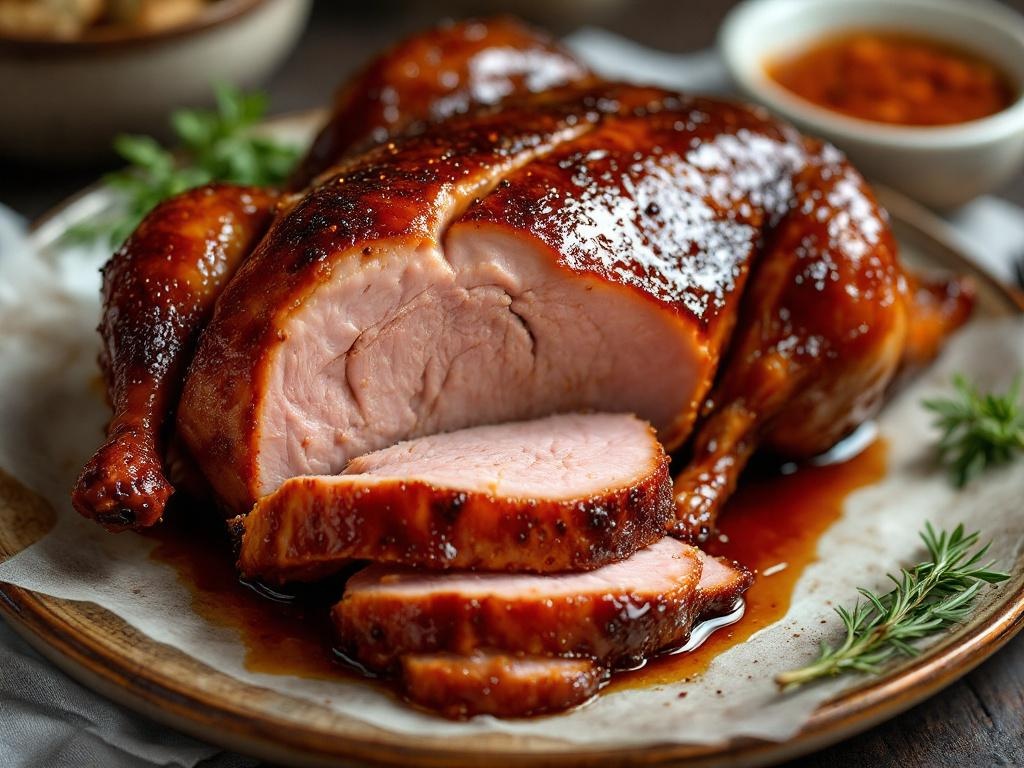
Cantonese Roast Duck (广式烧鸭)
One of 57 entries · Every Grain of Rice — Fuchsia Dunlop
Guangdong Province, China — Cantonese siu mei (roasted meat) tradition; codified in Hong Kong and spread through the Chinese diaspora
Cantonese roast duck is the civilian counterpart to Peking Duck — equally complex in preparation, faster in execution, and defined by a deeply lacquered skin that shatters on the bite and flesh perfumed from within by a spiced marinade sealed inside the cavity. Where Peking Duck is a ceremony, Cantonese roast duck is a meal: displayed hanging in restaurant windows across the Cantonese diaspora, sold by the half or quarter, eaten over rice or noodles. The preparation involves inflating the duck with air to separate skin from flesh (so the fat renders completely), filling the cavity with a mixture of soy sauce, rice wine, sugar, five spice, and star anise, sealing it shut with a metal skewer, then coating the outside with a malt syrup glaze. The duck is then air-dried — traditionally hanging overnight in a cool, ventilated space — before roasting at high heat. The drying stage is everything: it dessicates the skin so that when it enters the oven, it caramelises immediately rather than steaming. The result is that unmistakeable combination of shattering exterior and juicy, spiced, fat-rich interior.
- Peking Duck (Northern Chinese — formal ceremony version)
- Pato à l'Orange (French braised duck)
- Anatra all'Arancia (Italian duck with orange)
- Confit de Canard (French preserved duck leg)
lacquered, spiced, rich, deeply savoury, subtly sweet
Inflate the duck under the skin to separate skin from fat layer — a bicycle pump or straw works for home cooks Seal the cavity completely before air-drying — the internal marinade must not escape Air-dry for a minimum of 4 hours, ideally overnight uncovered in the refrigerator The malt syrup glaze must be applied to completely dry skin for lacquering to occur Roast initially at high heat (220°C) to set the glaze, then reduce to 180°C to cook through Rest for at least 15 minutes before chopping — the internal juices need to redistribute
Skipping the air-drying step — the skin steams rather than caramelises and will not lacquer Not sealing the cavity properly — the internal marinade drains out during roasting Using honey instead of malt syrup — the flavour profile and texture are different Chopping immediately after roasting — the juices run and the skin loses crispness from steam Not basting with the drippings during roasting — the glaze can dry out and burn Using a duck that hasn't been hung to fully drain of blood — residual moisture prevents lacquering
Every Grain of Rice — Fuchsia Dunlop
Kitchen membership opens the full Library.
visual: Skin shatters on the bite with a deep lacquer finish; flesh inside perfumed by spiced marinade.
Air-dry minimum 4 hours uncovered — skip this step and skin steams rather than caramelises, destroying the lacquer entirely.
- 1 whole duck — 1.8–2kg, cleaned, dried thoroughly
- 20g salt
- 15g white pepper
13 ingredients · 11 steps
Common Questions
Why does Cantonese Roast Duck (广式烧鸭) taste the way it does?
lacquered, spiced, rich, deeply savoury, subtly sweet
What are common mistakes when making Cantonese Roast Duck (广式烧鸭)?
Skipping the air-drying step — the skin steams rather than caramelises and will not lacquer Not sealing the cavity properly — the internal marinade drains out during roasting Using honey instead of malt syrup — the flavour profile and texture are different Chopping immediately after roasting — the juices run and the skin loses crispness from steam Not basting with the drippings during roasting — the glaze can dry out and burn Using a duck that hasn't been hung to fully drain of blood — residual moisture prevents lacquering
What dishes are similar to Cantonese Roast Duck (广式烧鸭)?
Peking Duck (Northern Chinese — formal ceremony version), Pato à l'Orange (French braised duck), Anatra all'Arancia (Italian duck with orange)