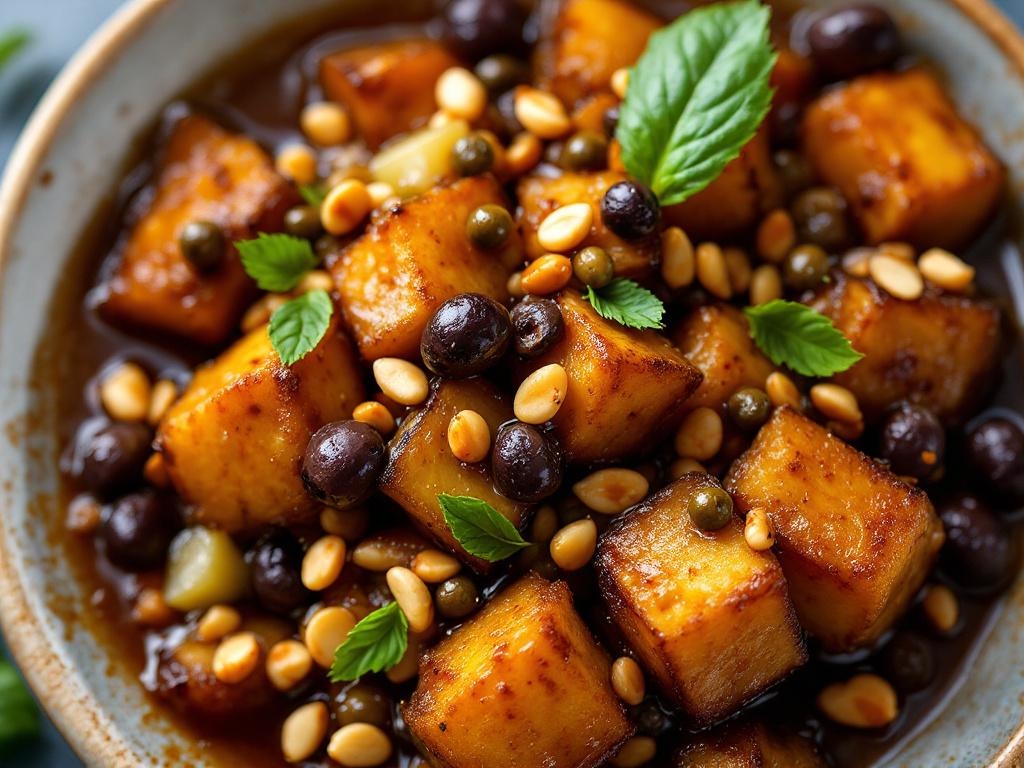
Caponata (Naturally Vegan — Sicilian Sweet-Sour Aubergine)
Sicily; caponata documented in Palermitan cooking c. 18th century; likely influenced by Arab traders who brought aubergines and sweet-sour preparations to Sicily during Arab rule (9th–11th century CE).
Caponata — the Sicilian preparation of aubergine in sweet-sour agrodolce with tomato, olives, capers, celery, and pine nuts — is naturally vegan and is one of the most complex, multi-layered preparations in Southern Italian cooking. The dish is characterised by its agrodolce (sweet-sour) quality from sugar and vinegar, and by the combination of textures and flavours — yielding aubergine, crisp celery, briny olives, caper saltiness, pine nut richness. The preparation is deceptively demanding: the aubergine must be fried separately before combining with the other ingredients, as the proper frying in olive oil gives it an interior richness and exterior crispness that no other cooking method replicates. The sweet-sour sauce must be balanced precisely — too sweet and it becomes a chutney; too sour and it becomes acidic and harsh. Caponata is always served at room temperature, which allows its flavours to integrate and the vinegar-sugar balance to express fully.
Fry the aubergine separately in generous olive oil until golden — this is the non-negotiable foundation; pan-roasted or baked aubergine produces a different (inferior) texture Salt the aubergine before frying if using older, more bitter varieties — modern varieties may not need it; taste first Agrodolce: add red wine vinegar and sugar to the tomato mixture and taste; the balance should be equal presence of both sweet and sour Combine all components while warm and let them meld — caponata improves significantly over 24 hours as the flavours integrate Serve at room temperature — cold caponata is flat; serving temperature is structural Generous olive oil is correct — caponata is an enriched preparation; under-oiling produces a lean, flat result
RECIPE: Serves: 4 | Prep: 25 min | Total: 50 min --- 800g Sicilian aubergine (or similar), cut into 2cm cubes 100ml extra virgin olive oil (Sicilian, DOP if available) 1 medium red onion, diced 3 cloves garlic, minced 400g San Marzano DOP tomatoes, crushed 60g green Castelvetrano olives, pitted and halved 40g golden raisins 30ml red wine vinegar 15g pine nuts, lightly toasted 8g sea salt 3g Tellicherry black pepper 10g fresh basil, torn 5g sugar --- 1. Heat 60ml olive oil in a large, wide pan over medium-high; fry aubergine in batches 5–6 minutes per batch until golden; drain on paper towel. 2. Add remaining oil to the same pan; sauté red onion over medium 4–5 minutes until softened. 3. Add garlic; cook 1 minute until fragrant. 4. Return aubergine to pan; add San Marzano tomatoes, olives, raisins, red wine vinegar, salt, and sugar. 5. Simmer uncovered 15–20 minutes, stirring occasionally, until aubergine is very tender and sauce thickens. 6. Remove from heat; fold through pine nuts and fresh basil. 7. Season with salt and pepper; serve at room temperature. Toasting the pine nuts before adding gives significantly more flavour than raw pine nuts — they should be golden, not pale A tablespoon of unsweetened cocoa powder in the agrodolce sauce is the traditional Palermitan addition — it adds a barely perceptible depth and is a signature of the classic recipe Cold caponata on bruschetta with good olive oil drizzled over is one of the finest antipasto preparations in Italian cooking
Baking instead of frying the aubergine — loses the specific textural quality that makes caponata what it is Imbalanced agrodolce — either the sweetness or acidity dominates; both must be present equally Serving immediately — caponata needs to rest; same-day preparation is a compromise Forgetting the briny elements (capers, olives) — these are structural, not optional garnish Over-cooking the celery — it should remain slightly crisp for textural contrast; add later than the aubergine
Common Questions
What are common mistakes when making Caponata (Naturally Vegan — Sicilian Sweet-Sour Aubergine)?
Baking instead of frying the aubergine — loses the specific textural quality that makes caponata what it is Imbalanced agrodolce — either the sweetness or acidity dominates; both must be present equally Serving immediately — caponata needs to rest; same-day preparation is a compromise Forgetting the briny elements (capers, olives) — these are structural, not optional garnish Over-cooking the celer