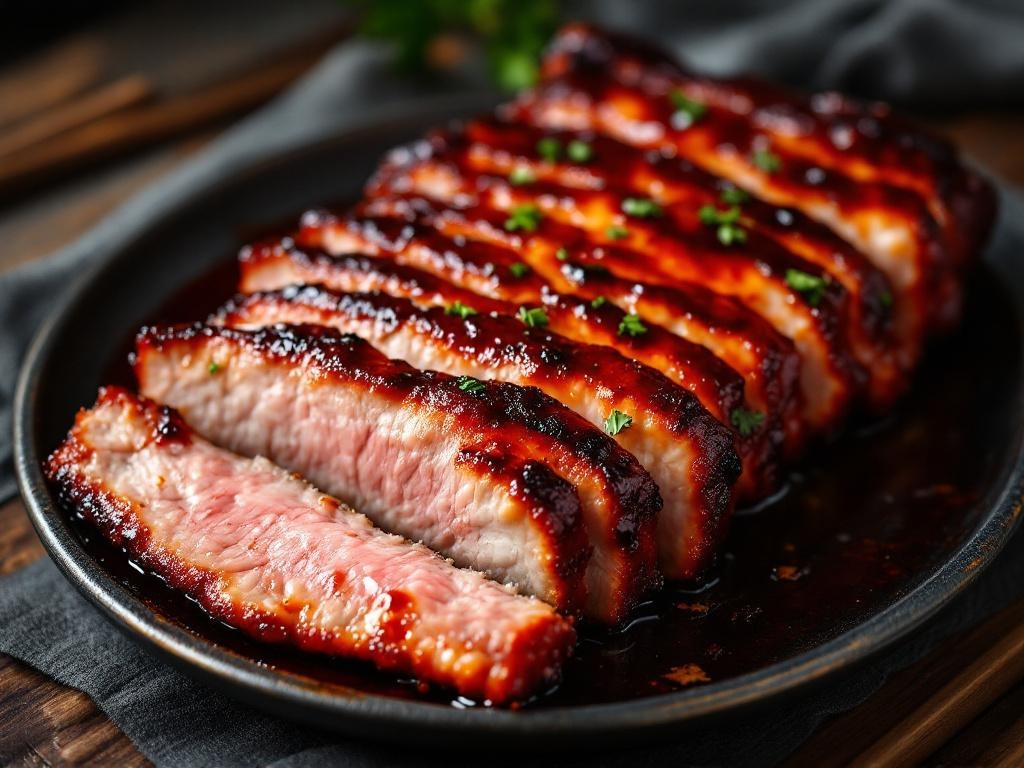
Char Siu (Cantonese Barbecue Pork)
Guangdong (Canton) Province, China; char siu documented as a preparation of the Cantonese siu mei (roast meats) tradition c. 17th century; now iconic across the Chinese diaspora.
Char siu — the glowing red, lacquered, honey-sweet barbecue pork that hangs in the windows of Cantonese roast meat shops — is one of the most distinctive preparations in Chinese cuisine and one of the most technically deceptive. The exterior looks like simple glazing but is the result of multiple stages: a complex marinade of hoisin, oyster sauce, soy, honey, five-spice, Shaoxing wine, and red fermented tofu (nam yu) penetrates the pork over 24 hours; the meat is roasted at high heat to develop the char; it is basted repeatedly during cooking with a honey glaze; it rests and caramelises again under a broiler at the very end. The result is a surface that is at once sticky, caramelised, slightly charred, and deeply savoury, while the interior remains succulent and richly marinated. Char siu is not a shortcut preparation — the full 24-hour marinade and multi-stage cooking are what separate authentic char siu from the approximation.
Use pork shoulder or pork neck (char siu in Cantonese means 'fork-roasted') — fat-marbled cuts stay moist through the high-heat cooking Marinate minimum 24 hours — shorter marination produces surface flavour only; the overnight time allows full penetration Red fermented tofu (nam yu) is the key ingredient for the characteristic reddish colour and depth — a small amount adds enormous character Roast at 200°C and baste every 10 minutes with honey glaze — each basting layer builds the lacquered surface Final 2-minute broil caramelises the last baste to a sticky char — watch carefully to prevent burning Rest before slicing — the juices need time to redistribute; slice across the grain for maximum tenderness
RECIPE: Serves: 4 | Prep: 20 min | Total: 3 hr 20 min (incl. marinating) --- 1kg pork shoulder butt — cut into 5cm chunks 100ml honey — divided 80ml soy sauce 60ml rice vinegar 40ml sesame oil 30g ginger — sliced 20g garlic — sliced 15ml five-spice powder 10g Sichuan peppercorns 5g sea salt 2g Tellicherry black pepper --- 1. Toast Sichuan peppercorns in dry wok 1 minute; crush and set aside. 2. Combine 50ml honey, soy sauce, rice vinegar, sesame oil, ginger, garlic, five-spice powder, and crushed Sichuan peppercorns in mixing bowl. 3. Toss pork chunks with marinade and sea salt; refrigerate 3 hours, turning every 45 minutes. 4. Preheat oven to 200°C; transfer pork to roasting pan; pour marinade over; cover with foil. 5. Roast 90 minutes; remove foil, brush with remaining honey, rotate pan; roast uncovered 30 minutes until dark mahogany exterior forms and internal temp reaches 75°C. 6. Rest 10 minutes; slice against the grain; brush with pan glaze; season with black pepper; serve hot or at room temperature. The red dye (red fermented tofu or red food colouring) is what produces the signature rosy-red colour — without it, the pork is brown; the colour signals authenticity to knowledgeable diners For home cooking without a rotisserie: hang the pork using hooks from the top rack in the oven over a foil-lined tray — the air circulation approximates the traditional hanging roast Sliced char siu on rice (char siu fan) with roasted pork drippings over white rice is one of Cantonese cuisine's most satisfying simple meals
Short marination time — surface flavour only without overnight marination Using lean pork — loin dries out during the high-heat cooking; shoulder or collar is essential Basting once rather than repeatedly — the lacquered surface is built through multiple thin layers Omitting the red fermented tofu — a significant flavour contributor that cannot be directly substituted Slicing with the grain — char siu cut with the grain is tough; cross-grain reveals the tender, pulled texture
Common Questions
What are common mistakes when making Char Siu (Cantonese Barbecue Pork)?
Short marination time — surface flavour only without overnight marination Using lean pork — loin dries out during the high-heat cooking; shoulder or collar is essential Basting once rather than repeatedly — the lacquered surface is built through multiple thin layers Omitting the red fermented tofu — a significant flavour contributor that cannot be directly substituted Slicing with the grain — char