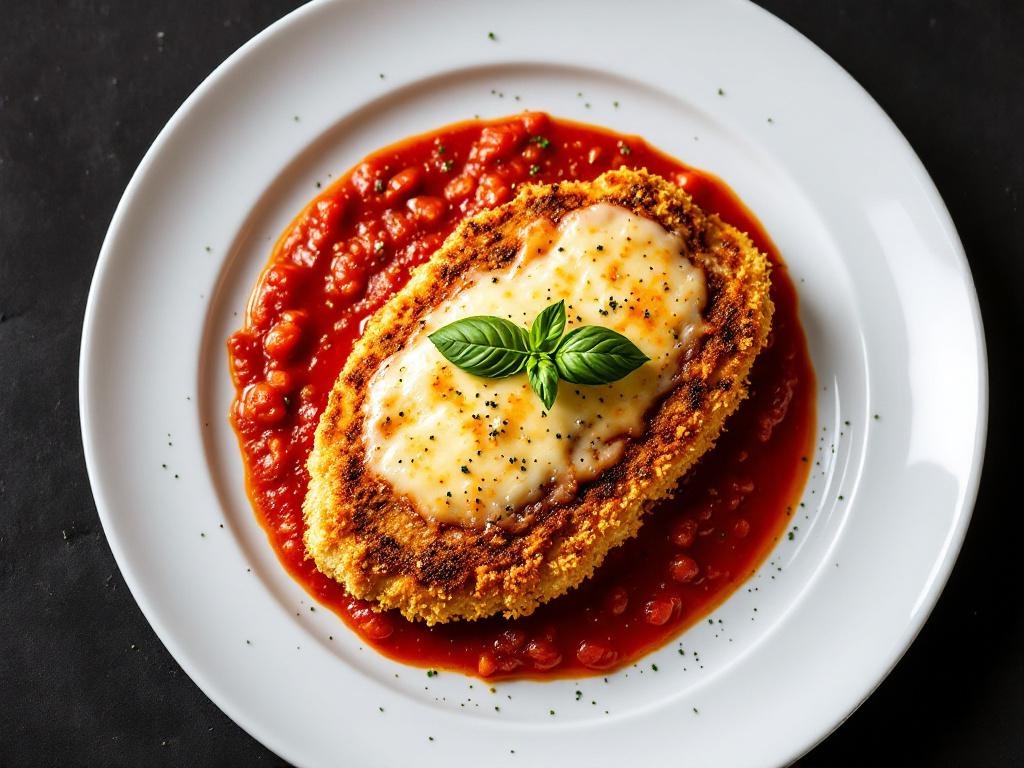
Chicken Parmesan
Italian-American, 19th-20th century. Derived from Sicilian and Campanian Parmigiana di Melanzane (eggplant with tomato and cheese), which Italian immigrants to the United States adapted using the more abundant and cheaper chicken breast. The word Parmigiana does not refer to Parma — it refers to the layering technique, possibly from the Sicilian word parmiciana (slats of a Persian blind).
Correctly understood, Chicken Parmigiana (Parmigiana di Pollo) is a bastard descendant of Melanzane alla Parmigiana, the eggplant dish of Sicily and Campania. The version most know — crumbed chicken breast, tomato sauce, melted mozzarella, Parmigiano — is an Italian-American creation. The definitive version uses free-range breast, pounded thin, crumbed with Japanese panko for maximum crunch, fried in neutral oil at 180C, finished in the oven with San Marzano sauce and fior di latte.
Montepulciano d'Abruzzo — medium-bodied, fruit-forward, enough acidity to cut the richness of the fried crust and cheese without overpowering. Or an Italian Peroni lager, which is how this dish is actually consumed most of the time, and correctly so.
{"Pound the breast to 1.5cm uniform thickness — this ensures even cooking and maximises the ratio of crust to meat","Triple crumb: flour, beaten egg, panko (not dry breadcrumbs). Panko absorbs less oil and creates a lighter, crunchier crust","Fry in batches at 180C in 2cm of neutral oil — do not crowd the pan, which drops the oil temperature and produces a greasy, steamed crust","Sauce goes on after frying: spoon 2 tablespoons San Marzano sauce on each schnitzel, add sliced fior di latte, grate Parmigiano over the top","Finish under the grill or in a 220C oven for 3-4 minutes until the cheese is bubbling and beginning to colour — not more, or the crust beneath the sauce steams soft","Serve immediately — the contrast between crisp crust and molten cheese lasts approximately 4 minutes after the grill"}
RECIPE: Serves: 4 | Prep: 20 min | Total: 35 min --- 4 boneless, skinless chicken breasts (150 g each), pounded to 8 mm thickness 150 g Parmigiano Reggiano DOP aged 24 months, grated 100 g panko breadcrumbs 2 large eggs 60 g all-purpose flour 500 ml marinara sauce (crushed San Marzano DOP tomatoes, garlic, olive oil) 200 g fior di latte mozzarella, sliced 4 mm thick 120 ml extra virgin olive oil 3 g sea salt 1 g Tellicherry black pepper --- 1. Set up breading station: flour in one bowl, beaten eggs in another, panko mixed with 75 g Parmigiano in a third. 2. Season chicken with sea salt and black pepper; coat each breast lightly in flour, shake off excess. 3. Dip in beaten egg, then dredge in panko-Parmigiano mixture, pressing gently to adhere; lay on parchment paper. 4. Heat 60 ml olive oil in a large skillet over medium-high; fry chicken 4 minutes per side until golden and cooked through (internal temp 165°F). Transfer to paper towels. 5. Spread 100 ml marinara on bottom of a 9 × 13 inch baking dish; arrange breaded chicken in single layer. Top each breast with 1 mozzarella slice and remaining marinara sauce. 6. Bake at 200°C for 12 minutes until cheese melts and bubbles slightly. Finish with remaining 25 g Parmigiano and fresh basil. The moment where Chicken Parmigiana lives or dies is the first two minutes after it comes out of the frying oil — use a wire rack, never paper towel. Paper towel traps steam and turns the base soggy. The wire rack allows air circulation under the schnitzel while you load it with sauce and cheese. Into the grill immediately. The window between crisp triumph and soggy defeat is about 6 minutes.
{"Using dry breadcrumbs: they produce a tight, dense crust that absorbs oil and softens quickly","Overloading the sauce: the sauce on Chicken Parmigiana is a condiment, not a base — too much sauce steams the crumb beneath it","Thick chicken: a thick breast means the inside is still raw when the crumb is golden, requiring oven time that softens the crust"}
Common Questions
Why does Chicken Parmesan taste the way it does?
Montepulciano d'Abruzzo — medium-bodied, fruit-forward, enough acidity to cut the richness of the fried crust and cheese without overpowering. Or an Italian Peroni lager, which is how this dish is actually consumed most of the time, and correctly so.
What are common mistakes when making Chicken Parmesan?
{"Using dry breadcrumbs: they produce a tight, dense crust that absorbs oil and softens quickly","Overloading the sauce: the sauce on Chicken Parmigiana is a condiment, not a base — too much sauce steams the crumb beneath it","Thick chicken: a thick breast means the inside is still raw when the crumb is golden, requiring oven time that softens the crust"}
What dishes are similar to Chicken Parmesan?
Japanese tonkatsu (crumbed and fried pork, same panko technique); Austrian Wiener Schnitzel (pounded and crumbed veal — the technical ancestor); Korean dakgaseu (chicken cutlet with tonkatsu sauce — the Eastern evolution of the same crumbing tradition).