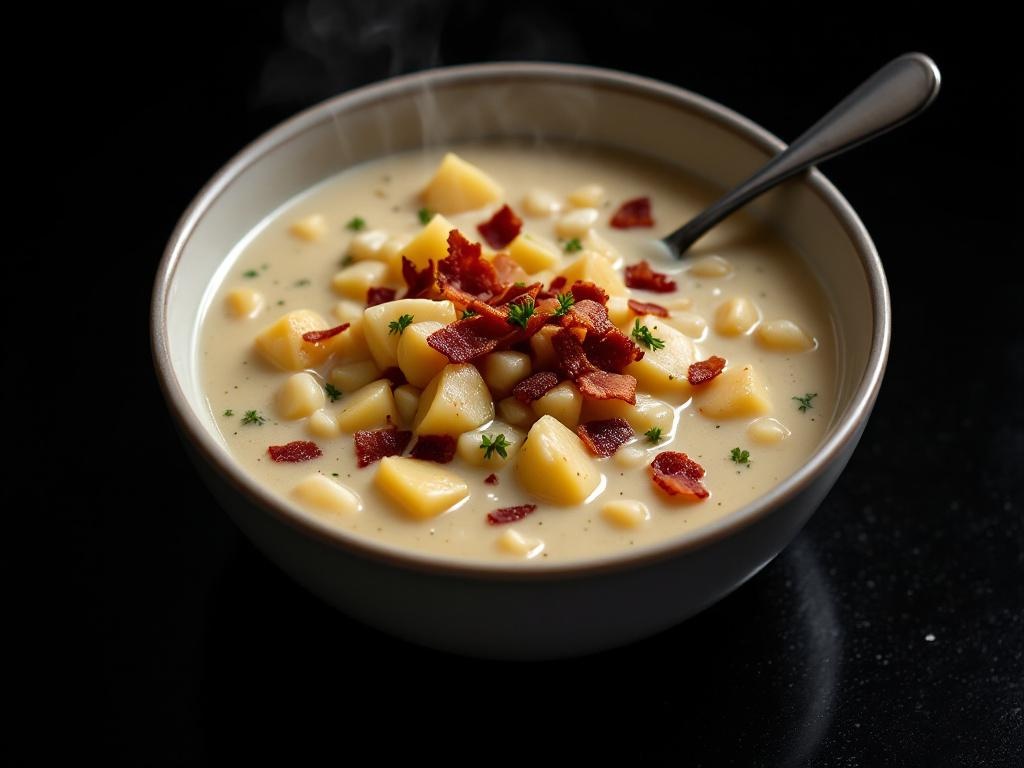
Clam Chowder
New England, United States. Clam chowder has been made in New England since colonial times, developed by European settlers who adapted Indigenous American traditions of cooking clams. The term 'chowder' derives from the French chaudière (cauldron). The cream-based New England version is the internationally recognised standard.
New England clam chowder is a thick, cream-based soup of clams, diced potato, smoky bacon, onion, and celery — one of the foundational soups of American cooking. The chowder should be thick enough to coat a spoon but fluid enough to pour; the clams should be tender, not rubbery; and the bacon should provide smokiness throughout the cream base. Manhattan clam chowder (tomato-based) exists but is not the definitive form.
Oyster crackers — the canonical American accompaniment. Or sourdough bread bowl (the San Francisco adaptation). Cold Anchor Steam beer or a New England IPA alongside.
{"Fresh clams (littleneck or cherrystone): steamed separately to open, with the steaming liquid strained and reserved for the base. Canned clams are an acceptable shortcut — use the can liquid","Bacon: thick-cut, cooked until the fat is rendered and the bits are crispy. The rendered fat becomes the cooking medium for the vegetables","The mirepoix: onion, celery, and a small amount of garlic — cooked in the bacon fat until soft. Potatoes added next and cooked briefly before the liquid","The liquid: equal parts reserved clam juice and light chicken stock, with a bottle of clam juice if using canned clams. Bring to a simmer and cook until potatoes are just tender","The cream: heavy cream added in the final stage — never boiled vigorously after adding cream or it breaks","The thickening: a flour-butter roux cooked into the vegetables before adding liquid provides body. The starches from the potato also thicken as they cook"}
RECIPE: Serves: 4 | Prep: 20 min | Total: 60 min --- 1kg littleneck clams — scrubbed, soaked 20 minutes in salted water 150g smoked bacon — diced 200g yellow onion — diced 150g celery — diced 200g russet potato — peeled, cut into 1cm cubes 4 cloves garlic — minced 500ml clam stock — reserved from clam cooking liquid, strained 400ml whole milk 200ml heavy cream 60g unsalted butter 40g all-purpose flour 1 bay leaf 2 tsp fresh thyme 1 tsp fine sea salt 1/2 tsp white pepper 100g oyster crackers --- 1. Bring large pot of water to boil; add drained clams and cover; cook 8–10 minutes until shells open (discard any unopened); strain liquid through fine sieve into measuring cup; shuck clams and chop coarsely. 2. Render bacon in heavy-bottomed pot over medium heat until fat releases and edges crisp, 4 minutes; remove to paper towel. 3. Add onion, celery, and potato to bacon fat; cook 5 minutes until softened. 4. Stir in minced garlic; cook 1 minute until fragrant. 5. Melt butter in pot, whisk in flour, and stir constantly 1 minute (do not brown); slowly add clam stock while whisking until fully incorporated and roux dissolves. 6. Add milk, cream, bay leaf, and thyme; bring to gentle simmer, stirring occasionally, until potatoes are tender, 12–15 minutes. 7. Fold in chopped clams and cooked bacon; season with salt and white pepper. 8. Serve in heated bowls topped with oyster crackers. The moment where clam chowder lives or dies is the clam timing — add the clams (and their steaming liquid) in the final 2 minutes of cooking. Clams are already cooked from steaming; you are only warming them through. Every additional minute of heat makes them tighter and more rubbery. Taste one at the 1-minute mark and the 2-minute mark — the moment they are yielding and tender is the moment to serve.
{"Over-cooking the clams: rubbery, shrunken clams are the most common chowder mistake — add clams in the last 2 minutes of cooking","Boiling after adding cream: the emulsion breaks and the cream separates","Thin chowder: the potato starch and flour roux must be cooked long enough to thicken"}
Common Questions
Why does Clam Chowder taste the way it does?
Oyster crackers — the canonical American accompaniment. Or sourdough bread bowl (the San Francisco adaptation). Cold Anchor Steam beer or a New England IPA alongside.
What are common mistakes when making Clam Chowder?
{"Over-cooking the clams: rubbery, shrunken clams are the most common chowder mistake — add clams in the last 2 minutes of cooking","Boiling after adding cream: the emulsion breaks and the cream separates","Thin chowder: the potato starch and flour roux must be cooked long enough to thicken"}
What dishes are similar to Clam Chowder?
French soupe de poisson (fish and shellfish soup — the French seafood soup tradition); Galician caldeirada (Portuguese fish stew — the Iberian shellfish soup parallel); Breton cotriade (cream-based fish soup from Brittany — the direct French ancestor of chowder).