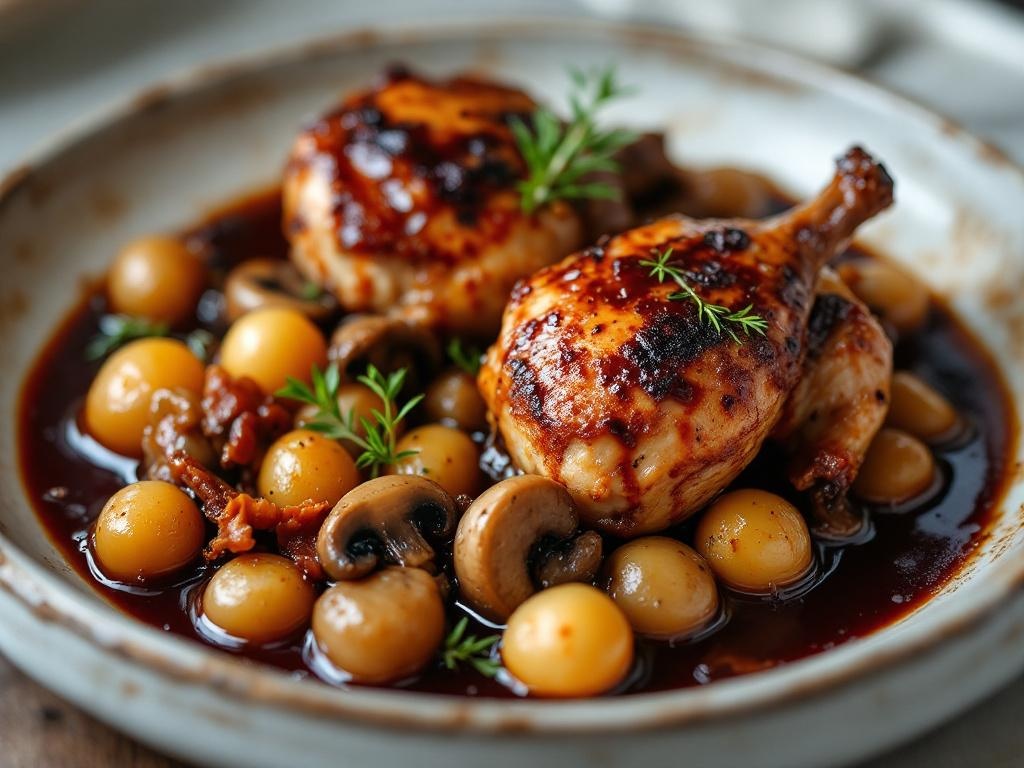
Coq au Vin
Burgundy and the Auvergne regions of France. A farmhouse dish designed for old roosters (coq) that were too tough to roast but would yield after long braising. Julia Child's version in Mastering the Art of French Cooking made it internationally known.
Chicken braised in red wine with lardons, mushrooms, and pearl onions. The lesser sibling of Beef Bourguignon — but in its original form (a rooster, coq, aged and tough, requiring hours in wine to yield) this was not a lesser dish. The modern version uses younger chicken, which requires delicacy — the wine braising time is shorter, and the risk of drying out the white meat is real.
Pinot Noir from Burgundy — the same wine used in the braise. A village-level Chambolle-Musigny or Vosne-Romanee is elevated by the dish and elevates it in return. Do not use Cabernet — the tannins are too aggressive for chicken.
{"Use chicken thighs and legs, not breasts — the dark meat can withstand 45 minutes of braising; breast meat will dry out. If using a whole chicken, add the breast for the final 20 minutes only","Flame the brandy: add 60ml cognac to the browned chicken in the pan and ignite with a long match — the alcohol burns off in 30 seconds, leaving the cognac flavours without the raw alcohol edge","Red wine: a decent Burgundy or Cotes du Rhone — the chicken flesh is more delicate than beef and an overly tannic wine can overwhelm it","Lardons browned first: the rendered fat from the lardons becomes the primary cooking fat for the chicken. Remove the lardons before browning the chicken, then return them to the braise","Thicken with beurre manie at the end: equal weight butter and flour kneaded together, whisked into the warm sauce off the heat — this produces a lighter thickening than a flour-first roux","Pearl onions glazed separately in butter and sugar until caramelised and gilded — then added to the finished dish"}
RECIPE: Serves: 4 | Prep: 35 min | Total: 120 min --- 1.4kg chicken — cut into 8 pieces (breasts halved, thighs and legs separated) 200g pearl onions — peeled 200g button mushrooms — halved 150g lardons — or thick-cut bacon, cubed 2 tbsp tomato paste 30g unsalted butter 30ml extra-virgin olive oil 500ml red Burgundy wine — Pinot Noir 250ml chicken stock 2 carrots — cut into batons 4 garlic cloves — minced 2 bay leaves 3 fresh thyme sprigs 1 tbsp black peppercorns Coarse sea salt Tellicherry black pepper Parsley — chopped, for garnish --- 1. Render lardons in a large, heavy pot over medium heat until crisp, drain on paper towels, and set aside. 2. Pat chicken dry; brown skin-side down in rendered fat and oil over medium-high heat (3–4 minutes per side), then remove and set aside. 3. Soften pearl onions and mushrooms briefly in pot; remove and reserve, then stir in tomato paste and cook 2 minutes. 4. Add garlic and cook 1 minute; deglaze with wine, scraping browned bits, and reduce by one-third. 5. Return chicken and lardons to pot, add stock, bay leaves, thyme, and peppercorns; bring to simmer, cover, and braise 45 minutes. 6. Add carrots, pearl onions, and mushrooms; simmer uncovered 15 minutes until chicken is fully cooked through and vegetables are tender. 7. Discard bay leaves and thyme; season carefully with salt and Tellicherry pepper. 8. Serve from the pot or transfer to a shallow dish, garnished with chopped parsley. The moment where coq au vin lives or dies is the sauce at the very end — after braising, remove all the chicken, strain the sauce, and reduce by half in a clean pan until deeply concentrated. Taste: it should be intensely savoury, slightly sweet from the wine reduction, with depth from the cognac. Add the beurre manie in small pieces, whisking constantly. Return chicken and garnishes. The sauce should cling to the chicken, not pool under it.
{"Using chicken breasts throughout: dry, fibrous breast meat after 45 minutes of braising","Under-reducing the sauce: the wine sauce must reduce to a glossy consistency that coats the back of a spoon","Skipping the cognac flambee: the cognac adds depth that wine alone cannot provide"}
- Greek kotopoulo krasato (chicken braised in wine — the Hellenic parallel); Spanish pollo al vino (chicken braised in wine, the Iberian version); Italian pollo alla Romana (chicken braised with white wine, capsicum, and herbs — the Roman interpretation).
Common Questions
Why does Coq au Vin taste the way it does?
Pinot Noir from Burgundy — the same wine used in the braise. A village-level Chambolle-Musigny or Vosne-Romanee is elevated by the dish and elevates it in return. Do not use Cabernet — the tannins are too aggressive for chicken.
What are common mistakes when making Coq au Vin?
{"Using chicken breasts throughout: dry, fibrous breast meat after 45 minutes of braising","Under-reducing the sauce: the wine sauce must reduce to a glossy consistency that coats the back of a spoon","Skipping the cognac flambee: the cognac adds depth that wine alone cannot provide"}
What dishes are similar to Coq au Vin?
Greek kotopoulo krasato (chicken braised in wine — the Hellenic parallel); Spanish pollo al vino (chicken braised in wine, the Iberian version); Italian pollo alla Romana (chicken braised with white wine, capsicum, and herbs — the Roman interpretation).