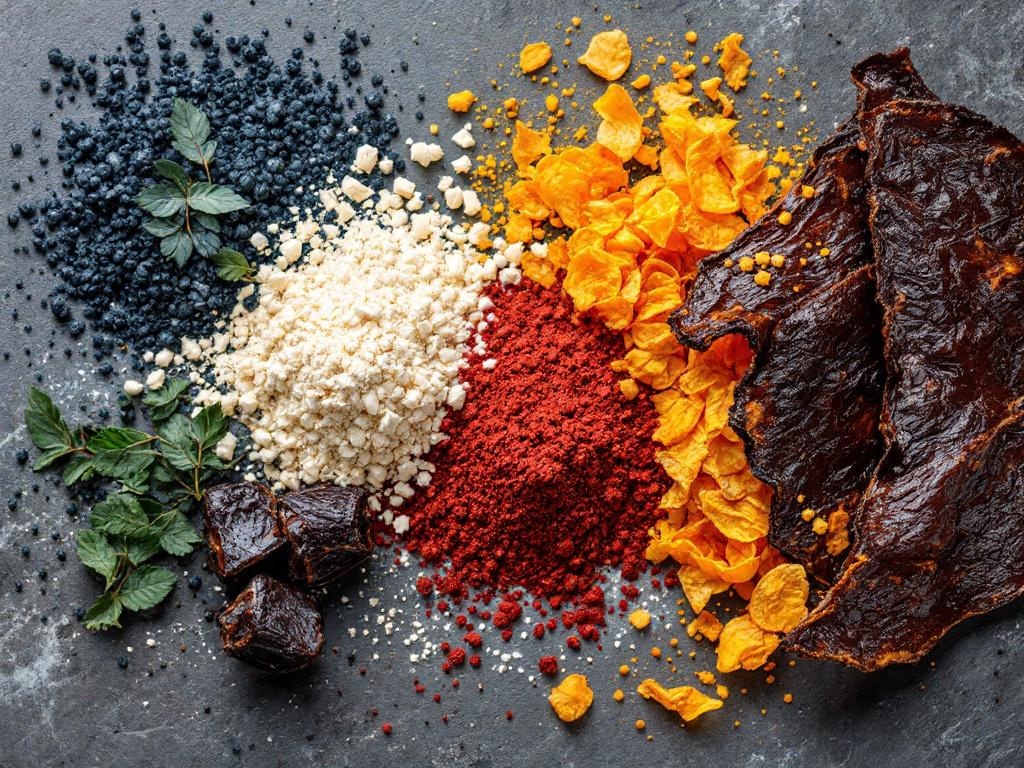
Dehydration — Making Powders, Chips, and Jerky
Dehydration as preservation is ancient — sun-dried fruits and fish documented in Mesopotamia; food dehydrators commercialised in the 20th century; maltodextrin powder technique developed in modernist cuisine, early 2000s
Dehydration removes water from food through the application of low heat and airflow, reducing water activity (Aw) below the threshold required for microbial growth and enzymatic deterioration, while concentrating flavour compounds and creating novel textures unavailable through other cooking methods. The technique spans from ancient sun-drying and salt-wind traditions to modern laboratory dehydrators and freeze-drying technology. The science centres on water activity (Aw) rather than total water content. Aw measures the availability of water for microbial use on a scale of 0–1; fresh food typically has Aw 0.97–0.99; most pathogens cannot grow below Aw 0.85; moulds are inhibited below 0.70; xerophilic organisms cease growth below 0.60. Food dehydrators reduce Aw by driving off free water through convective air flow at controlled low temperatures, typically 55–75°C. For powders (the modernist technique of maltodextrin-bound fats and concentrated liquids): reduced, concentrated preparations — caramelised onion purée, olive oil, fruit reduction — are blended with tapioca maltodextrin (a low-density starch) at approximately 60% starch to 40% base by weight. Maltodextrin absorbs and encapsulates fats and liquids, creating a dry, free-flowing powder that melts on the tongue, releasing the flavour. These powders are an alternative to dehydration proper — they do not require long drying times. For chips and crisps: thin slices or purées spread onto non-stick dehydrator trays at 60–70°C for 8–16 hours create glass-like, intensely flavoured chips. Root vegetables, mushrooms, citrus, and tomatoes all dehydrate cleanly. Tomato chips, mushroom crisps, and citrus tuiles are standard modernist garnishes. For jerky: pre-marinated strips of lean meat (beef, venison, turkey) dehydrated at 70°C for 4–8 hours reach safe Aw levels while developing intense Maillard-adjacent flavour from concentrated protein and sugar interactions.
Dehydration concentrates flavour dramatically — a mushroom chip delivers 10x the umami intensity of an equivalent weight of fresh mushroom in a single bite
Target water activity below 0.70 for shelf stability — food dehydrators typically achieve this with 6–12 hours of airflow at 55–75°C Slice uniformly — inconsistent thickness produces uneven drying with some pieces over-dried and others still moist For powders from fats and oils, use tapioca maltodextrin at approximately 60:40 maltodextrin-to-base ratio For jerky, marinate before dehydrating — dehydration concentrates seasoning dramatically, so under-marinating is a common error Pre-treatment with sodium metabisulphite or lemon juice prevents oxidative browning in fruit and vegetable dehydration Always cool dehydrated food completely before storing — residual heat causes condensation inside containers, rehydrating the product
RECIPE: Yield: 100g powder / 150g chips / 200g jerky | Prep: 20 min | Total: 360 min (6 hours at 65°C) --- [POWDER] 300g fresh mushrooms (cremini, cleaned and sliced thin) [CHIPS] 400g potato (Russet, mandolined 2mm thick, soaked 30 min in water) [JERKY] 500g beef brisket (trimmed, sliced 6mm against grain) 5 ml olive oil 2g sea salt per batch --- 1. For powder: arrange mushroom slices on dehydrator trays in single layer; set to 65°C for 6 hours until brittle. 2. For chips: pat potato slices dry completely; toss lightly with sea salt and olive oil; lay flat on trays without overlap. 3. For jerky: pat beef dry; marinate 12 hours in 20 ml soy sauce, 10 ml fish sauce, 5g brown sugar, 2g smoked paprika, 1g garlic powder; pat dry and lay on mesh trays. 4. Dehydrate chips at 70°C for 4 hours until golden and crisp; jerky at 65°C for 8–10 hours until flexible but not moist. 5. Grind cooled mushroom chips in spice mill until fine powder; pass through fine sieve. 6. Cool all products to room temperature before storing in airtight containers with desiccant packets. A standard domestic oven on its lowest setting (usually 60–70°C) with the door slightly ajar makes a functional dehydrator for occasional use For citrus chips, slice paper-thin on a mandoline and dry with a light dusting of icing sugar for caramelised, glossy tuiles For mushroom powders, dehydrate fully then grind in a spice grinder — the resulting powder adds deep umami to stocks, rubs, and sauces Silica gel packets or oxygen absorbers in sealed storage extend shelf life of dehydrated products dramatically For maltodextrin powders, start with a high-fat, fully reduced base — the higher the fat content, the better the encapsulation and the more dramatic the melt-on-tongue effect
Dehydrating at too-high temperatures which cook rather than dry the food, producing a cooked (not dehydrated) exterior that traps moisture inside Not checking for uniform dryness before storing — even one moist piece in a sealed container can cause the entire batch to mould Overloading the dehydrator trays with too many layers, reducing airflow and dramatically extending drying time Using fatty meat for jerky — fat does not dehydrate and becomes rancid rapidly in dehydrated products; always use lean cuts Failing to pasteurise jerky at 70°C internal before dehydrating — USDA recommends heat treatment to kill pathogens before or after drying
Common Questions
Why does Dehydration — Making Powders, Chips, and Jerky taste the way it does?
Dehydration concentrates flavour dramatically — a mushroom chip delivers 10x the umami intensity of an equivalent weight of fresh mushroom in a single bite
What are common mistakes when making Dehydration — Making Powders, Chips, and Jerky?
Dehydrating at too-high temperatures which cook rather than dry the food, producing a cooked (not dehydrated) exterior that traps moisture inside Not checking for uniform dryness before storing — even one moist piece in a sealed container can cause the entire batch to mould Overloading the dehydrator trays with too many layers, reducing airflow and dramatically extending drying time Using fatty me