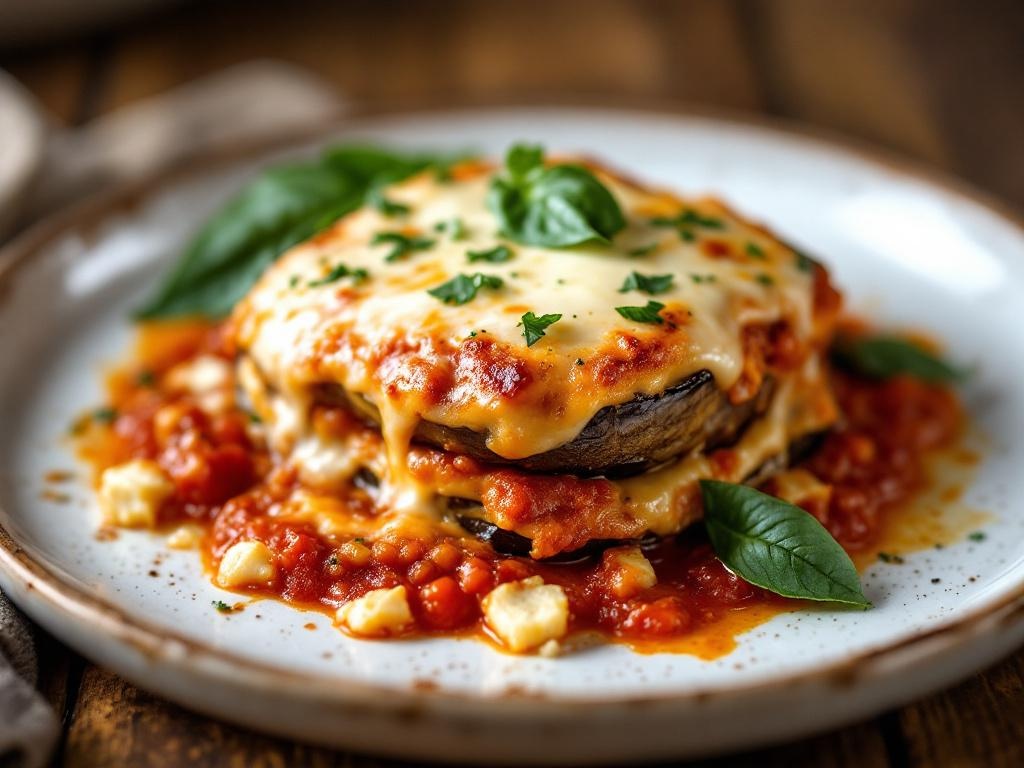
Eggplant Parmesan
Sicily and Campania. Despite the name Parmigiana, the dish is not from Parma — the name most likely derives from the Sicilian word parmiciana (louvred Persian blind), referring to the overlapping sliced layers. One of the oldest documented layered vegetable dishes in Italian cooking.
Melanzane alla Parmigiana is not battered and fried eggplant with tomato sauce. The authentic Sicilian and Campanian version is sliced eggplant, salted and pressed to remove bitterness, shallow-fried in olive oil until golden, then layered with simple tomato sauce, torn basil, and thin slices of fior di latte (not mozzarella di bufala, which is too wet). Baked until the top is bubbling and the layers have unified. Rest before serving.
Nero d'Avola from Sicily — the deep-fruited, earthy native grape of the island that produced the dish. The warmth of Nero d'Avola matches the sweetness of the slow-roasted eggplant and the richness of the fior di latte.
{"Eggplant: globe (Italian) variety, sliced 1cm thick, salted generously on both sides, pressed between plates with weight for 30 minutes, then dried — this removes moisture and bitterness","Fry in 1cm of extra virgin olive oil over medium-high heat until deep golden on both sides — the eggplant must be fully cooked through before assembly or it will remain hard after baking","The tomato sauce: San Marzano DOP, briefly cooked with garlic and basil — not reduced to a paste, slightly loose, as the eggplant will absorb some moisture during baking","Layering: sauce on the base, eggplant, sauce, torn fior di latte, Parmigiano-Reggiano, basil, repeat — minimum three layers, finishing with sauce and a heavy snowfall of Parmigiano","Bake at 180C for 40 minutes covered, then 10 minutes uncovered to develop the Parmigiano crust","Rest for 20 minutes before cutting: the layered structure sets during resting — cut immediately and the layers collapse"}
RECIPE: Serves: 4 | Prep: 45 min | Total: 75 min --- 800g globe eggplant — sliced 8mm thick lengthwise Coarse sea salt 300ml extra-virgin olive oil — for frying 400g San Marzano DOP canned tomatoes 30g fresh basil leaves 4 garlic cloves — minced 1 tsp dried oregano 250g Fior di Latte mozzarella — sliced 5mm 80g Parmigiano Reggiano DOP — aged 24 months, grated 60g fresh breadcrumbs 30ml extra-virgin olive oil — for layering Tellicherry black pepper --- 1. Salt eggplant slices heavily; lay on paper towels 20 minutes to release moisture, then pat dry. 2. Heat oil in a large skillet to 180°C; fry eggplant in batches 2–3 minutes per side until golden, drain on paper towels, and cool slightly. 3. Combine canned tomatoes, minced garlic, oregano, and half the basil in a bowl; season with salt and Tellicherry pepper. 4. Spread thin layer of tomato sauce on the bottom of a baking dish; layer half the eggplant, then half the remaining sauce, then half the mozzarella. 5. Repeat with remaining eggplant, sauce, and mozzarella; combine breadcrumbs, remaining basil, and Parmigiano Reggiano, then sprinkle over top and drizzle with 30ml oil. 6. Bake at 200°C for 25 minutes until cheese browns and sauce bubbles at edges. 7. Cool 5 minutes; garnish with fresh basil and serve warm. The moment where Parmigiana lives or dies is the frying — the eggplant must be fully cooked through in the frying pan before it ever goes into the oven. Press a finger into the centre of a fried slice: it should yield completely, with no resistance. If it springs back, it needs more time. The oven time is about unifying layers and developing the crust — not finishing the eggplant. Under-fried eggplant will never fully yield in the oven.
{"Skipping the salting and pressing: the eggplant retains bitterness and excess moisture, producing a wet, bitter result","Underfrying the eggplant before assembly: raw or undercooked eggplant remains firm during baking","Using fresh mozzarella without draining: excess moisture makes the parmigiana soupy"}
- Greek moussaka (layered eggplant with meat sauce and bechamel — the Northern European expression of the same idea); Turkish imam bayildi (eggplant stuffed and baked with tomato and onion — the Ottoman ancestor); French gratin (layered and baked to a crust — same architectural principle).
Common Questions
Why does Eggplant Parmesan taste the way it does?
Nero d'Avola from Sicily — the deep-fruited, earthy native grape of the island that produced the dish. The warmth of Nero d'Avola matches the sweetness of the slow-roasted eggplant and the richness of the fior di latte.
What are common mistakes when making Eggplant Parmesan?
{"Skipping the salting and pressing: the eggplant retains bitterness and excess moisture, producing a wet, bitter result","Underfrying the eggplant before assembly: raw or undercooked eggplant remains firm during baking","Using fresh mozzarella without draining: excess moisture makes the parmigiana soupy"}
What dishes are similar to Eggplant Parmesan?
Greek moussaka (layered eggplant with meat sauce and bechamel — the Northern European expression of the same idea); Turkish imam bayildi (eggplant stuffed and baked with tomato and onion — the Ottoman ancestor); French gratin (layered and baked to a crust — same architectural principle).