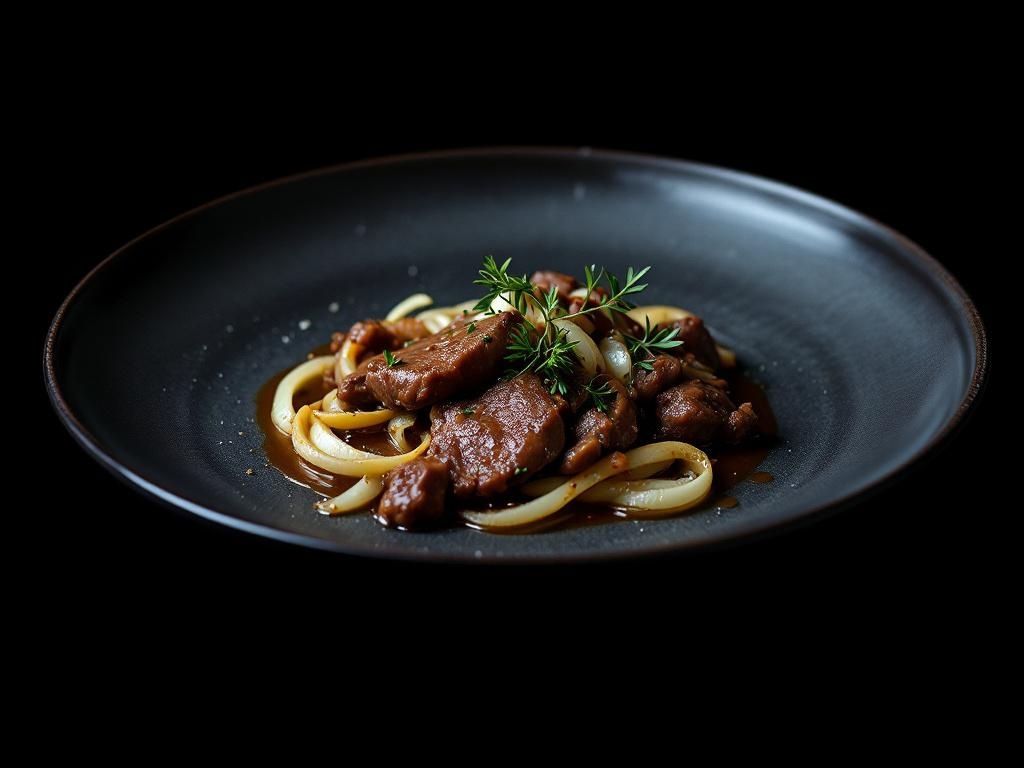
Fegato alla Veneziana (Venetian Calf's Liver and Onions)
Venice — Renaissance-era preparation documented by Bartolomeo Scappi in 1570; rooted in medieval Venetian medical tradition and spice-trade culture
Fegato alla veneziana is among the most important liver preparations in European cuisine — thin-sliced calf's liver cooked with an abundance of sweet white onions until the onions are completely soft and the liver is just cooked through, with a splash of white wine vinegar or dry white wine to deglaze. It is a dish that demands exact timing at the moment of cooking and complete mise en place, because the liver goes from perfect to overcooked in thirty seconds. The preparation represents Venice's historical relationship with liver as a desirable offal — not a poverty ingredient but a prized one. Medieval Venetian physicians prescribed liver for building strength, and the combination with onions was understood to balance the organ's richness. The dish appears in Bartolomeo Scappi's 1570 cookbook and has remained essentially unchanged in its Venetian form since the Renaissance. The onions are the foundation and require more time than the liver. Venetian white onions — large, mild, sweet varieties — are sliced into thin half-rings and sweated in butter and a thread of olive oil over very low heat for forty minutes until completely soft, golden, and sweet without any caramelisation. This extended, gentle cook is non-negotiable; browned onions change the flavour architecture of the dish entirely. A small amount of white wine is added toward the end of the onion cook and reduced away. Calf's liver is sliced very thinly — 3–4mm — against the grain, with all membrane removed. The heat is raised to high, and the liver slices are placed into the onion pan and cooked for 60 to 90 seconds on the first side — they should colour at the edges. A single flip, another 60 seconds, a splash of wine vinegar, and the liver comes out immediately. It should be just barely pink in the centre — the carryover cook in the onion completes it. Rest briefly and serve with soft polenta.
Sweet, melting onion enveloping barely-cooked liver — rich and mineral with a gentle sweetness from the long-cooked Venetian onions
Cook the onions for a full 40 minutes over low heat — they must be sweet and soft before the liver arrives Slice liver at maximum 4mm — thicker liver cannot be cooked to just-pink in the required short time Heat must be high when the liver goes in — the goal is browning, not steaming Cook liver for no more than 60–90 seconds per side and remove immediately — overcooked liver is grainy and bitter Remove all membrane from the liver before slicing — it contracts during cooking and creates an unpleasant texture
RECIPE: Serves: 4 | Prep: 15 min | Total: 20 min --- 600 g calf's liver (1 cm thick slice, very fresh from the butcher), sliced into 5 mm ribbons 500 g yellow onions (4 medium), thinly sliced 60 ml extra-virgin olive oil (Venetian) 40 g unsalted butter 150 ml dry white wine (Pinot Grigio or Vermentino) 30 ml whole milk or cream (optional, traditional in some versions) 15 g fresh flat-leaf parsley (finely chopped) 6 g fine sea salt 2 g white pepper 30 g unbleached flour (optional, for light coating) --- 1. Heat 40 ml olive oil and 25 g butter in a large, heavy-bottomed pan over medium-low heat; add thinly sliced onions and cook gently for 12–15 minutes, stirring occasionally, until very soft, translucent, and beginning to caramelize without browning (the onions should form the base of the dish and become almost melting). 2. Season the onions with 3 g fine sea salt and a pinch of white pepper; pour in white wine and let simmer for 2–3 minutes, then reduce heat to very low and keep warm. 3. Pat calf's liver slices dry with absorbent paper; season lightly with salt and white pepper on both sides (do not season heavily, as the liver is already delicate). 4. Heat remaining 20 ml olive oil and 15 g butter in a separate large, heavy pan over medium-high heat until it foams; working quickly (the liver cooks rapidly and becomes tough if overcooked), place liver slices in the pan and sear for 45 seconds on each side until just cooked through with a faint blush of pink at the centre (do not overcook). 5. Remove the liver from the pan and arrange it over the warm onions; if using milk or cream, stir a small splash into the onions for richness (traditional but optional), then scatter the liver slices evenly on top. 6. Sprinkle with fresh parsley, taste, adjust seasoning if necessary, and serve immediately while the liver is still warm and tender; the sauce should be creamy, aromatic, and abundant (fegato is as much about the onions as the liver itself). Some Venetian cooks add a very small pinch of cinnamon to the onions — an ancient trade-route spice note that adds warmth Flour the liver slices very lightly before cooking for a slight crust — traditional in some Venetian households Serve with white polenta (polenta bianca) — the creaminess of the polenta absorbs the sweet onion and liver juices perfectly For restaurant service, completely prepare the onions ahead; cook the liver to order in the onion pan — 90 seconds is all that is needed A very small squeeze of lemon at the end adds brightness — not traditional but used in modern Venetian trattorias to cut the richness
Rushing the onion cook — even 20 minutes is insufficient; the sweetness requires 40 minutes minimum Slicing liver too thick — it cannot cook through without going grey and dry Cooking liver over medium heat — it steams rather than browns and the texture is wrong Overcooking — the window between perfectly just-pink and overcooked is thirty seconds at high heat Using ox or pig liver instead of calf — the flavour is dramatically stronger and less refined
Common Questions
Why does Fegato alla Veneziana (Venetian Calf's Liver and Onions) taste the way it does?
Sweet, melting onion enveloping barely-cooked liver — rich and mineral with a gentle sweetness from the long-cooked Venetian onions
What are common mistakes when making Fegato alla Veneziana (Venetian Calf's Liver and Onions)?
Rushing the onion cook — even 20 minutes is insufficient; the sweetness requires 40 minutes minimum Slicing liver too thick — it cannot cook through without going grey and dry Cooking liver over medium heat — it steams rather than browns and the texture is wrong Overcooking — the window between perfectly just-pink and overcooked is thirty seconds at high heat Using ox or pig liver instead of calf