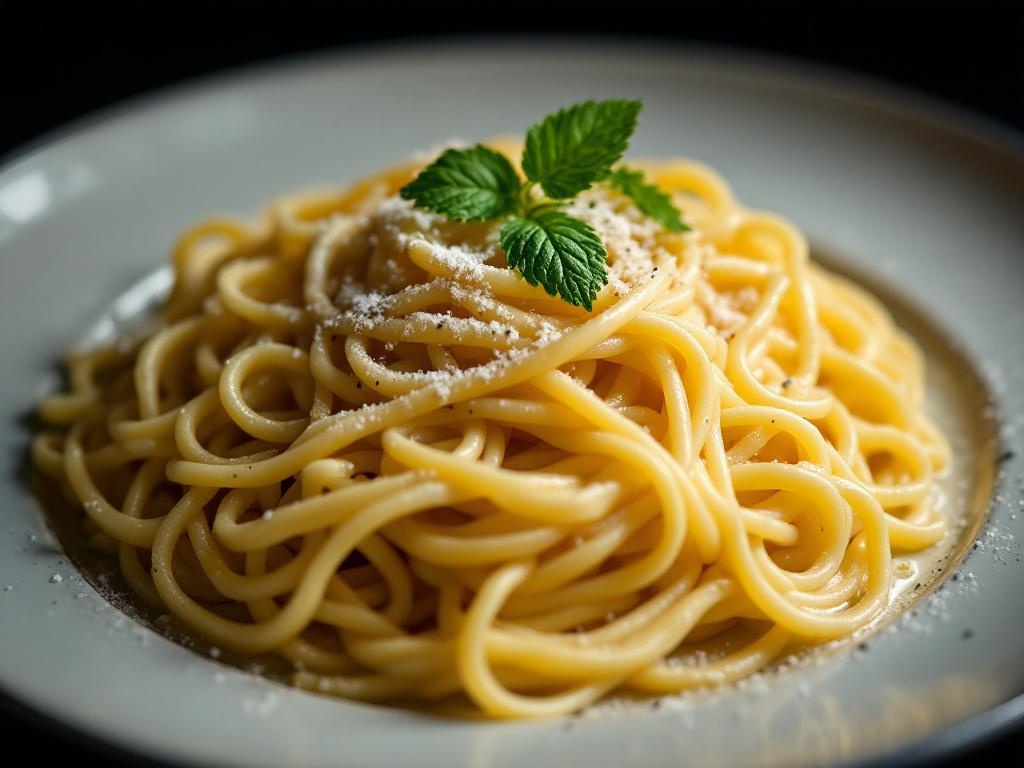
Fettuccine Alfredo
Rome, 1914. Created by Alfredo di Lelio at his restaurant Alfredo alla Scrofa for his wife who had lost her appetite after childbirth. He enriched a simple pasta burro e Parmigiano to maximum indulgence. American celebrities visiting Rome in the 1920s made it famous internationally, where it then evolved into the cream-based version now standard outside Italy.
The original Alfredo — as served at Alfredo alla Scrofa in Rome since 1914 — is two ingredients: fresh fettuccine and aged Parmigiano-Reggiano, finished with exceptional butter. No cream. No garlic. No chicken. The dish is a demonstration of quality over complexity: the finest eggs for the pasta, a 36-month Parmigiano, and unsalted Italian butter with a high fat content. The creaminess comes from the emulsion, not from cream.
Pinot Grigio from Trentino-Alto Adige — the restrained, mineral, copper-coloured style that was the original expression of the grape. The delicate acidity lifts the richness without competing. Alternatively, a Gavi di Gavi for its chalky dryness.
{"Fresh fettuccine: 100g 00 flour to 1 egg yolk plus one whole egg per serving — the extra yolks give the pasta a richness that makes cream redundant","Butter quality matters acutely here: use a European-style unsalted butter with minimum 82% fat content (Plugra, Isigny Sainte-Mere, or Lurpak). The lower water content of high-fat butter emulsifies better","Parmigiano-Reggiano aged 36 months minimum, grated on a Microplane to a fine powder — coarser grating creates a grainy sauce","The emulsion builds in the pan: drain pasta 60 seconds before al dente, reserving 200ml pasta water. In a wide pan, combine pasta, butter, and 50ml pasta water over low heat, tossing constantly","Add Parmigiano off the heat in three additions, tossing between each — the residual heat melts the cheese without seizing it","The sauce should be glossy and fluid — if it tightens, add pasta water in tablespoon amounts"}
RECIPE: Serves: 4 | Prep: 5 min | Total: 15 min --- 400 g fresh egg fettuccine 200 g unsalted butter — European style, 86% butterfat 100 g Parmigiano Reggiano DOP aged 36 months — finely grated 120 ml whole milk — full-fat 4 g sea salt 2 g white pepper — freshly ground 1 g nutmeg — freshly grated --- 1. Bring a large pot of salted water to a rolling boil and add fettuccine, stirring immediately to prevent sticking. 2. Cut butter into 2 cm cubes and place in a warm serving bowl with 60 ml of pasta cooking water. 3. Drain pasta when al dente (2–3 minutes for fresh) and transfer immediately to the butter mixture. 4. Toss pasta vigorously with butter and cooking water to emulsify, adding milk in two additions while stirring constantly. 5. Remove from heat, fold in Parmigiano Reggiano in three additions, stirring between each until fully incorporated. 6. Season with sea salt, white pepper, and nutmeg; toss once more and serve immediately in heated bowls. The moment where Alfredo lives or dies is the butter-paste: at Alfredo alla Scrofa, the tradition is to mix room-temperature butter with a small amount of the pasta cooking water to form an emulsified paste before the pasta arrives. This pre-emulsification means the sauce forms immediately on contact with the hot pasta. At home: the same principle applies — work the butter into the drained pasta with tongs over low heat before adding cheese.
{"Adding cream: cream produces a richer, heavier sauce but destroys the elegant simplicity that defines the original. It also masks the quality of the Parmigiano","Dried pasta: the starch profile of dried pasta does not emulsify as fluidly as fresh egg pasta in this dish","Grating Parmigiano too coarsely: the sauce turns grainy and the cheese clumps rather than coating the pasta"}
Common Questions
Why does Fettuccine Alfredo taste the way it does?
Pinot Grigio from Trentino-Alto Adige — the restrained, mineral, copper-coloured style that was the original expression of the grape. The delicate acidity lifts the richness without competing. Alternatively, a Gavi di Gavi for its chalky dryness.
What are common mistakes when making Fettuccine Alfredo?
{"Adding cream: cream produces a richer, heavier sauce but destroys the elegant simplicity that defines the original. It also masks the quality of the Parmigiano","Dried pasta: the starch profile of dried pasta does not emulsify as fluidly as fresh egg pasta in this dish","Grating Parmigiano too coarsely: the sauce turns grainy and the cheese clumps rather than coating the pasta"}
What dishes are similar to Fettuccine Alfredo?
Swiss pasta with alpine butter and Sbrinz cheese (same two-ingredient philosophy); Japanese Japanese mazesoba (noodles coated in a rich, minimal sauce built by tossing); French pasta au beurre (pasta tossed with cold butter — the same emulsification technique, no sauce).