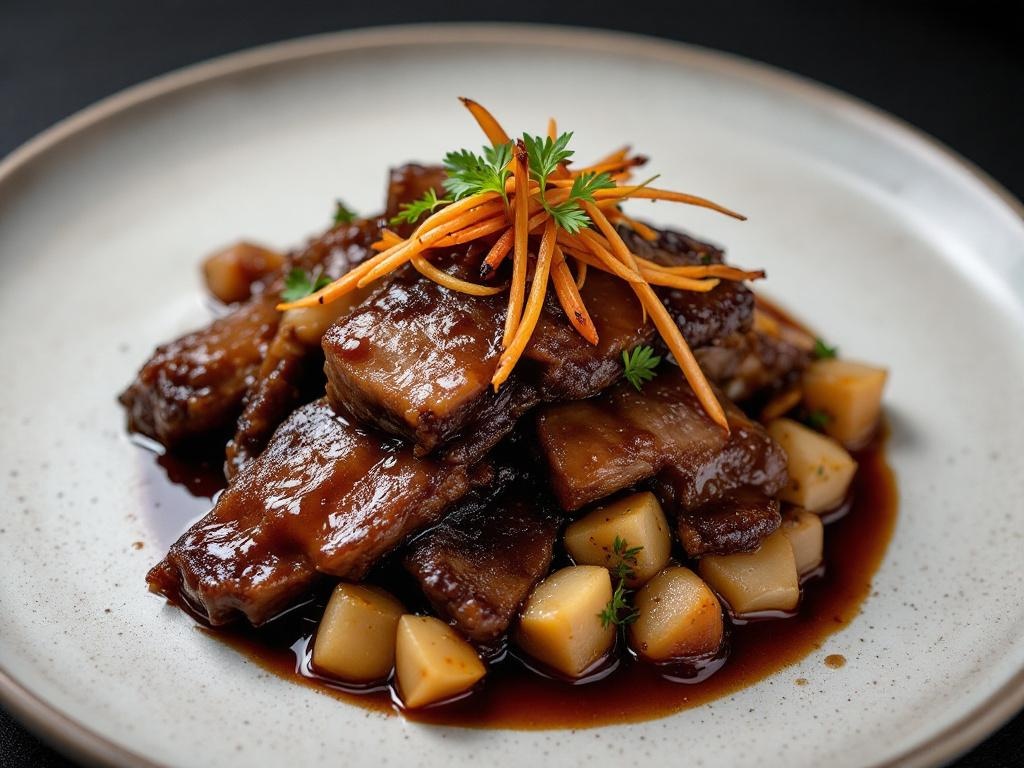
Galbi Jjim (Braised Short Ribs — Full Korean Method)
Korea; galbi jjim is a traditional royal court dish (gungjung yori) that became widely consumed; the braised preparation with soy and fruit is documented across the Joseon Dynasty period (1392–1897).
Galbi jjim — Korean braised short ribs — is one of the most celebrated feast dishes in Korean cooking, served at celebrations, Chuseok (harvest festival), and Seollal (Lunar New Year). The ribs are cut flanken-style (across the bone) or English-cut (between the bones) and braised in a soy-based sauce sweet with Asian pear and sesame, aromatic with garlic and ginger, and deepened with soy sauce and rice wine until the meat is completely yielding and the sauce has reduced to a glossy, lacquered glaze. The Asian pear serves a dual role: it tenderises the meat through its proteolytic enzymes (similar to papaya or pineapple) and contributes its characteristic sweet, slightly floral flavour. Galbi jjim is a preparation of patience — the ribs need at least 2 hours of low braising, and the dish improves dramatically overnight.
Score the meat deeply and soak in cold water for 1 hour to remove blood — this prevents the braise from turning murky and bitter Blanche the ribs in boiling water for 5 minutes and rinse — removes impurities and fat before braising Asian pear (or kiwi as a substitute) is grated and added to the marinade — the enzymes tenderise the meat; do not substitute apple (different enzymatic profile) Braise completely submerged at a low simmer with a tight lid for 2 hours minimum — the slow braise is essential for connective tissue transformation Daikon and carrot added in the last 30 minutes — they absorb the braise and provide texture contrast to the soft ribs Reduce the braising liquid to a glaze at the end — this concentration is what creates the signature glossy, sticky sauce
RECIPE: Serves: 4 | Prep: 25 min | Total: 180 min --- 1.2 kg beef short ribs (galbi), 4cm thick 6 dried shiitake mushrooms, stems removed 8 jujubes (dried Korean dates), halved 4 garlic cloves, minced 40 ml soy sauce (Korean, if possible) 30 ml mirin 15 ml rice vinegar 15 g fresh ginger, minced 5 g Tellicherry black pepper 5 sesame seeds, white 3 green onion stalks, cut into 5cm lengths 2 carrots, roll-cut into chunks 2 potatoes, cubed 240 ml beef stock or water --- 1. Pat beef ribs dry with paper towels; combine soy sauce, mirin, rice vinegar, garlic, ginger, and Tellicherry pepper in bowl to create marinade. 2. Marinate ribs for 30 minutes at room temperature, turning halfway through. 3. Soak dried shiitake in 120 ml warm water for 15 minutes; reserve soaking liquid and chop mushrooms. 4. Layer ribs in heavy-bottomed braising pot, scatter mushrooms and jujubes over and between ribs, add reserved mushroom liquid and beef stock. 5. Bring to boil over medium-high heat, then reduce to low, cover with lid and parchment, and braise for 90 minutes until ribs are tender. 6. Add carrots and potatoes, return to simmer, cover and continue braising for 25 minutes until vegetables are tender. 7. Uncover, increase heat to medium, and reduce braising liquid by half until glossy and concentrated (8 minutes), turning ribs occasionally. 8. Garnish with green onion and sesame seeds; serve in shallow bowls with braising liquid spooned over. The marinade (soy, Asian pear, garlic, ginger, sesame oil, sesame seeds, sugar) should be prepared and the ribs submerged overnight before braising — the flavour penetration significantly deepens the final dish For the most elegant presentation: strain the braising liquid, return it to the pan, and reduce separately before pouring over the plated ribs — this gives a cleaner, more refined result than reducing with the ribs in the pan Galbi jjim is one of the Korean dishes most transformed by overnight resting — make it the day before and reheat for maximum flavour
Skipping the soaking and blanching — the braise turns cloudy and the flavour is muddy Substituting regular pear or apple — the enzyme content is insufficient; Asian pear or kiwi specifically Braising at too high a temperature — boiling rather than simmering makes the meat stringy Adding the vegetables at the beginning — daikon and carrot over-soften during a 2-hour braise Not reducing the sauce — a thin braising liquid is not galbi jjim; the reduction creates the characteristic glossy, sticky sauce
Common Questions
What are common mistakes when making Galbi Jjim (Braised Short Ribs — Full Korean Method)?
Skipping the soaking and blanching — the braise turns cloudy and the flavour is muddy Substituting regular pear or apple — the enzyme content is insufficient; Asian pear or kiwi specifically Braising at too high a temperature — boiling rather than simmering makes the meat stringy Adding the vegetables at the beginning — daikon and carrot over-soften during a 2-hour braise Not reducing the sauce —