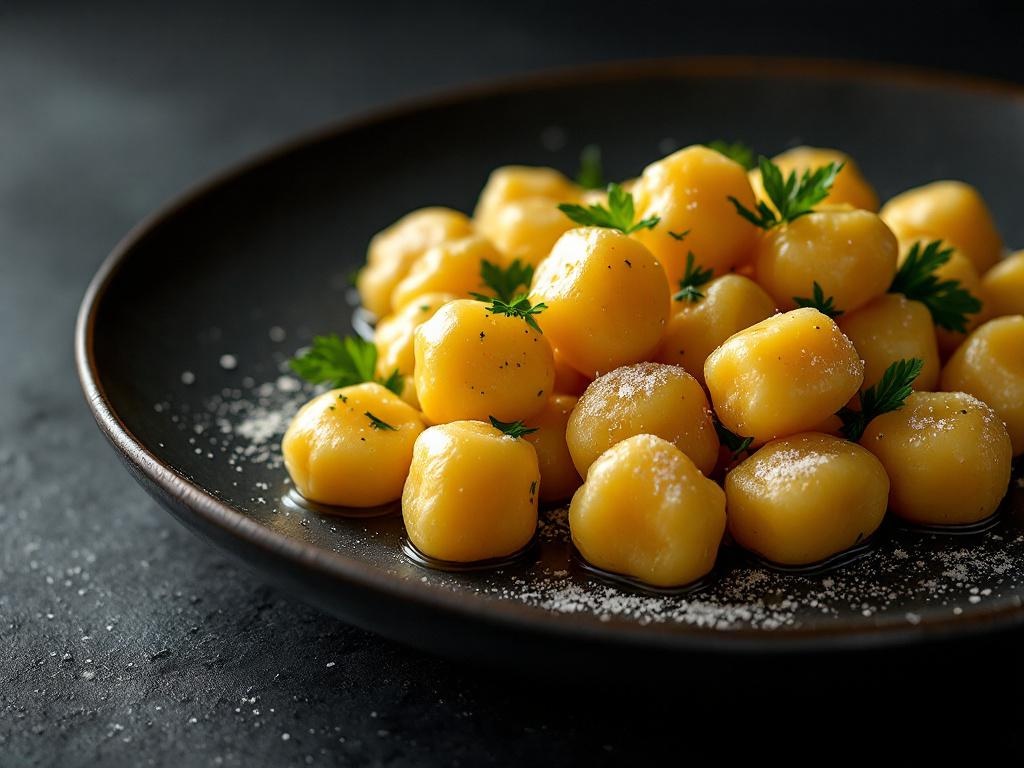
Gnocchi
Verona, Veneto, and northern Italy broadly. Gnocchi Veronese tradition includes the Baccala Gnocchi and the annual Venerdi Gnocolar (Gnocchi Friday) at Verona's carnival. Potato gnocchi as we know them date from the 18th century when potatoes arrived in Italy from the Americas.
Gnocchi are potato dumplings. The technique is not about flour — it is about removing as much moisture from the potato as possible before flour is added. The more moisture in the potato, the more flour is needed, and the more flour means tougher gnocchi. The ideal gnocchi dissolves at the push of a tongue against the palate — pillowy, barely there, dressed rather than sauced.
For gnocchi al pomodoro: Bardolino Chiaretto rosato from the shores of Lake Garda, near Verona. For gnocchi al gorgonzola: a Langhe Riesling from Piedmont, whose acidity cuts through the blue cheese. For gnocchi burro e salvia: a young Soave Classico.
{"Floury potato variety only: Maris Piper, Desiree, or Russet — waxy varieties (Charlotte, Jersey Royal) contain too much moisture and produce gummy gnocchi","Bake, do not boil: bake potatoes at 200C until completely tender, then halve and scoop — boiling absorbs water into the potato","Pass through a ricer or mouli while still hot, then spread on a clean surface to steam-dry for 5 minutes before adding flour","Minimal flour: start with 100g 00 flour per 500g riced potato — add more only if needed. The less flour, the lighter the gnocchi","Egg yolk only (not whole egg): one yolk per 500g potato adds richness and binding without the water content of egg white","Work the dough minimally: fold together until just combined — overworking develops gluten and produces elastic, tough gnocchi"}
RECIPE: Serves: 4 | Prep: 45 min | Total: 75 min --- 600 g Russet potatoes — floury variety 100 g "00" flour — Italian, Antimo Caputo or equivalent 50 g Parmigiano Reggiano DOP aged 24 months — finely grated 1 large egg yolk — room temperature 4 g sea salt 1 g white pepper — freshly ground 1 g nutmeg — freshly grated --- For serving: 80 g unsalted butter — European style, 86% butterfat 20 leaves fresh sage 40 g Parmigiano Reggiano DOP — aged 24 months, grated --- 1. Boil unpeeled potatoes in salted water until a knife passes through the center with no resistance (25 minutes); drain thoroughly. 2. While warm, peel potatoes using a clean kitchen towel and pass through a ricer or mouli mill onto a clean bench. 3. Create a well in the center of the riced potato; crack egg yolk into the well and sprinkle with sea salt, white pepper, nutmeg, and 50 g grated Parmigiano Reggiano. 4. Using a fork, gradually incorporate the egg and cheese into the potato, then sift 00 flour over the mixture and knead gently with your hands until a soft, non-sticky dough forms (2–3 minutes; do not overwork). 5. Divide dough into 4 equal portions; on a lightly floured bench, roll each portion into a rope 1.5 cm in diameter, then cut into 2 cm pieces. 6. Using the back of a fork, press each gnocco against the bench to create ridges on one side and a small indent on the other (optional but traditional). 7. Bring a large pot of salted water to a rolling boil; cook gnocchi in batches (do not overcrowd) until they rise to the surface, then continue simmering for 2 minutes; drain gently with a slotted spoon. 8. In a large skillet, heat butter over medium heat until foaming; add sage leaves and swirl until butter is golden and sage is crisp (3 minutes); add cooked gnocchi and toss gently to coat, finishing with grated Parmigiano Reggiano. The moment where gnocchi lives or dies is the test cook — always cook one gnocchi before cutting the rest. If it falls apart in the water, add a little more flour and retest. If it is dense and chewy, the potato was too wet or the dough was over-worked (accept the batch and adjust next time). The ideal test gnocchi rises to the surface after 90 seconds and holds its shape without puffing or collapsing. Dress in brown butter with sage, or with a simple tomato sauce — gnocchi is not the vehicle for a complex ragu.
{"Boiling the potatoes: they absorb water, requiring more flour, producing heavier gnocchi","Adding flour while the potato is cold: the flour does not incorporate evenly — the potato must be warm when flour is added","Over-kneading: the moment the dough comes together, stop. Every additional fold develops gluten"}
- German Schupfnudeln (rolled potato dumplings, same technique); Polish kopytka (potato dumplings with exactly the same moisture-removal technique); Chinese tang yuan (soft rice-flour dumplings with minimal flour — same logic of minimal binding agent for maximum delicacy).
Common Questions
Why does Gnocchi taste the way it does?
For gnocchi al pomodoro: Bardolino Chiaretto rosato from the shores of Lake Garda, near Verona. For gnocchi al gorgonzola: a Langhe Riesling from Piedmont, whose acidity cuts through the blue cheese. For gnocchi burro e salvia: a young Soave Classico.
What are common mistakes when making Gnocchi?
{"Boiling the potatoes: they absorb water, requiring more flour, producing heavier gnocchi","Adding flour while the potato is cold: the flour does not incorporate evenly — the potato must be warm when flour is added","Over-kneading: the moment the dough comes together, stop. Every additional fold develops gluten"}
What dishes are similar to Gnocchi?
German Schupfnudeln (rolled potato dumplings, same technique); Polish kopytka (potato dumplings with exactly the same moisture-removal technique); Chinese tang yuan (soft rice-flour dumplings with minimal flour — same logic of minimal binding agent for maximum delicacy).