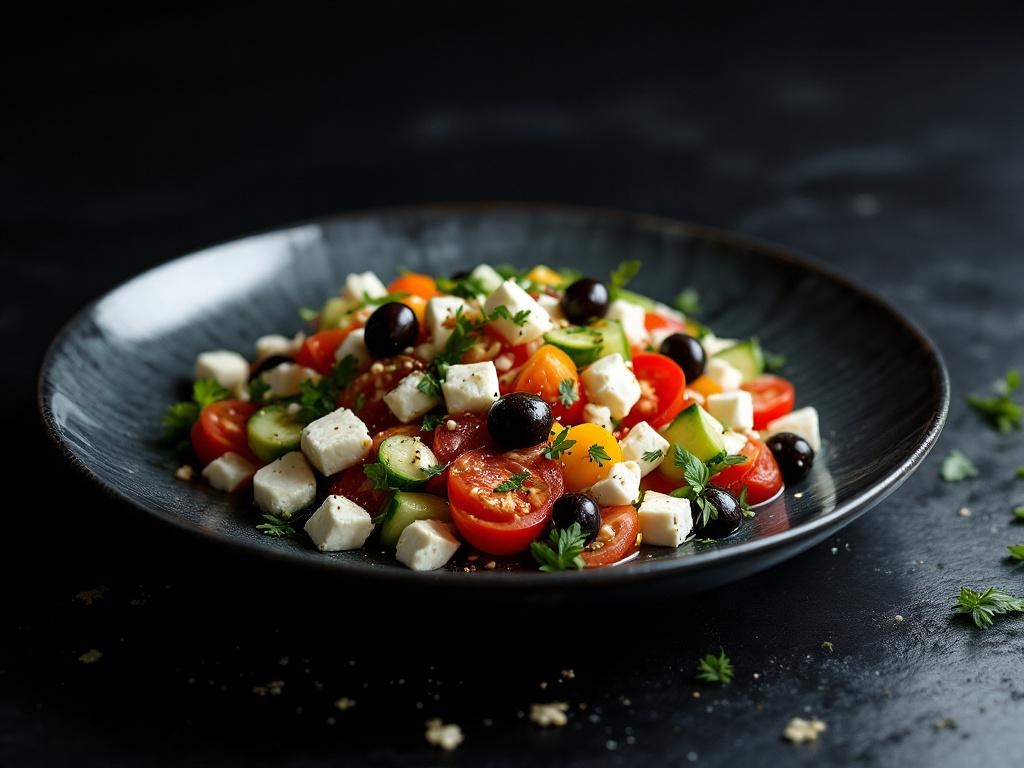
Greek Salad
Greece, rural tradition. The horiatiki (village salad) was the everyday salad of Greek peasant farmers — whatever was ripe in the garden, dressed with the house olive oil. The specific combination of tomato, cucumber, feta, and olives reflects the agricultural abundance of the Greek Aegean summer.
The authentic Greek salad (horiatiki — village salad) has no lettuce, no dressing beyond salt and olive oil, and no chopping of the tomatoes beyond quartering. It is tomato, cucumber, green pepper, Kalamata olives, and a slab (not crumbled) of Dodoni feta, finished with dried Greek oregano and olive oil. The version found outside Greece (with lettuce, crumbled feta, and bottled dressing) is a different, inferior object.
Ouzo (with water and ice) or a glass of chilled Assyrtiko from Santorini — the mineral, citrus character of Assyrtiko alongside the salty feta and ripe tomatoes is the canonical Greek island pairing.
{"Ripe summer tomatoes: the entire salad depends on tomato quality. Out-of-season tomatoes produce a flat salad. Quartered, not diced — the large pieces are characteristic","Cucumber: thickly sliced in half-moons, not paper-thin. The cucumber should have presence and crunch","Feta: a thick slab (not crumbled) of genuine Greek PDO feta — Dodoni or Epiros brands. The slab is placed on top of the vegetables, not mixed in","Kalamata olives: the black wrinkled olives of the Peloponnese — not generic black olives from a can","The finish: dried Greek oregano crumbled over the feta slab, then excellent Cretan or Peloponnesian olive oil drizzled generously. No vinegar, no lemon — just olive oil and salt","No lettuce: lettuce is not in a real Greek salad. Period"}
RECIPE: Serves: 4 | Prep: 15 min | Total: 15 min --- 400g ripe tomatoes, cut into 2cm chunks 200g English cucumber, peeled in stripes, cut into 2cm chunks 1 red onion, sliced thinly into half-moons 200g Feta DOP cheese, cut into 2cm cubes 60g Kalamata olives, pitted 15g dried oregano 90ml extra-virgin olive oil 30ml red wine vinegar 3g sea salt 1g black pepper --- 1. Arrange tomato chunks in large shallow bowl, scatter cucumber and red onion over top. 2. Distribute Feta cubes and Kalamata olives across salad. 3. Whisk together extra-virgin olive oil, red wine vinegar, sea salt, and black pepper in small bowl until emulsified. 4. Drizzle dressing evenly over salad, scatter dried oregano across top, toss gently with your hands (do not over-mix). 5. Taste and adjust salt/acid as needed; serve immediately at room temperature. The moment where Greek salad lives or dies is the tomato quality — taste a tomato before assembling. It must be sweet, acidic, and fragrant. If the tomato is bland, the entire salad will be bland. Wait for summer tomatoes; do not make this salad with winter tomatoes. A Greek farmer's market tomato in August is a different vegetable from a supermarket tomato in January.
{"Adding lettuce: definitively incorrect. The salad has no lettuce","Crumbling the feta: the slab is the presentation — crumbled feta loses its identity in the salad","Using bottled dressing or vinegar: the only dressing is olive oil and salt"}
- Turkish çoban salatasi (shepherd's salad — tomato and cucumber salad without feta — the Turkish cousin); Israeli salad (very finely diced tomato and cucumber, olive oil and lemon — the Israeli version); Caprese salad (tomato and mozzarella with olive oil — the Italian structural parallel).
Common Questions
Why does Greek Salad taste the way it does?
Ouzo (with water and ice) or a glass of chilled Assyrtiko from Santorini — the mineral, citrus character of Assyrtiko alongside the salty feta and ripe tomatoes is the canonical Greek island pairing.
What are common mistakes when making Greek Salad?
{"Adding lettuce: definitively incorrect. The salad has no lettuce","Crumbling the feta: the slab is the presentation — crumbled feta loses its identity in the salad","Using bottled dressing or vinegar: the only dressing is olive oil and salt"}
What dishes are similar to Greek Salad?
Turkish çoban salatasi (shepherd's salad — tomato and cucumber salad without feta — the Turkish cousin); Israeli salad (very finely diced tomato and cucumber, olive oil and lemon — the Israeli version); Caprese salad (tomato and mozzarella with olive oil — the Italian structural parallel).