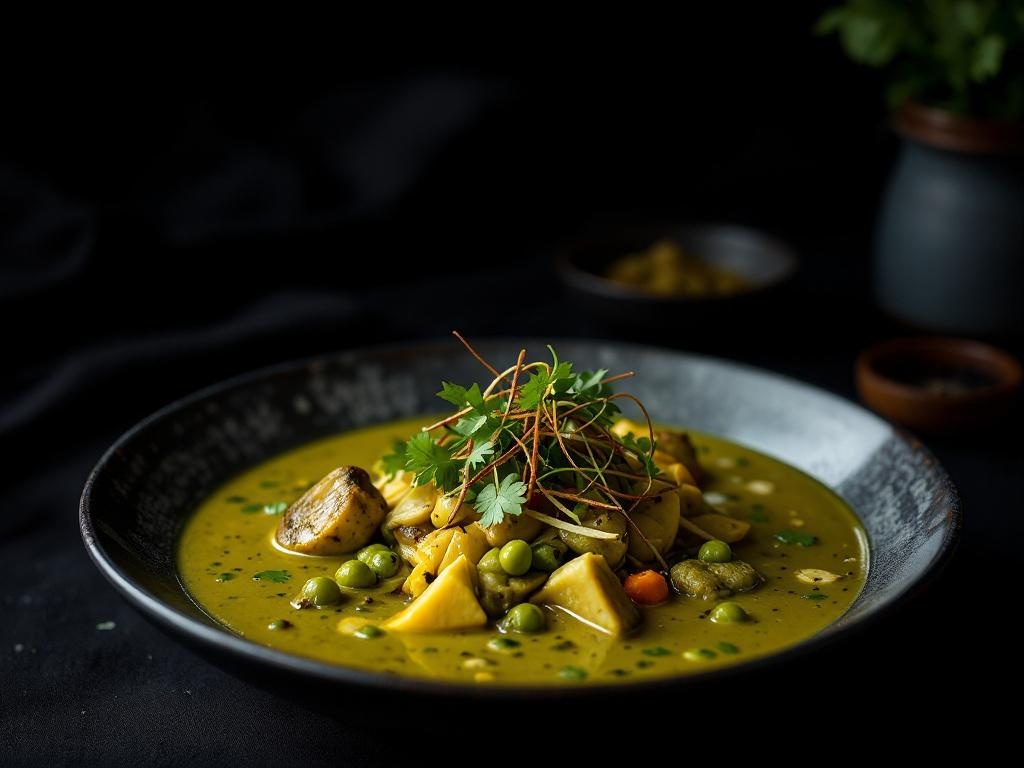
Green Curry
Central Thailand. Green curry (kaeng khiao wan — kaeng means curry, khiao means green, wan means sweet) is a central Thai preparation. The specific combination of fresh green herbs and chilies distinguishes it from the dried chili-based red curry of southern Thailand.
Thai green curry (kaeng khiao wan) gets its colour from fresh green chillies, lemongrass, galangal, and fresh green herbs pounded into a paste. The curry is not mild — it is the hottest of the Thai curries when made correctly. The coconut milk is added in two stages: a small amount is fried with the paste first (the bloom), then the rest is added. This initial frying develops the paste's flavour before the diluting coconut milk arrives.
Riesling Spatlese from the Mosel — the off-dry sweetness and high acidity of Mosel Riesling is one of the best wine pairings for Thai green curry. The residual sugar buffers the chilli heat; the acidity cuts through the coconut cream. Or a cold Chang lager for the informal version.
{"Green curry paste: fresh long green chillies, bird's eye chillies, lemongrass (white part only), galangal, kaffir lime zest, coriander root, shallots, garlic, shrimp paste (gapi), white pepper, and cumin seeds — pounded in a granite mortar in order from hardest to softest until a fine paste. Mae Ploy brand is the acceptable commercial substitute","Coconut cream (not light coconut milk): the first addition is 200ml coconut cream fried in a dry wok over medium heat until the oil separates (kra-than) — this takes 5-7 minutes and is when the paste is added and fried in the coconut oil","Paste bloom: fry the paste in the separated coconut oil for 3-4 minutes until fragrant and the paste has lost its raw smell — this is the most important flavour-development step","Fish sauce and palm sugar balance: the Thai cook's constant adjustment — add fish sauce for salt and umami, palm sugar for sweetness, a squeeze of lime for acid","Thai eggplant (pea eggplant or Thai round eggplant): added in the final 5 minutes — they require very little cooking","Kaffir lime leaves, shredded fine, added at service (not during cooking)"}
RECIPE: Serves: 4 | Prep: 15 min | Total: 30 min --- 400 ml coconut milk — full-fat 3 tablespoons green curry paste — store-bought or house-made 300 g boneless chicken thighs — cut 2 cm cubes 100 g Thai eggplant — halved 75 g long beans — cut 3 cm lengths 3 kaffir lime leaves — torn 15 ml fish sauce — nam pla 10 ml palm sugar 2 tablespoons vegetable oil 2–3 Thai bird's eye chilies — whole, for heat 10 g Thai basil — whole leaves Salt — to taste --- 1. Heat oil in wok over medium-high heat; add green curry paste and toast 2 minutes, stirring, until fragrant and darkened. 2. Pour in 100 ml coconut milk; stir to form smooth paste, simmering 1 minute. 3. Add chicken cubes; stir constantly 3 minutes until coated and beginning to firm. 4. Pour in remaining 300 ml coconut milk; add Thai eggplant, long beans, kaffir lime leaves, and whole chilies; bring to gentle simmer. 5. Reduce heat to low; simmer uncovered 12 minutes until chicken is cooked through and vegetables are tender. 6. Stir in fish sauce and palm sugar; adjust seasoning with salt. 7. Remove from heat; fold in Thai basil leaves. 8. Transfer to serving bowl; remove whole chilies if less heat desired; serve with steamed jasmine rice. The moment where green curry lives or dies is the paste bloom. When the paste hits the separated coconut oil, it sizzles loudly and begins to release its volatile aromatic compounds — you will smell the galangal, the lemongrass, the shrimp paste, in sequence. This aromatic bloom tells you the paste is cooking correctly. Stir continuously and reduce the heat if the paste begins to brown rather than fry — browning changes the flavour from fresh and bright to cooked and muted.
{"Skipping the coconut cream separation step: the paste fried in the coconut oil (rather than water-based coconut milk) produces a much more complex, less watery curry","Not frying the paste long enough: under-cooked paste tastes raw and harsh","Over-thickening with too much coconut milk: authentic Thai green curry should be fluid, not stew-like"}
- Indian saag paneer (green herb-based curry — a spiritual parallel in a different tradition); Malaysian laksa (coconut milk-based curry broth with a similar paste technology); Peruvian aji de gallina (chicken in aji amarillo sauce — similar paste-fry-then-liquid curry construction).
Common Questions
Why does Green Curry taste the way it does?
Riesling Spatlese from the Mosel — the off-dry sweetness and high acidity of Mosel Riesling is one of the best wine pairings for Thai green curry. The residual sugar buffers the chilli heat; the acidity cuts through the coconut cream. Or a cold Chang lager for the informal version.
What are common mistakes when making Green Curry?
{"Skipping the coconut cream separation step: the paste fried in the coconut oil (rather than water-based coconut milk) produces a much more complex, less watery curry","Not frying the paste long enough: under-cooked paste tastes raw and harsh","Over-thickening with too much coconut milk: authentic Thai green curry should be fluid, not stew-like"}
What dishes are similar to Green Curry?
Indian saag paneer (green herb-based curry — a spiritual parallel in a different tradition); Malaysian laksa (coconut milk-based curry broth with a similar paste technology); Peruvian aji de gallina (chicken in aji amarillo sauce — similar paste-fry-then-liquid curry construction).