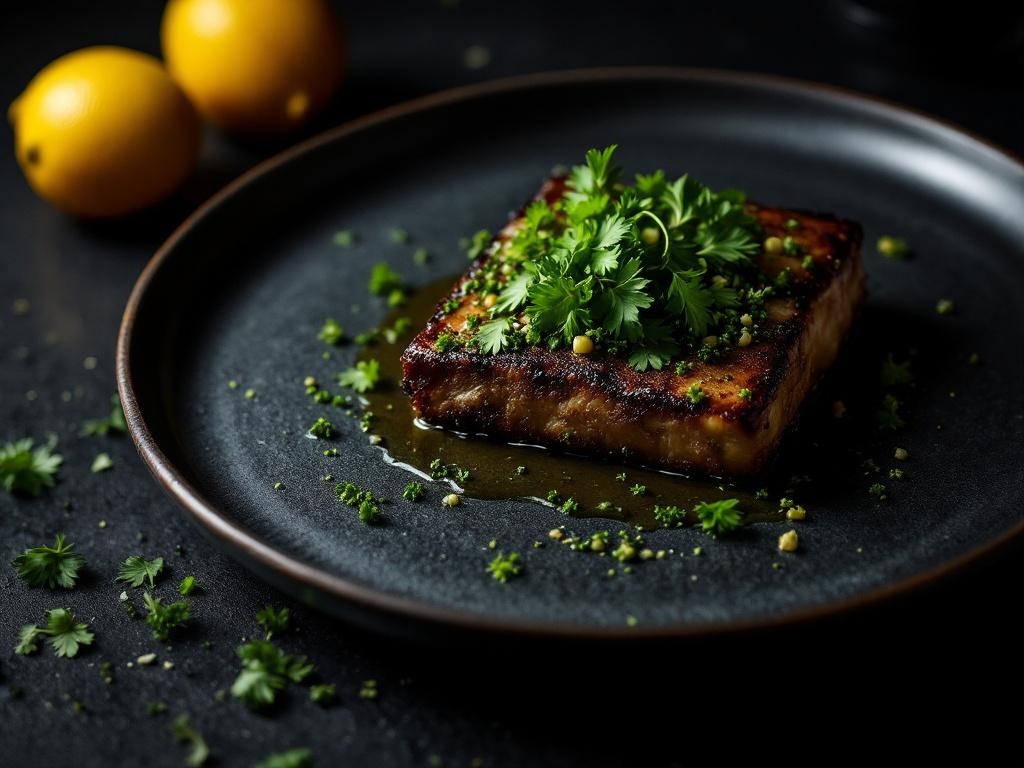
Gremolata
Milan, Lombardy, Italy — the traditional garnish for Ossobuco alla Milanese
Gremolata is Milan's essential finishing condiment — a raw mixture of finely chopped lemon zest, garlic, and flat-leaf parsley that is scattered over Ossobuco alla Milanese at the moment of serving. It is never cooked, never made in advance, and never served alongside — it goes directly onto the dish and is eaten as part of each bite. The genius of gremolata is its function: after the long, slow braise of veal shin in wine and stock, the dish is rich, soft, and deep. Gremolata provides the exact opposite — bright citrus acidity from the lemon zest, raw pungency from the garlic, clean herbal freshness from the parsley. The combination lifts the entire dish without disrupting its coherence. The technique is entirely in the chopping: all three ingredients must be very finely minced, almost to the point where they blend at their edges. A rough chop produces uneven bites — a pocket of raw garlic here, a piece of parsley there. Properly made gremolata should be fine enough to scatter like a seasoning, not spoon like a relish. Gremolata has migrated beyond ossobuco in modern kitchens — it works brilliantly on braised lamb shanks, grilled fish, roasted beets, and bean soups. But its function is always the same: to provide acid, pungency, and freshness as a counter to richness or long cooking. Outside of its Milanese context, gremolata with anchovy stirred in (a modern adaptation) works particularly well on grilled meats.
Bright, pungent, citrus-fresh — the finishing note that lifts rich braises
Chop all three ingredients to the same fine size — the mixture should be homogeneous Make gremolata at the last possible moment — lemon zest oxidises, garlic becomes bitter, parsley wilts Use only the outer yellow part of the lemon peel — the white pith is bitter No oil — gremolata is a dry scatter, not a sauce or dressing Add directly to the plated dish, not mixed into the sauce
RECIPE: Yield: 150 ml | Prep: 8 min | Total: 8 min --- 60 g Italian flat-leaf parsley, finely chopped 30 g lemon zest, finely minced (approximately 2 lemons) 15 g garlic, minced 45 ml extra virgin olive oil 2 g fine sea salt 1 g black pepper, freshly ground --- 1. Combine finely chopped parsley, lemon zest, and minced garlic in a small bowl. 2. Drizzle with extra virgin olive oil and mix gently to combine. 3. Season with fine sea salt and freshly ground black pepper. 4. Use immediately as a finishing garnish for braised meats, risotto, or seafood; do not store more than 2 hours to preserve brightness. A microplane zester produces finer lemon zest than a box grater — the result is lighter and more evenly distributed For a less aggressive garlic note, blanch the garlic briefly in boiling water then shock in cold water before chopping Orange zest can replace or complement lemon zest for a sweeter, more perfumed gremolata Anchovy finely minced into the gremolata adds umami depth that works especially well with braised lamb A pinch of flaky salt scattered with the gremolata adds textural contrast
Making gremolata in advance — it loses brightness and the garlic becomes harsh within minutes Chopping too coarsely — uneven pieces produce uneven bites Using the pith — white pith dramatically increases bitterness Adding oil — it changes the texture and makes it closer to a salsa verde Using curly parsley instead of flat-leaf — curly parsley has less flavour and a worse texture
Common Questions
Why does Gremolata taste the way it does?
Bright, pungent, citrus-fresh — the finishing note that lifts rich braises
What are common mistakes when making Gremolata?
Making gremolata in advance — it loses brightness and the garlic becomes harsh within minutes Chopping too coarsely — uneven pieces produce uneven bites Using the pith — white pith dramatically increases bitterness Adding oil — it changes the texture and makes it closer to a salsa verde Using curly parsley instead of flat-leaf — curly parsley has less flavour and a worse texture