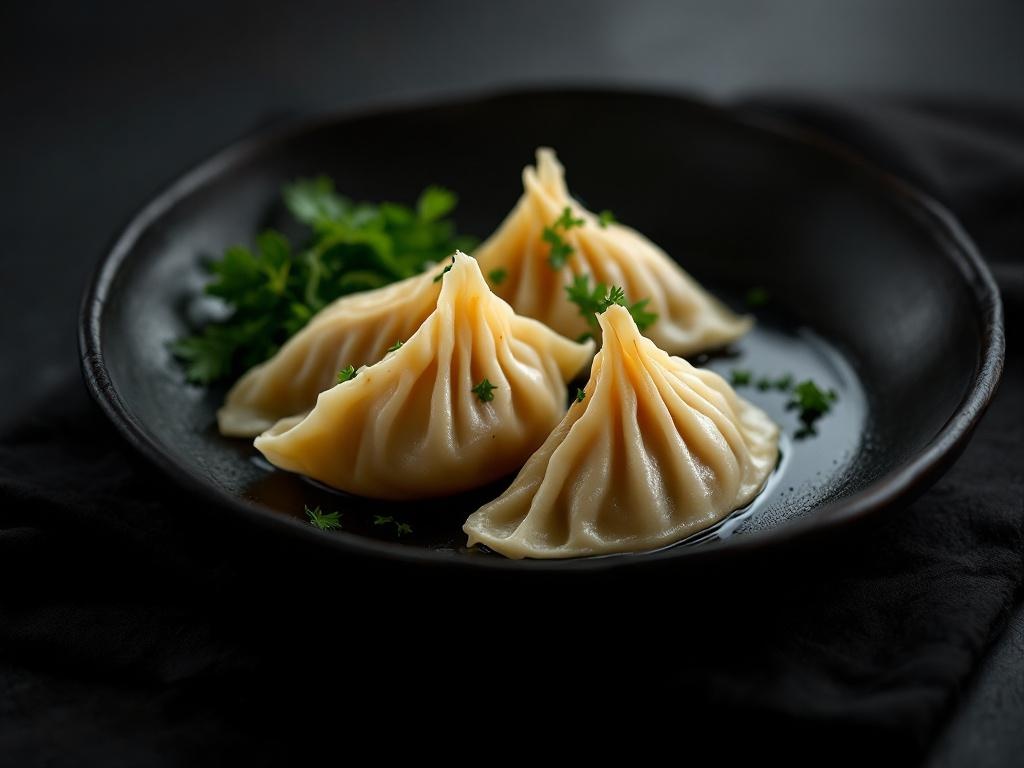
Gyoza
Japan, adapted from Chinese jiaozi via Manchuria. The Chinese jiaozi was introduced to Japan by returning soldiers after World War II and adapted into the Japanese form — thinner wrappers, more garlic, sesame oil in the filling, and the distinctive pan-fry/steam hybrid technique that became the Japanese standard.
Japanese gyoza: thin-skinned, pleat-folded dumplings filled with pork, nappa cabbage, garlic chive, and sesame oil. Pan-fried in a technique unique to Japanese cooking — yaki-mushi (steam-fry) — where the gyoza is first seared on the flat base until crisp, then steam-finished with water added to the pan and a lid placed on, then finished with the lid off to evaporate the water and re-crisp the base. The result is a gyoza with a glass-crisp bottom and tender, steamed top.
Cold Kirin Ichiban lager — the clean, slightly bitter Japanese lager cuts through the pork fat and sesame of the gyoza. Or a chilled choko of Ozeki One Cup junmai sake, the informal companion of gyoza at an izakaya.
{"Filling preparation: finely chopped nappa cabbage mixed with 1 teaspoon salt, rested 10 minutes, then squeezed thoroughly in a cloth — extracting the moisture is critical. Wet filling makes wet gyoza","Filling composition: 200g ground pork (30% fat), the dried cabbage, 3 tablespoons finely chopped garlic chive (nira), 1 teaspoon minced fresh ginger, 1 tablespoon soy sauce, 1 tablespoon sesame oil, white pepper","Gyoza wrappers: thinner than Chinese dumpling wrappers (1.5mm), made from hot water dough (boiling water softens the starch, producing a more pliable, thinner wrapper)","The pleat: hold the wrapper with filling in one palm, seal the top edge first, then use the thumb and index finger of the other hand to fold 5-6 pleats along the front edge toward the centre — the pleats create a structural arch that protects the base from the initial sear","The yaki-mushi technique: 1 tablespoon oil in a flat-bottomed pan over medium-high heat. Add gyoza flat-side down. Sear 2-3 minutes until the base is deeply golden. Add 60ml water and immediately cover. Steam 3 minutes. Remove lid and allow water to evaporate. Finish over high heat for 1 minute to re-crisp","Dipping sauce: rice vinegar, soy sauce, and la-yu (Japanese chilli oil) — the acid from the vinegar cuts the pork fat"}
RECIPE: Serves: 4 (16 pieces) | Prep: 50 min | Total: 70 min --- Dough: 200g bread flour — Japanese or all-purpose 120ml water — boiling 50g cornstarch Filling: 200g ground pork — 20% fat 100g napa cabbage — finely minced 50g shiitake mushrooms — finely minced 30g scallions — minced 15g fresh ginger — grated 10g garlic — minced 15ml soy sauce — Kikkoman shoyu 10ml sesame oil — toasted 5g salt — fine sea salt Dipping Sauce: 60ml soy sauce — Kikkoman shoyu 30ml rice vinegar — naturally brewed 10ml sesame oil — toasted 5g garlic — minced 2ml chili oil — or to taste Oil for pan-frying: 30ml neutral oil — vegetable or peanut 100ml water — for steaming --- 1. Pour boiling water slowly into bread flour while stirring with chopsticks until shaggy mass forms; dust with cornstarch and knead by hand for 5 minutes until smooth and slightly elastic dough forms. Wrap and rest 20 minutes. 2. Combine ground pork, minced napa cabbage, shiitake, scallions, grated ginger, minced garlic, soy sauce, toasted sesame oil and salt in bowl; mix gently with chopsticks until filling is evenly combined but not overworked. 3. Divide dough into 16 equal pieces; roll each into ball, then flatten into 8cm rounds using slight rocking motion with the heel of hand. 4. Place 12g filling in center of each wrapper; fold dough in half to form crescent, then bring the two ends toward center and pinch to seal into purse shape or traditional gyoza half-moon pleated shape. 5. Whisk together soy sauce, rice vinegar, toasted sesame oil, minced garlic and chili oil in small bowl for dipping sauce; divide into serving dishes. 6. Heat neutral oil in non-stick skillet over medium-high heat until shimmering; arrange gyoza flat-side down in single layer (work in batches if needed). Sear for 2 minutes without moving until bottoms are golden brown and crispy. 7. Add 100ml water to skillet, immediately cover with lid and reduce heat to medium; steam for 5 minutes until water is absorbed and dough is tender. Remove lid, cook uncovered for 30 seconds more, transfer to warmed platter and serve immediately with dipping sauce on the side. The moment where gyoza lives or dies is the pleat seal — the pleats must be pressed firmly enough that they do not open during steaming, but not so firmly that the wrapper tears. Test the seal by holding the gyoza between two fingers with the pleated side up and gently squeezing — a properly sealed gyoza should hold its shape without the filling pushing through the pleats.
{"Wet filling: the most common problem. Squeeze the cabbage thoroughly or the filling steams inside the wrapper","Not searing before steaming: the base must be golden and set before the water is added or the gyoza steams only and lacks the contrasting crunch","Lifting the lid during steaming: lets the steam escape and the wrapper cooks unevenly"}
Common Questions
Why does Gyoza taste the way it does?
Cold Kirin Ichiban lager — the clean, slightly bitter Japanese lager cuts through the pork fat and sesame of the gyoza. Or a chilled choko of Ozeki One Cup junmai sake, the informal companion of gyoza at an izakaya.
What are common mistakes when making Gyoza?
{"Wet filling: the most common problem. Squeeze the cabbage thoroughly or the filling steams inside the wrapper","Not searing before steaming: the base must be golden and set before the water is added or the gyoza steams only and lacks the contrasting crunch","Lifting the lid during steaming: lets the steam escape and the wrapper cooks unevenly"}
What dishes are similar to Gyoza?
Chinese jiaozi (the direct ancestor — thicker wrapper, less garlic, boiled or pan-fried); Korean mandu (dumpling — similar to both jiaozi and gyoza, with a slightly different filling profile including tofu); Nepalese momo (pan-fried dumplings with a similar steam-finish technique).