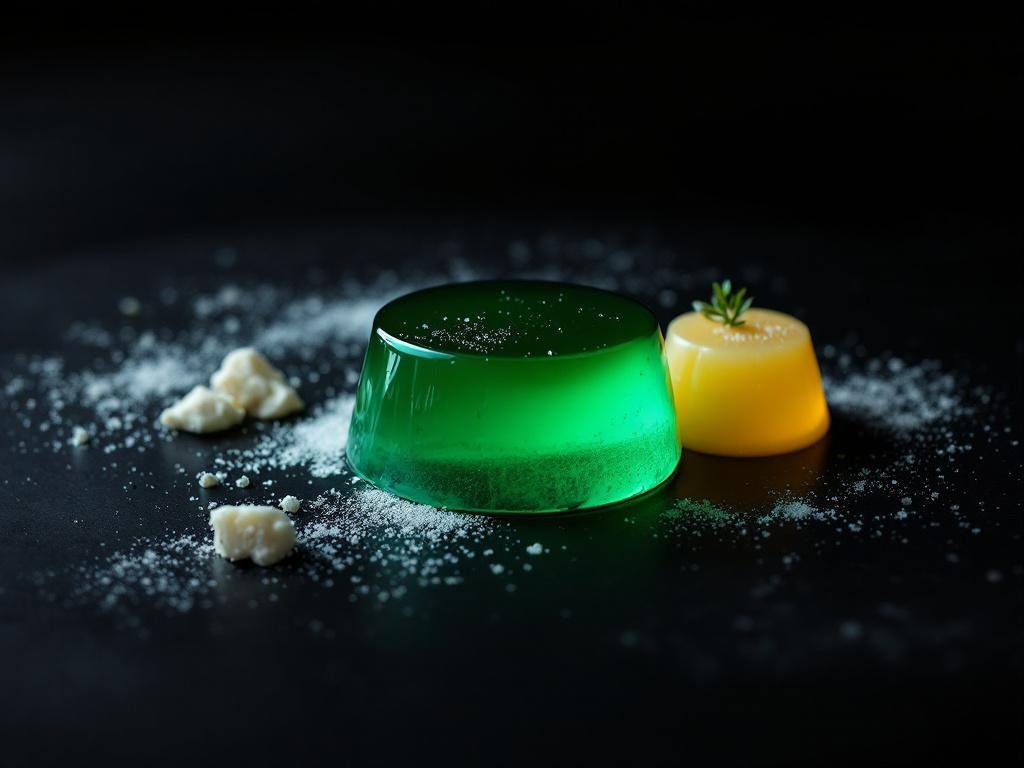
Hydrocolloids — Gelatin vs Agar Setting Ratios
Gelatin use recorded in European cookery since the 17th century; agar identified and used in Japanese cooking (kanten) since the 17th century, industrialised in the 19th century
Hydrocolloids are water-soluble polymers that form gels or increase viscosity when dispersed in aqueous solutions. Gelatin and agar are the two most widely used in professional kitchens, but their behaviours differ fundamentally in ways that determine which is appropriate for each application. Gelatin is a protein derived from the collagen of animal bones and connective tissue. It forms a thermoreversible gel that melts at approximately 25–35°C — body temperature — which is the source of its characteristic melt-in-the-mouth sensation. Gelatin concentration governs texture: 0.5–1% produces a barely-set, trembling consistency; 1.5–2% yields a soft, sliceable set; 3%+ creates a firm, bouncy gel. Bloom strength (measured in grams of force required to puncture the gel) ranges from 50 to 300 — higher bloom gelatin requires less quantity for the same set. Gelatin must be bloomed in cold water (5–10x its weight) before melting into the warm base; boiling destroys its gelling capacity. Acidic ingredients and enzymes from fresh pineapple (bromelain), papaya (papain), and kiwi (actinidin) break down gelatin's protein structure and prevent setting. Agar is a polysaccharide derived from red algae, making it suitable for vegetarian and vegan applications. It sets at a far higher temperature — 32–40°C — and melts at 80–85°C, making agar gels stable at room temperature and even warm serving conditions. Standard ratios: 0.2–0.5% for soft gel, 0.8–1% for firm gel, 1.5%+ for rigid sheets. Agar gels are brittle rather than elastic, and can be blended after setting to create fluid, pourable gels (fluid gels) — a versatile modernist texture unavailable with gelatin. Key differences: gelatin is melt-in-mouth and elastic; agar is heat-stable and brittle. Neither can be substituted directly — ratios, temperatures, and final textures differ entirely.
Gelatin-set preparations carry flavour with silky melt; agar-set preparations deliver clean, sharp flavour release on the palate
Gelatin sets 0.5–3%+ depending on desired firmness; bloom strength inversely affects required quantity Agar sets 0.2–1.5% depending on desired firmness; always boil to fully dissolve before cooling Gelatin melts near body temperature — use for melt-in-mouth applications; agar holds at warm service temperatures Agar gels can be blended after setting to produce smooth fluid gels — a technique impossible with gelatin Fresh pineapple, papaya, and kiwi contain proteases that destroy gelatin — always use cooked or canned versions Blooming gelatin in cold water before use ensures even hydration and prevents lumping when added to warm liquids
RECIPE: Hydrocolloids — Gelatin vs Agar Setting Ratios Yield: Reference batch | Prep: 20 min | Total: 4 hours + setting --- GELATIN METHOD: 500 ml liquid base (stock, juice, or flavoured liquid) 5 g bronze-grade gelatin sheets (or 3 g powdered gelatin) AGAR METHOD: 500 ml liquid base (stock, juice, or flavoured liquid) 2.5 g agar-agar powder --- GELATIN PROCESS: 1. Chill liquid base to 4°C; bloom gelatin sheets in 100 ml ice-cold water for 5 minutes until fully softened. 2. Warm 400 ml of the liquid base to 40°C (not above 60°C); squeeze excess water from gelatin and whisk into warm liquid until fully dissolved. 3. Combine with remaining 100 ml chilled base; pour into a shallow pan and refrigerate 4 hours until fully set. 4. Gelatin sets at 10–15°C, melts at mouth temperature, and can be melted and reset 2–3 times before breakdown occurs. AGAR PROCESS: 1. Combine agar powder with 100 ml cold liquid base and whisk; allow to hydrate 2 minutes. 2. Pour remaining 400 ml liquid base into a saucepan; bring to a full boil, then whisk in agar mixture. 3. Maintain a rolling boil for 1 minute, stirring constantly; pour into a shallow pan and cool to room temperature (sets within 30–45 minutes at ambient temperature). 4. Agar sets irreversibly at room temperature, withstands temperatures up to 85°C, and cannot be reset. RECIPE (Technique Showcase): Yield: 3 × 250ml samples | Prep: 15 min | Total: 90 min --- For Gelatin Sample (500ml): 250ml cold vegetable stock 3g powdered gelatin (125 Bloom, food grade) For Agar Sample (500ml): 250ml cold vegetable stock 1.2g agar agar powder (premium culinary grade) For Comparison Base: 250ml cold vegetable stock (control, unflavored) --- 1. Gelatin method: Sprinkle powdered gelatin over 60ml cold stock and let bloom 5 minutes until fully hydrated; heat remaining 190ml stock to 60°C (not boiling), remove from heat, stir in bloomed gelatin until completely dissolved (1 minute), pour into a shallow pan, cool to room temperature 20 minutes, then refrigerate 60 minutes until set to a soft, quivering gel. 2. Agar method: Combine agar powder with cold stock, whisking until fully suspended; bring to a boil over medium heat, stirring occasionally, and maintain a gentle boil for 2 minutes to fully activate agar; pour into a shallow pan, cool to room temperature 15 minutes, then refrigerate 30 minutes until set to a firm, sliceable gel. 3. Observe and compare gelatin set (melts at body temperature, more delicate texture, slow setting) versus agar set (stable at room temperature and above 40°C, firmer mouthfeel, rapid setting); gelatin preferred for delicate terrines and aspic; agar essential for vegetarian applications and thermostable preparations requiring durability. For fluid gels with agar, set the gel fully in a thin layer, cube it, then blend with a small amount of liquid to a smooth, pourable consistency Add 0.5% locust bean gum alongside agar to produce an elastic, less brittle texture closer to gelatin In precise work, always weigh gelatin rather than counting leaves — leaf weight varies significantly between brands Test set strength by placing a small spoonful in the freezer for 2 minutes to predict final texture For crystal-clear gelatin-set consommés, strain through wet muslin and keep the gel barely warm until setting
Boiling a gelatin-based mixture, which destroys its gelling proteins and prevents setting Substituting agar for gelatin at equal ratios — agar is approximately twice as powerful and produces a very different texture Adding gelatin or agar to cold liquid without proper dissolution, producing grainy or incompletely set gels Ignoring bloom strength differences between leaf and powder gelatin — 1 leaf gelatin ≈ 2–2.5g powder at 200 bloom Using agar in an application requiring melt-in-mouth texture — agar remains firm well above body temperature
Common Questions
Why does Hydrocolloids — Gelatin vs Agar Setting Ratios taste the way it does?
Gelatin-set preparations carry flavour with silky melt; agar-set preparations deliver clean, sharp flavour release on the palate
What are common mistakes when making Hydrocolloids — Gelatin vs Agar Setting Ratios?
Boiling a gelatin-based mixture, which destroys its gelling proteins and prevents setting Substituting agar for gelatin at equal ratios — agar is approximately twice as powerful and produces a very different texture Adding gelatin or agar to cold liquid without proper dissolution, producing grainy or incompletely set gels Ignoring bloom strength differences between leaf and powder gelatin — 1 leaf