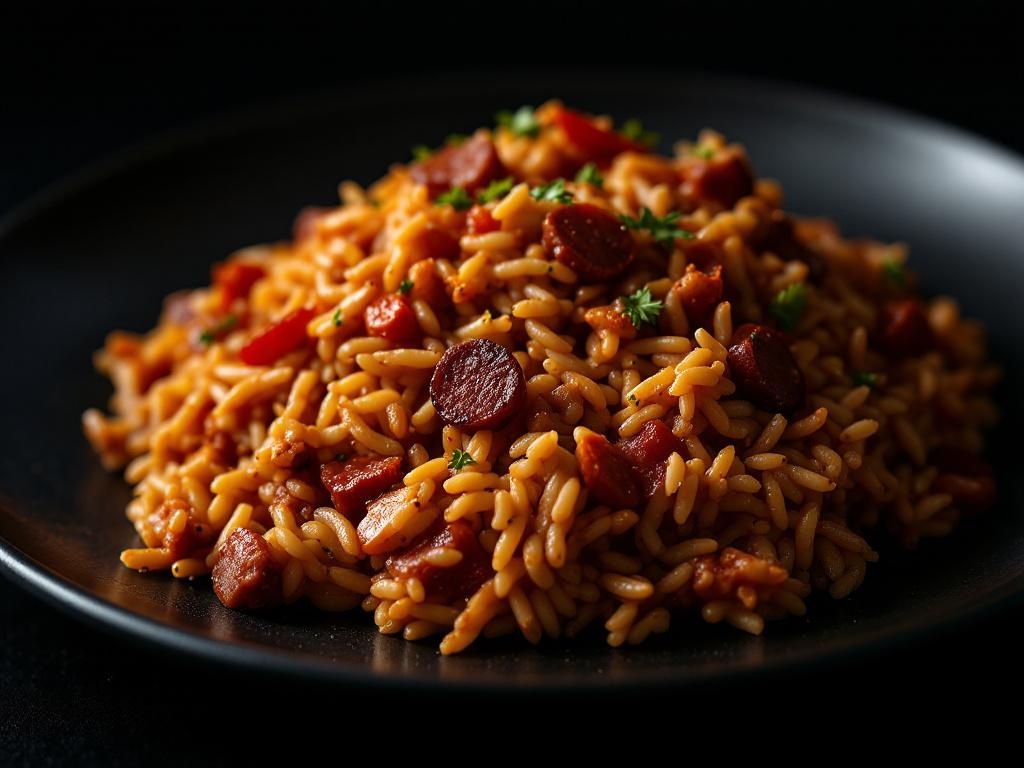
Jambalaya
Louisiana, United States. Jambalaya reflects Louisiana's Spanish and French colonial heritage — it is a direct descendant of Spanish paella (the same rice-in-seasoned-stock technique) adapted with local ingredients. The name may derive from the Spanish jamón (ham) or the Provençal jambalaia. Both Creole (urban New Orleans) and Cajun (rural Acadiana) traditions are authentic.
Jambalaya is Louisiana's great rice dish — a one-pot preparation of long-grain rice cooked in a stock with the holy trinity (celery, bell pepper, onion), andouille sausage, chicken, and shrimp. Creole jambalaya (the 'red' version) includes tomato; Cajun jambalaya (the 'brown' version) does not. The rice must be cooked in the seasoned stock until each grain is separate, tender, and has absorbed the complex flavour of the rendered sausage and spices. It is the Louisiana equivalent of Spanish paella — the same architecture.
Abita Amber lager — the local Louisiana craft beer alongside a bowl of jambalaya. Or a bottle of Tabasco at the table — the Louisiana hot sauce is always present for individual heat adjustment.
{"Andouille sausage: sliced and rendered in a heavy pot first — the fat from the andouille is the cooking medium for everything that follows. The fond from browning the sausage is the foundational flavour","The holy trinity: onion, celery, and green bell pepper added to the rendered sausage fat, cooked until soft","Long-grain white rice: the specific grain structure holds up during the long cook in stock. Do not use medium or short-grain — they turn to mush","The stock: chicken stock seasoned with cayenne, Creole seasoning (Tony Chachere's), thyme, and bay. Liquid-to-rice ratio is critical: 2:1","The cook: bring to a boil, add rice, stir once, cover and cook on low heat for 20 minutes. Do not open the lid — the steam cooks the rice","Shrimp last: added in the final 5 minutes with the lid removed. The shrimp should be just pink and curled — they are fully cooked in 3-4 minutes"}
RECIPE: Serves: 4 | Prep: 20 min | Total: 50 min --- 200g andouille sausage, sliced 1cm thick 200g chicken thigh, cut into 2cm cubes 200g shrimp (16/20 count), peeled and deveined 90g celery, diced 1cm 90g yellow onion, diced 1cm 90g bell pepper (mixed red and green), diced 1cm 150g long-grain white rice 200ml chicken stock 200ml crushed San Marzano DOP tomatoes 30ml Creole tomato paste 5g fresh thyme leaves 3g Maldon sea salt 2g Cayenne pepper 1g filé powder (optional, finishing) 30ml neutral oil --- 1. Heat oil in a large, heavy-bottomed pot over medium-high heat; render andouille 4 minutes until fat releases, then add chicken and sear 5 minutes until opaque at edges. 2. Add onion, celery, and bell pepper; cook 4 minutes, stirring occasionally, until softened and aromatics release. 3. Stir in tomato paste and thyme, cook 2 minutes; add rice and toast 2 minutes, stirring constantly. 4. Deglaze with stock and tomatoes, scraping the bottom; bring to a boil, then reduce heat to low, cover, and simmer 15 minutes. 5. Fold in shrimp, season with salt and Cayenne; cover and cook 5 minutes until rice is tender and shrimp are opaque. 6. Remove from heat, rest 3 minutes; finish with a pinch of filé powder and serve in shallow bowls. The moment where jambalaya lives or dies is the rice-to-liquid ratio — if the ratio is off, the rice will either be undercooked with excess liquid or dry and scorched at the base. Before adding the rice, taste the stock. It should be aggressively seasoned — more than seems comfortable — because the raw rice will absorb a significant amount of the salt and spice as it cooks. Underseasoned stock at the beginning produces flat jambalaya.
{"Stirring the rice after the initial mix: agitation releases starch and makes the rice gluey — the one-stir rule is absolute","Overcooking the shrimp: they continue cooking from residual heat after the heat is off — add them last and serve promptly","Wrong rice variety: medium-grain rice becomes creamy and starchy — long-grain is essential for the separate-grain texture"}
- Spanish paella (the ancestor — rice cooked in seasoned stock with protein — same one-pot architecture); West African jollof rice (seasoned rice with tomato and protein — the West African structural parallel); Indian biryani (layered spiced rice with protein — the South Asian version of rice cooked with seasoned stock).
Common Questions
Why does Jambalaya taste the way it does?
Abita Amber lager — the local Louisiana craft beer alongside a bowl of jambalaya. Or a bottle of Tabasco at the table — the Louisiana hot sauce is always present for individual heat adjustment.
What are common mistakes when making Jambalaya?
{"Stirring the rice after the initial mix: agitation releases starch and makes the rice gluey — the one-stir rule is absolute","Overcooking the shrimp: they continue cooking from residual heat after the heat is off — add them last and serve promptly","Wrong rice variety: medium-grain rice becomes creamy and starchy — long-grain is essential for the separate-grain texture"}
What dishes are similar to Jambalaya?
Spanish paella (the ancestor — rice cooked in seasoned stock with protein — same one-pot architecture); West African jollof rice (seasoned rice with tomato and protein — the West African structural parallel); Indian biryani (layered spiced rice with protein — the South Asian version of rice cooked with seasoned stock).