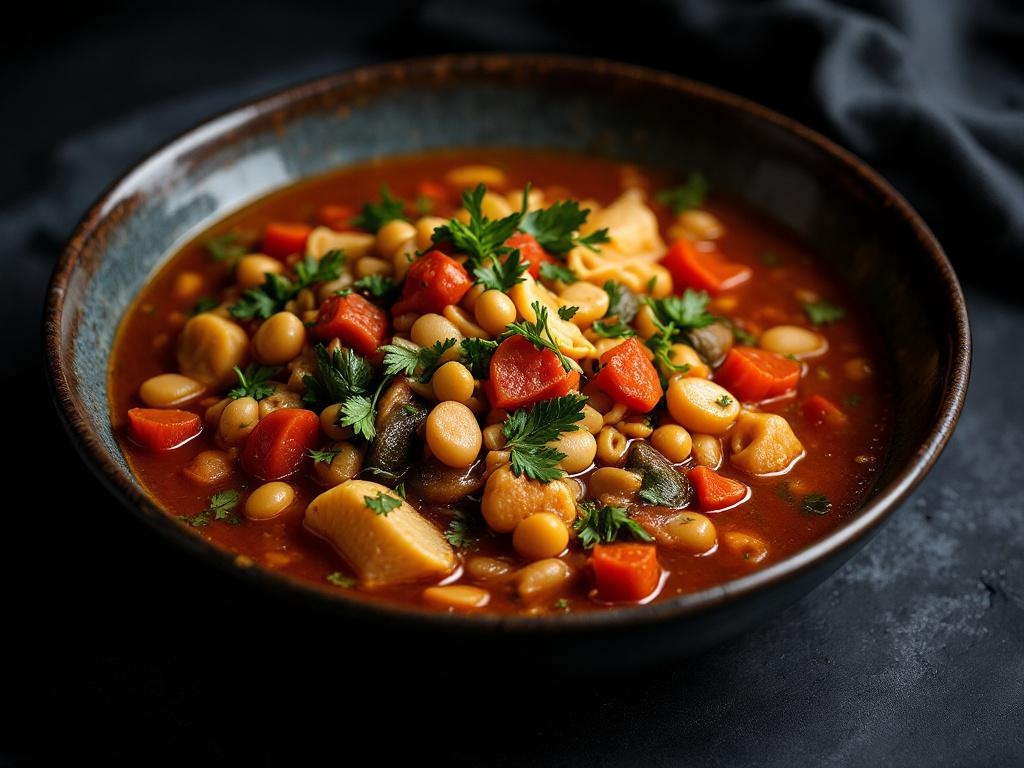
Minestrone
Italy-wide, with regional variations. The word minestrone derives from minestra (soup or course), with the -one suffix indicating largeness. Every region of Italy has a version — Genovese with pesto, Milanese with rice, Neapolitan with pasta. The concept of making substantial soup from seasonal vegetables and legumes is as old as Italian cooking.
Minestrone is not a soup with random vegetables thrown in. It is a disciplined construction where each vegetable is added in reverse order of cooking time so all arrive at tenderness simultaneously. A Parmigiano rind simmers in the broth throughout — this is the backbone. The soup is served thick enough that a spoon dragged through the surface holds its path.
Vermentino or a light Barbera d'Asti — the soup has tomato acidity and the wine needs to match without competing. In winter: a young Dolcetto d'Alba, whose light tannins and cherry fruit work with the earthy beans and vegetables.
{"Build a soffritto first: onion, celery, carrot in olive oil for 15 minutes until soft — this is the flavour base for every litre of soup","Parmigiano rind: add one 10cm piece of aged Parmigiano rind to the pot with the stock — it dissolves slowly over the cooking time, contributing glutamate depth to the broth","Hard vegetables first: celeriac, turnip, potato added 30 minutes before softer vegetables — all should finish simultaneously","Cannellini or borlotti beans: half pureed and stirred back into the soup to thicken the broth — this is the textural signature of classic minestrone","Pasta or rice added in the last 10 minutes of cooking — the pasta should be slightly undercooked when the soup is served as it continues cooking in the hot broth","Finish with a spoonful of basil pesto stirred through at the table — this is the Genovese tradition and transforms the soup"}
RECIPE: Serves: 4 | Prep: 20 min | Total: 75 min --- 60 ml extra virgin olive oil — first cold-pressed 120 g yellow onion — small dice 80 g carrot — small dice 60 g celery — small dice 2 cloves garlic — minced 150 g Savoy cabbage — ribboned 100 g zucchini — small dice 80 g green beans — cut into 2 cm pieces 100 g cannellini beans — canned, drained 400 g San Marzano DOP tomatoes — canned, whole 1 liter vegetable or chicken stock — homemade preferred 60 g small pasta — ditalini or tubetti 8 g sea salt 2 g Tellicherry black pepper — freshly ground 20 g fresh parsley — flat-leaf, chopped 40 g Parmigiano Reggiano DOP — aged 24 months, for serving --- 1. Heat olive oil in a large pot over medium heat; add onion, carrot, and celery, and sweat until translucent (8 minutes), stirring occasionally. 2. Add minced garlic and cook 1 minute until fragrant; stir in Savoy cabbage and cook 2 minutes until just wilted. 3. Add zucchini and green beans, cook 3 minutes, then add cannellini beans and San Marzano tomatoes (crushed by hand). 4. Pour in stock, bring to a boil, then reduce heat and simmer uncovered for 25 minutes until vegetables are nearly tender. 5. Add dried pasta and stir; continue simmering for 8–10 minutes (pasta should be al dente) until vegetables are very tender. 6. Season with sea salt and Tellicherry pepper; taste and adjust seasoning. 7. Ladle minestrone into bowls, garnish with fresh parsley, and finish with a light grating of Parmigiano Reggiano at the table. The moment where minestrone lives or dies is the finish — specifically the pesto stirred through at the table (if making the Genovese version). The raw basil and garlic of the pesto contrasts with the long-cooked sweetness of the soup in the same way gremolata contrasts with osso buco. Do not stir the pesto into the pot — it loses its vibrancy. Add a tablespoon to each bowl at the moment of serving.
{"Adding all vegetables at once: the result is a mush of overcooked vegetables rather than a textured soup","Skipping the Parmigiano rind: this single ingredient contributes more depth than any amount of additional seasoning","Serving too liquid: minestrone should be thick, almost stew-like — reduce until it meets the standard of a spoon holding its path"}
- French soupe au pistou (Provencal minestrone with basil-garlic-cheese sauce stirred through — essentially identical in concept and technique); Spanish fabada asturiana (substantial bean and vegetable soup); Portuguese caldo verde (thick, substantial vegetable soup as a meal).
Common Questions
Why does Minestrone taste the way it does?
Vermentino or a light Barbera d'Asti — the soup has tomato acidity and the wine needs to match without competing. In winter: a young Dolcetto d'Alba, whose light tannins and cherry fruit work with the earthy beans and vegetables.
What are common mistakes when making Minestrone?
{"Adding all vegetables at once: the result is a mush of overcooked vegetables rather than a textured soup","Skipping the Parmigiano rind: this single ingredient contributes more depth than any amount of additional seasoning","Serving too liquid: minestrone should be thick, almost stew-like — reduce until it meets the standard of a spoon holding its path"}
What dishes are similar to Minestrone?
French soupe au pistou (Provencal minestrone with basil-garlic-cheese sauce stirred through — essentially identical in concept and technique); Spanish fabada asturiana (substantial bean and vegetable soup); Portuguese caldo verde (thick, substantial vegetable soup as a meal).