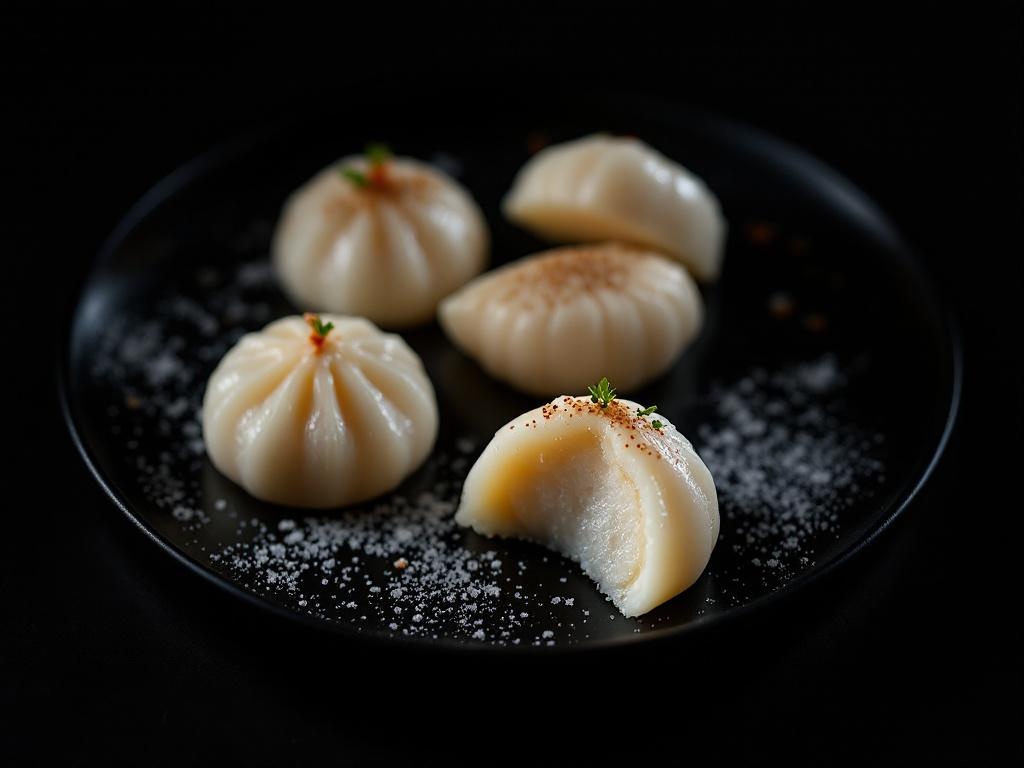
Mochi
Japan. Mochi is one of Japan's oldest foods — glutinous rice cakes were offered to the gods in Shinto rituals from the Nara period (8th century). Kagami mochi (mirror mochi) is the New Year offering. Daifuku mochi (filled mochi) became a popular sweet in the Edo period. The New Year mochitsuki pounding ceremony is a living tradition.
Mochi is made from glutinous rice (mochigome) pounded until the grain structure is destroyed and a smooth, elastic, translucent mass forms. The result is one of the most distinctive food textures on earth — simultaneously yielding and resilient, almost rubbery at first resistance, then giving completely. It is wrapped around sweet red bean paste (anko), dusted with kinako (roasted soybean flour), or grilled until the exterior blisters and chars.
Matcha (powdered green tea, prepared in a bowl with a bamboo whisk) — the classic Japanese sweet pairing. The intense bitter, umami quality of matcha meets the sweet red bean filling and neutral rice taste of mochi in a complete flavour circuit. This is the wagashi (Japanese confection) and o-cha (tea) tradition.
{"Glutinous rice (mochigome), not standard short-grain rice — the high proportion of amylopectin starch in glutinous rice is what produces the distinctive elastic texture when pounded","Soak overnight in cold water before steaming — the full hydration is necessary for even pounding","Steam in a steamer basket (not boil) at high heat for 25 minutes until completely translucent and yielding throughout","The pounding (mochitsuki): traditionally in a large mortar (usu) with wooden mallets, the pounding destroys the grain structure and develops the glutinous network. The pounding must be completed while the mochi is still hot","Modern shortcut: sweet rice flour (shiratamako or mochiko) mixed with water and microwave-cooked achieves a similar result in 5 minutes","Dust hands generously with katakuriko (potato starch) when shaping — mochi is extremely sticky and will adhere to everything"}
RECIPE: Serves: 4 (yields 12 mochi) | Prep: 15 min | Total: 30 min --- 200 g sweet mochigome rice flour (mochiko) 150 ml water 30 g caster sugar 2 g sea salt 40 g cornstarch (for dusting) 60 g anko (red bean paste) or desired filling --- 1. Mix mochigome, water, sugar, and salt in a microwave-safe bowl; stir until smooth and lump-free. 2. Cover loosely and microwave on high for 2 minutes; stir vigorously, then microwave another 1 minute until thick and translucent. 3. Dust a clean work surface generously with cornstarch; transfer hot mochi dough onto it. 4. Dust top of dough with additional cornstarch; cool for 3–4 minutes until handleable but still warm. 5. Divide into 12 portions; flatten each into a 7 cm disc, place 5 g filling in centre, fold edges up, and seal by pressing and rolling into a ball. 6. Dust finished mochi with cornstarch to prevent sticking; serve at room temperature. The moment where mochi lives or dies is the temperature during shaping — mochi must be shaped while still warm and pliable. As it cools, it becomes stiff and tears when stretched. Work quickly with generously starch-dusted hands, portioning 30-40g balls, pressing a well in the centre, placing the filling, and pinching closed. The pinch must be firm — a loose seal opens during handling.
{"Using standard short-grain rice: the amylose starch in standard rice does not produce the glutinous, elastic texture","Not dusting with starch before shaping: the mochi sticks to everything, including itself","Over-working mochi with sweet bean paste filling: the paste tears through the mochi skin if the filling is too warm or the mochi is over-stretched"}
Common Questions
Why does Mochi taste the way it does?
Matcha (powdered green tea, prepared in a bowl with a bamboo whisk) — the classic Japanese sweet pairing. The intense bitter, umami quality of matcha meets the sweet red bean filling and neutral rice taste of mochi in a complete flavour circuit. This is the wagashi (Japanese confection) and o-cha (tea) tradition.
What are common mistakes when making Mochi?
{"Using standard short-grain rice: the amylose starch in standard rice does not produce the glutinous, elastic texture","Not dusting with starch before shaping: the mochi sticks to everything, including itself","Over-working mochi with sweet bean paste filling: the paste tears through the mochi skin if the filling is too warm or the mochi is over-stretched"}
What dishes are similar to Mochi?
Korean tteok (glutinous rice cake — the Korean version of the same glutinous rice preparation); Chinese tang yuan (glutinous rice balls in sweet soup — the same ingredient at a different scale); Filipino palitaw (flat glutinous rice cake with sesame and coconut — the Southeast Asian cousin).