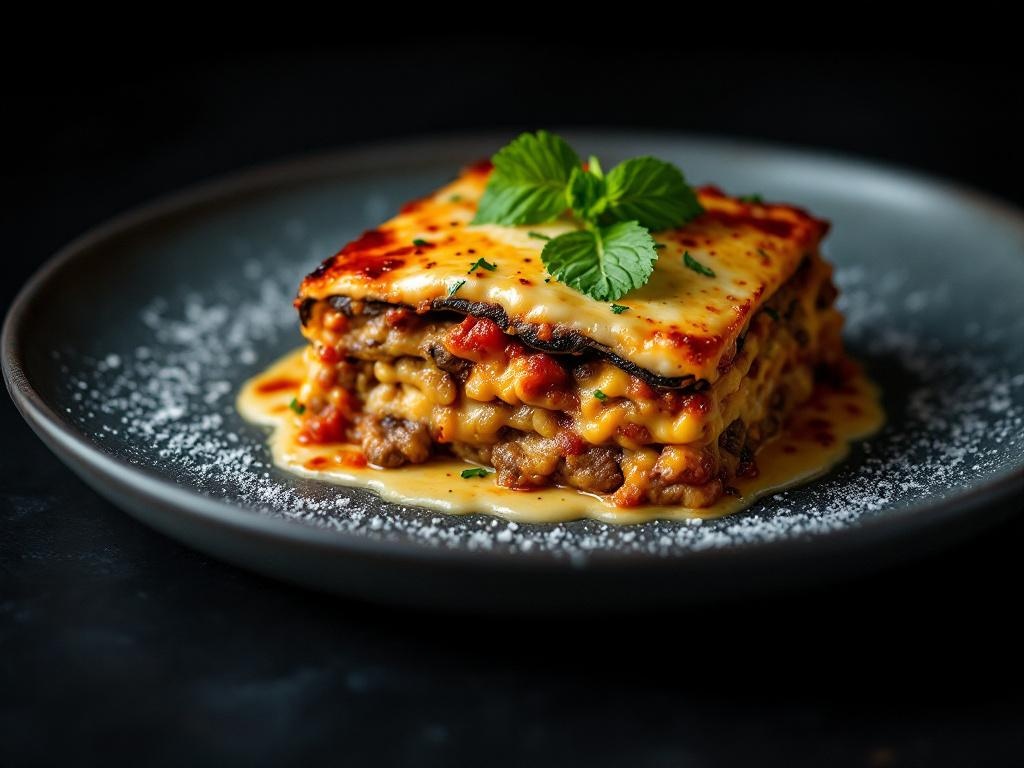
Moussaka
Greece, with antecedents in the Arab world. The name derives from the Arabic musakka'a. The layered eggplant and meat preparation exists throughout the Middle East; the Greek version with béchamel was codified by Nikolaos Tselementes, the influential early 20th-century Greek chef who introduced French culinary techniques to Greek cooking.
Moussaka is Greece's defining baked dish — layers of sliced, salted, and fried eggplant, spiced minced lamb with tomato, and a thick béchamel topping, baked until the béchamel is golden and the layers are set. Each component must be properly prepared: the eggplant dry (not oil-saturated), the meat sauce reduced and complex, the béchamel thick enough to hold its shape when sliced. It is not a quick dish.
Agiorgitiko or Xinomavro — the two great indigenous Greek red wine varieties. Agiorgitiko (from Nemea, Peloponnese) with its soft tannins and plum character matches the rich lamb and béchamel. Or a glass of cold Greek lager (Mythos).
{"Eggplant: sliced 1cm thick, salted for 30 minutes, rinsed, dried, brushed with olive oil, and roasted at 200C until golden — not fried in oil. Frying produces oil-saturated eggplant; roasting produces tender, dry slices that absorb the meat sauce without becoming waterlogged","The meat sauce (kima): minced lamb browned in olive oil with onion and garlic, then red wine, tomato, cinnamon, allspice, cloves, and a bay leaf. Reduced until thick and almost dry — any residual liquid will make the moussaka watery","Béchamel: classic French béchamel (butter, flour, milk) thickened to a consistency that holds peaks — thick enough to hold its shape when spread. Egg yolks added off heat for richness","The layer sequence: eggplant, meat sauce, eggplant, béchamel — not more than two layers of eggplant","Bake at 180C for 45-50 minutes until the béchamel is golden and a knife inserted in the centre meets only slight resistance","Rest for 20 minutes before slicing: the layers need to set, otherwise they slide apart when portioned"}
RECIPE: Serves: 6 | Prep: 30 min | Total: 75 min --- 400g eggplant, sliced 8mm thick 300g ground lamb 120g onion, diced small 30ml olive oil 200ml whole milk 40g unsalted butter 30g plain flour 3g grated nutmeg 200ml dry red wine 200g tinned San Marzano DOP tomatoes 3 cloves garlic, minced 4g dried oregano 60g Kefalotyri cheese, grated 3g sea salt 1g black pepper --- 1. Salt eggplant slices heavily, rest for 15 minutes; pat dry, brush lightly with olive oil, bake at 200°C for 12 minutes until golden. 2. Brown ground lamb over medium-high heat, drain excess fat, remove and reserve; sauté diced onion in same pan with 15ml olive oil until soft, add garlic and oregano, bloom for 1 minute. 3. Deglaze pan with red wine, scraping fond, reduce by half; return lamb, add tomatoes and 2g salt, simmer for 10 minutes until sauce thickens slightly. 4. Prepare béchamel: melt butter, whisk in flour, cook roux for 2 minutes stirring constantly; gradually add cold milk while whisking, simmer for 8 minutes until thickened, season with nutmeg, 1g salt, and black pepper. 5. Layer half the eggplant in a 9×12-inch baking dish, spread half the meat sauce over, layer remaining eggplant, top with remaining meat sauce. 6. Pour béchamel evenly over top, scatter Kefalotyri cheese across surface, bake at 180°C for 25 minutes until golden brown and bubbling at edges; rest 10 minutes before serving. The moment where moussaka lives or dies is the meat sauce reduction — after adding the tomato and wine, the sauce must be cooked over medium heat, stirring occasionally, for 20-25 minutes until all visible liquid has evaporated and the sauce appears almost dry on the pan. When you drag a wooden spoon through the sauce, the path should remain visible for 3 seconds before closing. Any remaining liquid will steam inside the moussaka during baking and produce a watery, structurally unstable result.
{"Wet meat sauce: any standing liquid in the meat sauce will make the moussaka watery during baking","Oil-saturated eggplant: frying produces eggplant that is greasy and releases oil into the dish","Slicing too soon: the béchamel is still liquid-set when hot — it needs 20 minutes to firm"}
- Turkish musakka (a similar layered eggplant and meat dish without béchamel — the Ottoman version); Egyptian musaqa'a (tomato-braised eggplant with chickpeas — the Egyptian variant); Balkan pasticada (layered meat and pasta — the Dalmatian parallel).
Common Questions
Why does Moussaka taste the way it does?
Agiorgitiko or Xinomavro — the two great indigenous Greek red wine varieties. Agiorgitiko (from Nemea, Peloponnese) with its soft tannins and plum character matches the rich lamb and béchamel. Or a glass of cold Greek lager (Mythos).
What are common mistakes when making Moussaka?
{"Wet meat sauce: any standing liquid in the meat sauce will make the moussaka watery during baking","Oil-saturated eggplant: frying produces eggplant that is greasy and releases oil into the dish","Slicing too soon: the béchamel is still liquid-set when hot — it needs 20 minutes to firm"}
What dishes are similar to Moussaka?
Turkish musakka (a similar layered eggplant and meat dish without béchamel — the Ottoman version); Egyptian musaqa'a (tomato-braised eggplant with chickpeas — the Egyptian variant); Balkan pasticada (layered meat and pasta — the Dalmatian parallel).