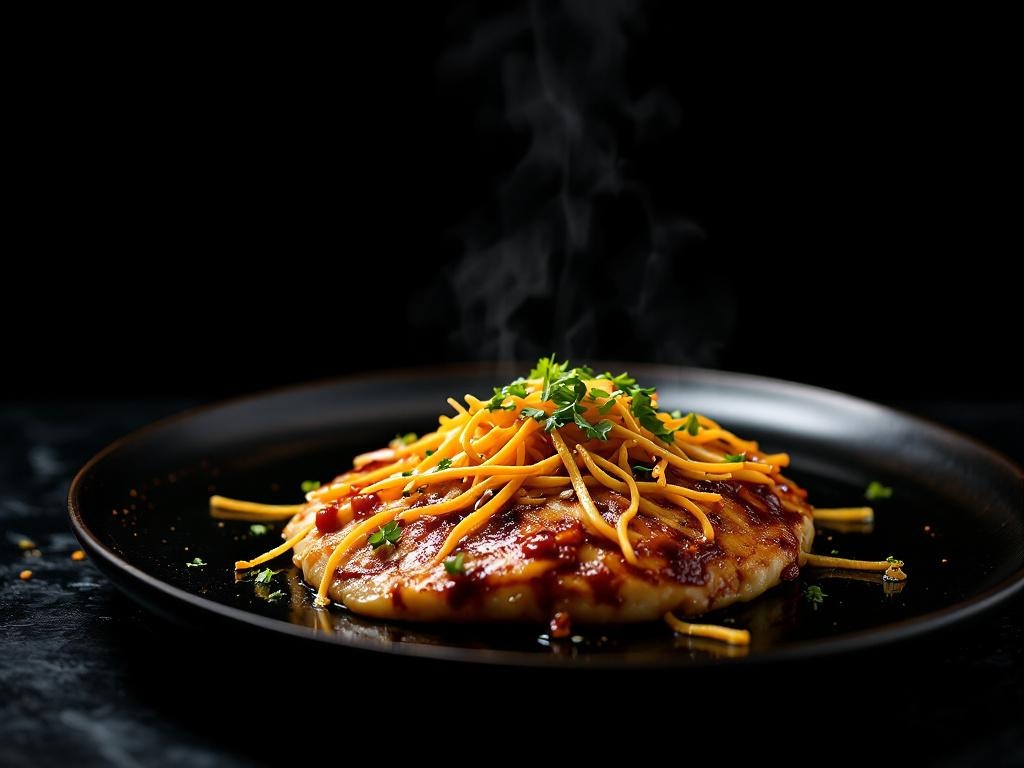
Okonomiyaki
Osaka (Kansai) and Hiroshima, Japan. The Kansai style evolved from pancake-like street foods of the 1930s. Hiroshima developed its layered style independently after World War II. The two styles remain a point of fierce regional pride.
Okonomiyaki (okonomi = what you like, yaki = grilled) is a Japanese savoury pancake — a thick, sizzling disc of shredded cabbage and batter, loaded with toppings, finished with okonomiyaki sauce, Japanese mayonnaise, dried bonito flakes, and aonori. The two main styles — Osaka (Kansai) and Hiroshima — differ fundamentally: Osaka mixes everything into the batter; Hiroshima layers the components separately. Both are correct, both are great.
Cold Asahi Super Dry or Sapporo lager — okonomiyaki is a casual, communal dish. The clean lager and the sizzling pancake is the quintessential Osaka casual dining experience. Kirin Lemon (a Japanese soft drink) is the non-alcoholic companion.
{"The batter: nagaimo (Japanese mountain yam) grated and mixed with water, flour, and egg — the grated nagaimo gives the batter a sticky, elastic quality that produces a lighter, fluffier pancake than flour alone","Cabbage: nappa cabbage, very finely shredded (1-2mm), constitutes 60% of the volume of the pancake — more cabbage than batter","Osaka style: cabbage, batter, egg, pork belly slices, spring onion all mixed together and cooked as one unified pancake on a teppan","Cook on a teppan (flat iron griddle) or cast-iron pan at medium heat — the teppan provides even heat across the entire surface","Flip only once, gently with two spatulas — the pancake is fragile until the second side is set","Sauce application: okonomiyaki sauce (a thick, fruity-savoury sauce similar to Worcestershire but sweeter), then Kewpie Japanese mayonnaise in a zigzag pattern, then katsuobushi, then aonori"}
RECIPE: Serves: 4 | Prep: 25 min | Total: 35 min --- 200 g all-purpose flour 200 ml dashi stock 2 eggs 100 g green cabbage, finely shredded 60 g tempura batter vegetables or mushrooms, diced 40 ml neutral oil 40 ml okonomiyaki sauce (Okonomi) 20 ml bonito oil or Japanese mayo 1 sheet toasted nori, finely sliced 10 g bonito flakes 3 g sea salt 2 g Tellicherry black pepper --- 1. Whisk flour, dashi, and eggs until just combined (lumpy batter is correct); fold in cabbage and vegetables gently. 2. Heat 20 ml oil in a 25 cm non-stick pan over medium-high heat until shimmering. 3. Pour batter into pan; spread to 1.5 cm thickness, cook 5–6 minutes until golden on base, shaking pan occasionally. 4. Flip carefully using two spatulas; cook reverse side 4–5 minutes until golden and cooked through. 5. Slide onto a warm plate; drizzle okonomiyaki sauce and mayo in crossed lines over surface. 6. Sprinkle nori strips and bonito flakes over top; serve immediately with extra sauce and mayo on the side. The moment where okonomiyaki lives or dies is the flip — use two wide spatulas, approaching from opposite sides, and flip in one definitive motion. The pancake will be 2-3cm thick and fragile. After the flip, press down gently with the spatula to ensure full contact with the pan. The second side should cook for 3-4 minutes until the pancake feels springy when pressed — not liquid in the centre.
{"Too little cabbage: the cabbage provides moisture, sweetness, and texture — a batter-heavy okonomiyaki is dense and stodgy","Flipping too early: the underside must be set and golden before the flip or the pancake tears","Using standard mayonnaise: Kewpie's egg yolk-only formula is measurably richer and tangier than regular mayo — this specific product matters"}
- Korean pajeon (scallion pancake — thinner, more egg-forward, but the same flour-egg-vegetable pancake tradition); Vietnamese banh xeo (sizzling rice-flour pancake with pork and shrimp — the Southeast Asian parallel); Chinese jianbing (street crepe with egg and condiments — the Beijing version of the filled savoury pancake).
Common Questions
Why does Okonomiyaki taste the way it does?
Cold Asahi Super Dry or Sapporo lager — okonomiyaki is a casual, communal dish. The clean lager and the sizzling pancake is the quintessential Osaka casual dining experience. Kirin Lemon (a Japanese soft drink) is the non-alcoholic companion.
What are common mistakes when making Okonomiyaki?
{"Too little cabbage: the cabbage provides moisture, sweetness, and texture — a batter-heavy okonomiyaki is dense and stodgy","Flipping too early: the underside must be set and golden before the flip or the pancake tears","Using standard mayonnaise: Kewpie's egg yolk-only formula is measurably richer and tangier than regular mayo — this specific product matters"}
What dishes are similar to Okonomiyaki?
Korean pajeon (scallion pancake — thinner, more egg-forward, but the same flour-egg-vegetable pancake tradition); Vietnamese banh xeo (sizzling rice-flour pancake with pork and shrimp — the Southeast Asian parallel); Chinese jianbing (street crepe with egg and condiments — the Beijing version of the filled savoury pancake).