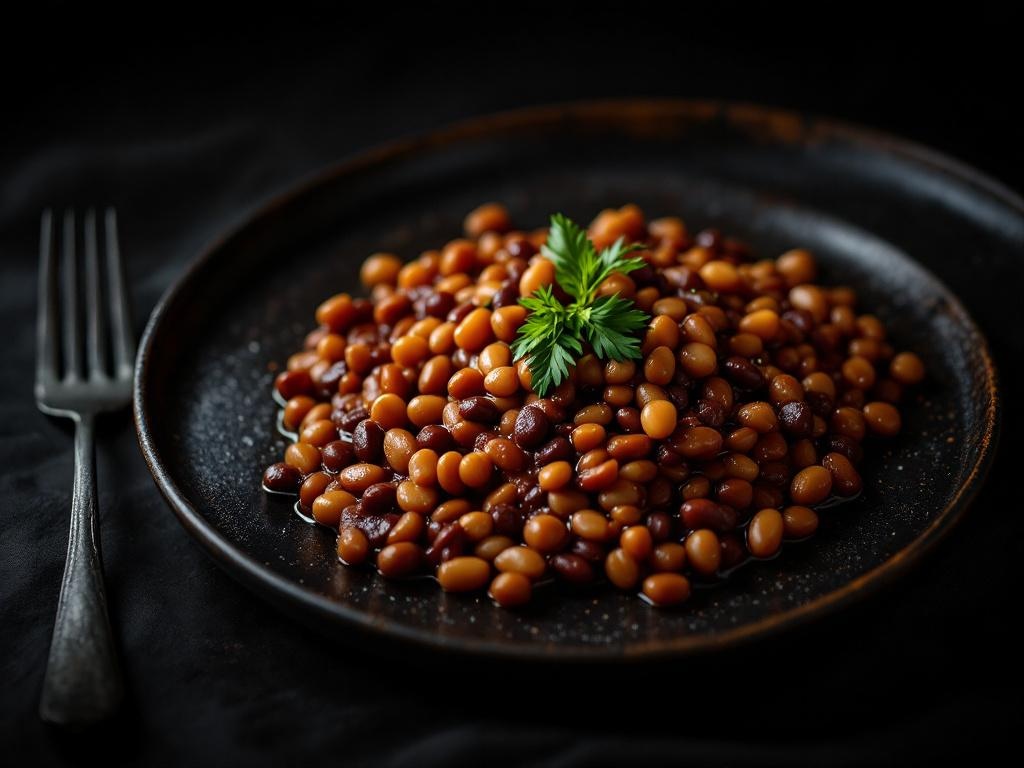
Refried Beans
Mexico. Frijoles refritos are pan-Mexican — every region has a version. The pinto bean is the northern Mexican standard; black bean (frijoles negros) is the southern Mexican and Yucatan tradition. Both are correct; they are regional variations on the same preparation.
Frijoles refritos (refried beans — misnomered; the 'refried' is a mistranslation of 'well-fried,' not 'fried again') are pinto or black beans cooked from dried, then mashed and fried in lard until they form a smooth, creamy, slightly shiny paste. They should be rich, savoury, and deeply flavoured — not watery, not pasty, not underseasoned. They are used as a base layer in multiple dishes and are inseparable from Mexican cooking.
Served as a base layer in huevos rancheros, under carnitas in a taco, or as a side dish alongside tamales. Frijoles refritos are a component, not a standalone — their role is always in relation to the other elements on the plate.
{"Dried pinto beans: soaked overnight, then simmered with half an onion, garlic, and an epazote sprig (the dried herb essential to beans in Mexican cooking) for 2-3 hours until completely tender","Lard: the fat for frying the beans. Vegetable oil is an acceptable substitute; butter is not. The lard gives refried beans their characteristic richness","The mash: beans mashed with a potato masher or passed through a food mill while hot — some texture is preferred. A blender produces too-smooth a result","The fry: heat lard in a heavy pan, add the mashed beans, stir and cook over medium heat for 5-7 minutes. The beans will dry out slightly and begin to pull away from the pan — this is correct","The consistency: add reserved bean cooking liquid tablespoon by tablespoon to reach the right consistency — thick enough to spread, fluid enough to slide off a spoon","Season aggressively: beans need significant salt, and the salt should be added during cooking (not after), which softens the beans' natural earthiness"}
RECIPE: Serves: 4 | Prep: 10 min | Total: 45 min --- 400 g dried pinto beans 60 ml lard or neutral oil 120 g white onion, diced 4 g kosher salt 2 g cumin seeds 1 g ancho chilli powder --- 1. Soak pinto beans in cold water for 8 hours or overnight; drain and rinse thoroughly. 2. Bring beans to boil in fresh water, reduce heat, and simmer 35–40 minutes until completely tender; drain, reserving 120 ml cooking liquid. 3. Heat lard in heavy skillet over medium-high; render onion until translucent, 3 minutes. 4. Add warm cooked beans and reserved liquid; mash coarsely with wooden spoon or potato ricer to achieve chunky paste texture. 5. Season with salt, cumin seeds, and ancho chilli powder; stir continuously 2 minutes to toast spices and deepen flavour. 6. Continue cooking and stirring 3–5 minutes until beans reach thick, spreadable consistency; adjust salt to taste. The moment where refried beans live or die is the bean cooking liquid — save every drop of the liquid the beans cooked in. It contains dissolved starches and minerals that, when added back to the fried beans during the final cooking, create the characteristic glossy, creamy consistency. Water added in place of bean cooking liquid produces a flat, starchy result.
{"Using canned beans: the texture and flavour are inferior — the bean cooking liquid (from dried beans) is an essential component of the dish","Not enough lard: the beans become dry and pasty rather than creamy and rich","Under-seasoning: refried beans need more salt than you think — taste continuously during the fry"}
- Brazilian feijão tropeiro (bean and pork meal — the Brazilian bean preparation); Cuban black beans and rice (the Caribbean slow-cooked bean tradition); Bangladeshi dal (lentil dal — the South Asian legume preparation with similar slow-cook-and-season structure).
Common Questions
Why does Refried Beans taste the way it does?
Served as a base layer in huevos rancheros, under carnitas in a taco, or as a side dish alongside tamales. Frijoles refritos are a component, not a standalone — their role is always in relation to the other elements on the plate.
What are common mistakes when making Refried Beans?
{"Using canned beans: the texture and flavour are inferior — the bean cooking liquid (from dried beans) is an essential component of the dish","Not enough lard: the beans become dry and pasty rather than creamy and rich","Under-seasoning: refried beans need more salt than you think — taste continuously during the fry"}
What dishes are similar to Refried Beans?
Brazilian feijão tropeiro (bean and pork meal — the Brazilian bean preparation); Cuban black beans and rice (the Caribbean slow-cooked bean tradition); Bangladeshi dal (lentil dal — the South Asian legume preparation with similar slow-cook-and-season structure).