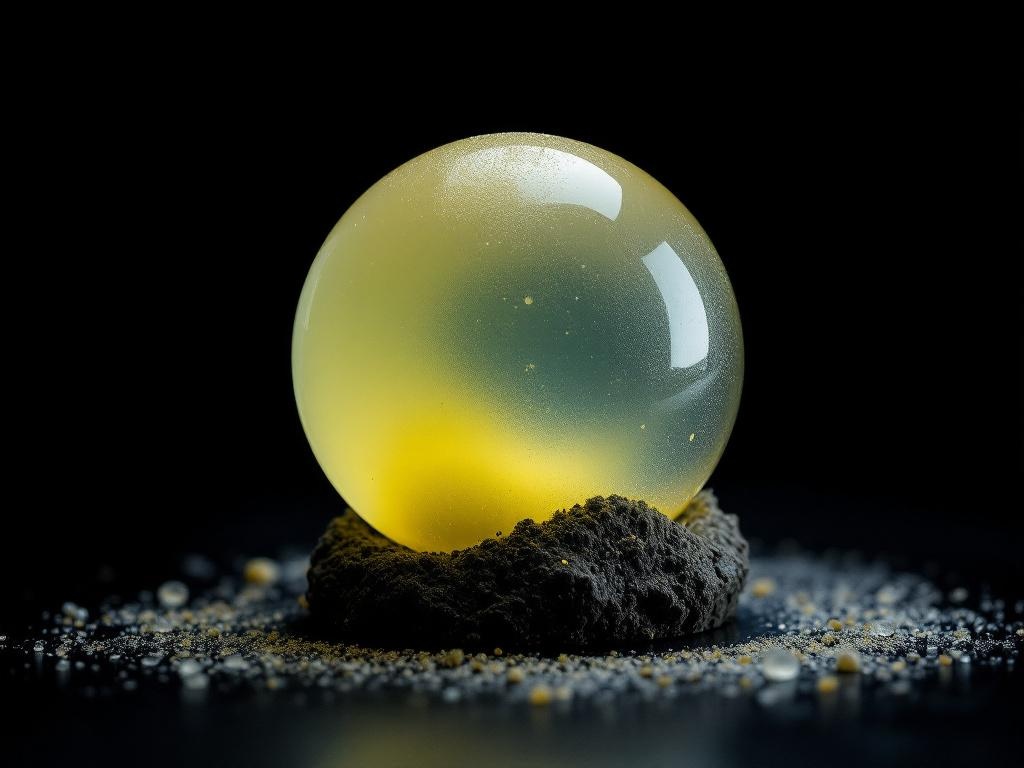
Reverse Spherification (Calcium Lactate Shell Method)
Refined by the elBulli team and culinary modernists in the mid-2000s as a practical evolution of basic spherification for professional kitchen use
Reverse spherification inverts the reagent positions of basic spherification to overcome its key limitations: short shelf life and incompatibility with calcium-rich or highly acidic liquids. In reverse spherification, calcium lactate (or calcium lactate gluconate for clearer results) is dissolved into the flavoured base, and sodium alginate is dissolved into the setting bath. When the calcium-laden base contacts the alginate bath, gelation proceeds from the outside inward, forming a membrane that does not continue to thicken once the sphere is removed. This outside-in gelation means the sphere stabilises quickly and then stops — reverse spheres can be made hours or even a day in advance and held in flavoured water without degradation. The interior remains perfectly liquid indefinitely. This shelf stability makes reverse spherification the professional default in fine dining kitchens where advance preparation is essential to service flow. Calcium lactate is used at approximately 2–3% in the base. Calcium lactate gluconate (a blended salt) is preferred when the base requires crystal clarity because it has no chalky bitterness. The alginate bath is prepared at 0.5–0.6% — higher than basic spherification — and must rest for several hours to fully hydrate and become bubble-free. The bath must be made fresh daily as it degrades. Because calcium is in the base, dairy products, stocks, and purées can all be spherified without premature gelling. The technique is ideal for yoghurt spheres, olive oil globes, mango 'yolks', and even spirits-based caviar pearls. The outer membrane is slightly thicker than basic spherification but still has a satisfying pop. Temperature plays an important role: the base should be at room temperature or slightly warm for optimal sphere formation, while the bath should be kept between 18–22°C.
Produces a clean, self-contained liquid burst with a slightly firmer skin than basic spherification — ideal for intense reductions, spirits, and cream-based fillings
Calcium lactate or calcium lactate gluconate is dissolved in the flavoured base at 2–3% by weight Sodium alginate bath at 0.5–0.6% must be fully hydrated and degassed — allow several hours of resting Gelation proceeds outside-in and self-arrests on removal, allowing advance preparation and holding Calcium-rich bases (dairy, stocks) work without premature gelling — the technique's primary advantage Spheres must be rinsed and stored in flavoured neutral water to prevent flavour dilution or skin drying Bath must be replaced daily as continued gelation degrades the setting solution over time
RECIPE: Reverse Spherification — Calcium Lactate Shell Method Yield: 40-50 spheres | Prep: 15 min | Total: 25 min --- 500 ml sodium alginate bath base (1 l water + 5 g sodium alginate, blended and rested 30 min) 250 ml flavoured liquid (fruit juice, consommé, or purée) 2.5 g calcium lactate 1 l water (for rinsing) --- 1. Dissolve calcium lactate into your chosen flavoured liquid using an immersion blender on medium speed for 1 minute until fully incorporated. 2. Pour sodium alginate bath into a shallow bowl (prepare this 30 minutes in advance to allow air bubbles to settle). 3. Fill a second bowl with 1 l plain water for rinsing. 4. Draw calcium lactate liquid into a 10 ml pipette or spherification spoon; hold 2 cm above the sodium alginate bath and release drops slowly. 5. Allow each sphere to sit in the sodium alginate bath for 2–3 minutes, gently stirring occasionally (longer soak = thicker membrane). 6. Use a slotted spoon to transfer spheres to rinse water; agitate gently for 30 seconds. 7. Drain on a clean cloth. Reverse spheres hold for 24 hours refrigerated and are ideal for delicate flavours and larger formats. RECIPE (Technique Showcase): Yield: 40–50 pearls | Prep: 15 min | Total: 25 min --- 200ml fruit juice or flavored liquid 2g calcium lactate (food grade) 500ml water 2.5g sodium alginate (premium culinary grade) --- 1. Dissolve calcium lactate into fruit juice by stirring until fully incorporated; set aside. 2. Prepare sodium alginate bath by hydrating in 500ml water using an immersion blender on high speed for 2 minutes; allow air bubbles to settle for 10 minutes, then transfer to a shallow bowl. 3. Fill a spherification spoon (5ml capacity) with calcium lactate liquid and carefully lower into sodium alginate bath; hold for 20–30 seconds to allow a thin membrane to form on the exterior. 4. Using a slotted spoon, remove sphere and transfer to a clean water bath to rinse; agitate gently to remove excess alginate solution. 5. Drain spheres on a paper towel-lined tray; serve within 2–4 hours as garnish or flavor component—reverse spherification maintains juice integrity longer than traditional method and suits delicate or acidic liquids. Add a small amount of sugar or salt matching the flavour profile to the holding water to prevent osmotic dilution of spheres Use a deep, wide container for the alginate bath and lower spheres with a slotted spoon in a single smooth motion For crystal-clear spheres, use calcium lactate gluconate — it has no visual cloudiness or chalky aftertaste Test sphere integrity before service by gently pressing — a good reverse sphere has elastic, consistent resistance Make the alginate bath the night before service to ensure full hydration and zero trapped air
Not resting the alginate bath long enough, producing bubbles that result in broken or irregular shells Using calcium chloride instead of calcium lactate in the base, which adds bitterness and affects flavour Overloading the bath with too many spheres at once, depleting local calcium and causing uneven gelation Storing finished spheres in plain water, which dilutes flavour over time — use lightly flavoured holding water Failing to replace the alginate bath during long service, leading to deteriorating sphere quality
Common Questions
Why does Reverse Spherification (Calcium Lactate Shell Method) taste the way it does?
Produces a clean, self-contained liquid burst with a slightly firmer skin than basic spherification — ideal for intense reductions, spirits, and cream-based fillings
What are common mistakes when making Reverse Spherification (Calcium Lactate Shell Method)?
Not resting the alginate bath long enough, producing bubbles that result in broken or irregular shells Using calcium chloride instead of calcium lactate in the base, which adds bitterness and affects flavour Overloading the bath with too many spheres at once, depleting local calcium and causing uneven gelation Storing finished spheres in plain water, which dilutes flavour over time — use lightly f