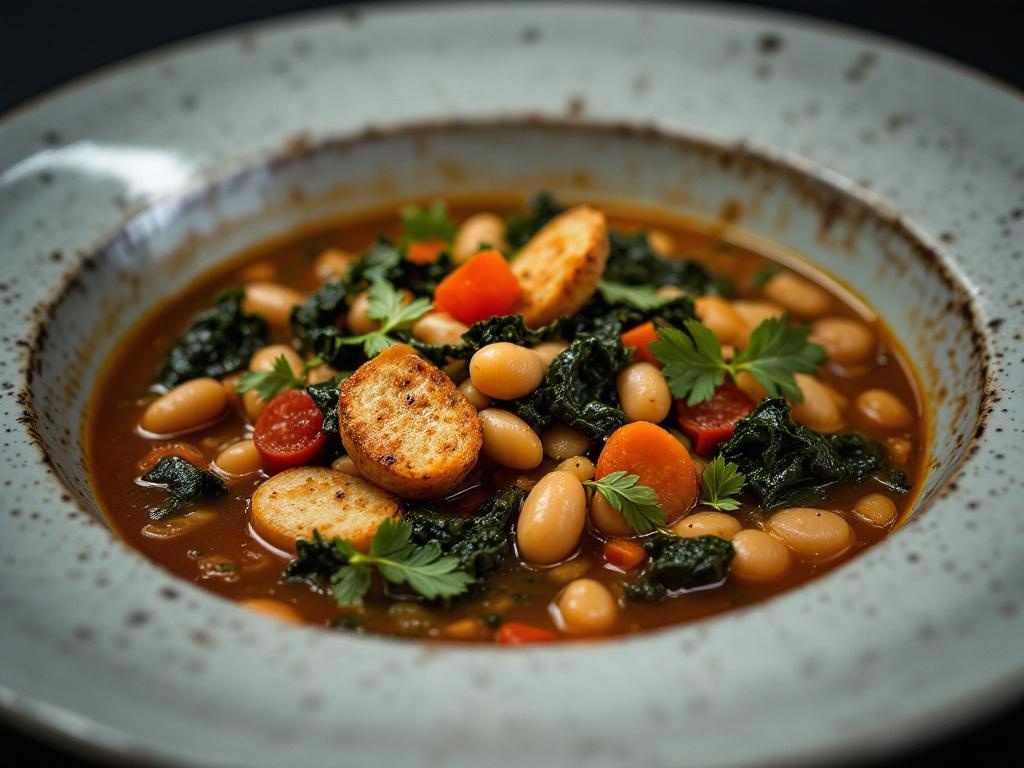
Ribollita (Naturally Vegan)
Tuscany (Florence and surrounding region); ribollita emerged from the tradition of la cucina povera — peasant cooking that maximised every ingredient; documented c. 14th century.
Ribollita — 'reboiled' in Italian — is Tuscany's great frugal dish: a thick bean and vegetable soup enriched with stale bread and 'reboiled' the next day, thickening into something between soup and stew. It is entirely vegan, entirely satisfying, and entirely dependent on quality extra virgin olive oil for its character. The Tuscan tradition of cooking with cavolo nero (Tuscan black kale), cannellini beans, and day-old bread produces a dish that is greater than the sum of its parts: the bread dissolves into the soup over two days of reboiling, creating a porridge-like consistency that is simultaneously rustic and refined. The finishing pour of cold-press olive oil — generous, even extravagant — is both a flavour component and a sign of respect for the dish. Ribollita teaches the modern cook to treat bread as an ingredient rather than an accompaniment, and to see leftover soup as an opportunity rather than an afterthought.
Use dried cannellini beans cooked from scratch — the cooking liquid becomes the soup base; canned beans produce a thinner, less flavourful result Cavolo nero (Tuscan kale) is traditional — it holds its structure through multiple reboilings where spinach or regular kale would not Stale bread goes in during the last 20 minutes of the first cooking — it should partially dissolve but not completely Reboil the next day — the second cooking collapses the bread completely and melds all flavours; the name is instruction, not suggestion Olive oil finish is generous — at least 2 tablespoons per bowl poured over at service Season gently during cooking; season aggressively at service — the dish intensifies overnight
RECIPE: Serves: 4 | Prep: 20 min | Total: 50 min --- 60 ml extra virgin olive oil 1 large yellow onion, diced 4 cloves garlic, minced 2 medium carrots, diced 3 celery stalks, diced 400 g canned San Marzano DOP tomatoes 250 g cavolo nero (Lacinato kale), roughly chopped 150 g cannellini beans, cooked or canned 750 ml vegetable stock 150 g day-old Tuscan bread, cubed 1 bay leaf Salt and Tellicherry black pepper to taste 10 g fresh basil, torn --- 1. Heat 30 ml olive oil in a heavy-bottomed pot over medium heat; add onion, carrot, and celery, sauté until softened, 8 minutes. 2. Add garlic and cook 1 minute; pour in tomatoes with juice, stock, beans, and bay leaf; bring to a simmer. 3. Cook uncovered 20 minutes, stirring occasionally, until vegetables are tender. 4. Stir in cavolo nero and bread cubes, simmer 8 minutes until kale wilts and bread softens slightly. 5. Season with salt and pepper; remove bay leaf. 6. Drizzle remaining olive oil over each bowl, tear basil into soup, and serve hot. Add a Parmesan rind during cooking for a vegan-adjacent approach that the Florentine tradition endorses, or omit entirely for strict vegan preparation — the beans produce enough body without it The soup should be thick enough that you can pull a spoon through it and the channel holds briefly For the most authentic presentation: serve in wide, shallow bowls with a swirl of olive oil and a few flakes of sea salt
Using fresh bread — it dissolves too completely; stale bread holds structure through the reboiling and then collapses at the right moment Not reboiling — serving on day one is not ribollita; the overnight development is structural Adding too much liquid — this is a thick dish; it should hold shape on the plate like a very thick stew Skimping on olive oil — the olive oil is half the flavour; be generous Using regular kale instead of cavolo nero — regular kale becomes too soft; the sturdy Tuscan variety is essential if available
Common Questions
What are common mistakes when making Ribollita (Naturally Vegan)?
Using fresh bread — it dissolves too completely; stale bread holds structure through the reboiling and then collapses at the right moment Not reboiling — serving on day one is not ribollita; the overnight development is structural Adding too much liquid — this is a thick dish; it should hold shape on the plate like a very thick stew Skimping on olive oil — the olive oil is half the flavour; be gen