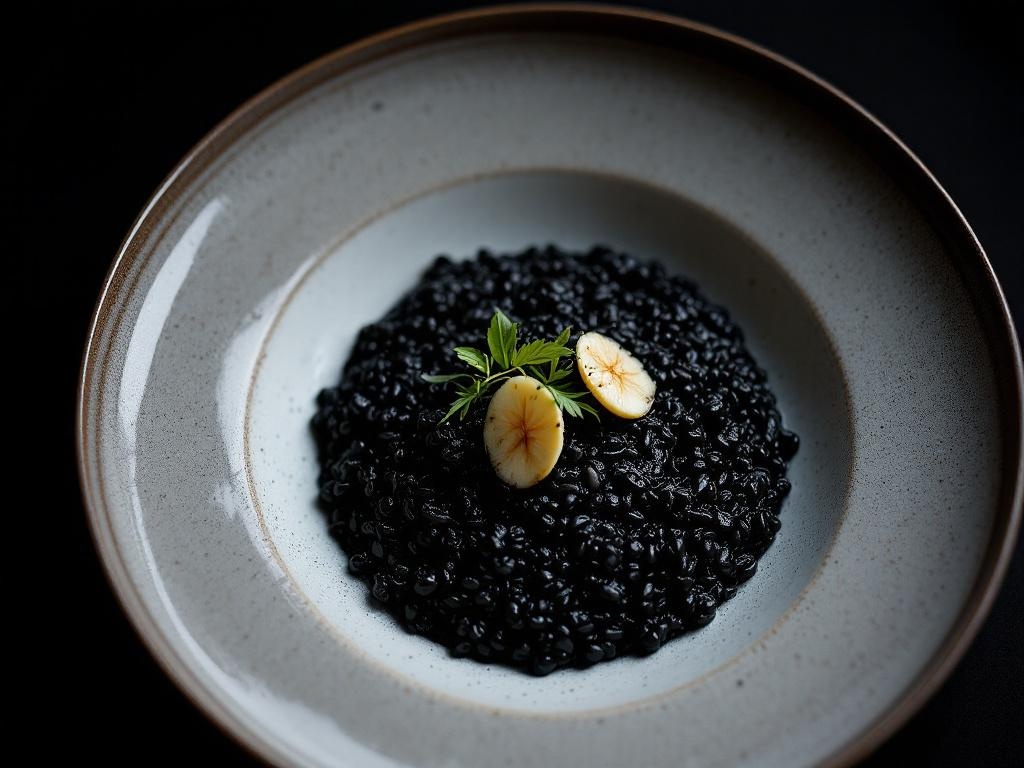
Risotto Nero (Venetian — Squid Ink and Soffritto)
Venice and the Venetian lagoon — laguna cooking tradition with roots in the medieval spice trade and fishermen's kitchens of the Rialto
Risotto nero is one of the most visually dramatic preparations in Italian cuisine — a jet-black risotto coloured and flavoured by the ink sac of cuttlefish (seppia), transformed through the risotto method into a glossy, deeply savoury, oceanic dish that is one of Venice's defining contributions to the Italian table. It belongs to the cucina di laguna — the cooking of the Venetian lagoon — where cuttlefish, mussels, crabs, and shrimp have been the central proteins for centuries. The ink of the cuttlefish (nero di seppia) is not merely a colourant. It contains amino acids, polysaccharides, and compounds that add genuine flavour — a briny, umami-rich depth that amplifies the flavour of the cuttlefish itself. Fresh ink sacs are preferable to packaged sachets; a large cuttlefish contains enough ink for a full risotto, and the sac must be extracted intact to prevent rupture and waste. The preparation begins with a soffritto of finely diced white onion sweated in olive oil until completely soft and transparent — this takes a full ten minutes over low heat. The cleaned, sliced cuttlefish body is added and cooked until it releases its liquids and they reduce. The ink is added at this stage, dissolved in a little white wine, and the mixture turns immediately and completely black. Vialone nano rice — the preferred Venetian risotto rice, with a firmer centre and higher starch release than arborio — is added and toasted briefly before the progression of stock additions begins. The stock must be fish stock, ideally made from the cuttlefish heads and tentacles. The risotto is finished all'onda — with a wave-like fluidity — rather than stiff, and mounted with cold butter (mantecatura) but without Parmigiano, which has no place in seafood risotto. A drizzle of raw olive oil at service brightens and adds a verdant counterpoint.
Intensely oceanic, briny, and umami-rich — the cuttlefish ink turns the risotto into a dramatic, moody sea-flavoured canvas
Use vialone nano rice — it is the Venetian standard and produces a different starch quality than arborio Extract ink sacs intact and dissolve in white wine before adding — this ensures uniform colour distribution Do not add Parmigiano to seafood risotto — it is categorically excluded from the Venetian seafood canon Mantecatura with cold butter off the heat is essential — it creates the glossy, flowing consistency The soffritto must be fully softened before the cuttlefish is added — raw onion flavour will not dissipate in the short braise
RECIPE: Serves: 4 | Prep: 20 min | Total: 35 min --- 320 g Arborio or Vialone Nano rice (Venetian variety preferred) 1 litre fish or chicken stock (warm) 300 g fresh squid (cleaned, body and tentacles), cut into 5 mm rings 30 ml squid ink (cuttlefish ink if squid ink unavailable; freshly extracted or quality commercial grade) 150 ml dry white wine (Pinot Grigio or Vermentino) 1 large yellow onion (150 g), finely diced (soffritto base) 2 cloves garlic (finely minced) 80 g unsalted butter (divided: 40 g for soffritto, 40 g for mantecatura) 50 g Parmigiano Reggiano DOP, finely grated 60 ml extra-virgin olive oil (Ligurian or Tuscan) 4 g fine sea salt 1 g white pepper Fresh flat-leaf parsley (for garnish) --- 1. Heat 40 g butter and 30 ml olive oil in a heavy-bottomed risotto pan over medium heat; add diced onion and cook gently for 4–5 minutes without colouring, stirring occasionally (soffritto). 2. Add minced garlic and cook 1 minute until fragrant; add squid rings and sauté 2 minutes, stirring gently, until just opaque (do not overcook). 3. Pour white wine over the squid and onion; let the wine reduce by half (approximately 2 minutes), then add squid ink and stir to incorporate the colour evenly throughout the base. 4. Add rice to the pan and toast for 2 minutes, stirring constantly to coat each grain with the ink and soffritto base. 5. Begin adding warm stock one ladle at a time (approximately 150 ml), stirring frequently; wait until each addition is mostly absorbed before adding the next ladle (approximately 18–20 minutes total). 6. After approximately 16 minutes, taste the rice; it should be creamy and al dente (slight resistance in the centre of each grain). 7. Remove from heat and vigorously stir in 40 g cold butter and Parmigiano (mantecatura); season with fine sea salt and white pepper to taste. 8. Plate immediately, drizzle with remaining olive oil, garnish with fresh parsley, and serve at once while the risotto is flowing and creamy. Fresh cuttlefish ink is dramatically more nuanced than sachets — seek it from a good fishmonger who butchers whole cuttlefish The tentacles of the cuttlefish, chopped small and added to the soffritto, provide textural interest alongside the body A small amount of white wine added just before mantecatura adds acidity that prevents the rich butter from feeling heavy For service, a white element — white polenta cake, aioli, or a single white prawn — creates a graphic contrast against the black Vialone nano from the Veneto's Baldo lowlands (Isola della Scala) is the benchmark variety; seek producers from this area
Using packaged squid ink as the sole flavour source without actual cuttlefish in the risotto — the dish becomes one-dimensional Using arborio instead of vialone nano — arborio releases starch differently and the texture changes significantly Adding Parmigiano at the finish — it curdles in contact with seafood proteins and contradicts the clean marine flavour Overcooking to a stiff, dry consistency — risotto nero should move and flow at service Frying the cuttlefish rather than sweating it — the goal is to cook it gently so it remains tender
Common Questions
Why does Risotto Nero (Venetian — Squid Ink and Soffritto) taste the way it does?
Intensely oceanic, briny, and umami-rich — the cuttlefish ink turns the risotto into a dramatic, moody sea-flavoured canvas
What are common mistakes when making Risotto Nero (Venetian — Squid Ink and Soffritto)?
Using packaged squid ink as the sole flavour source without actual cuttlefish in the risotto — the dish becomes one-dimensional Using arborio instead of vialone nano — arborio releases starch differently and the texture changes significantly Adding Parmigiano at the finish — it curdles in contact with seafood proteins and contradicts the clean marine flavour Overcooking to a stiff, dry consistency