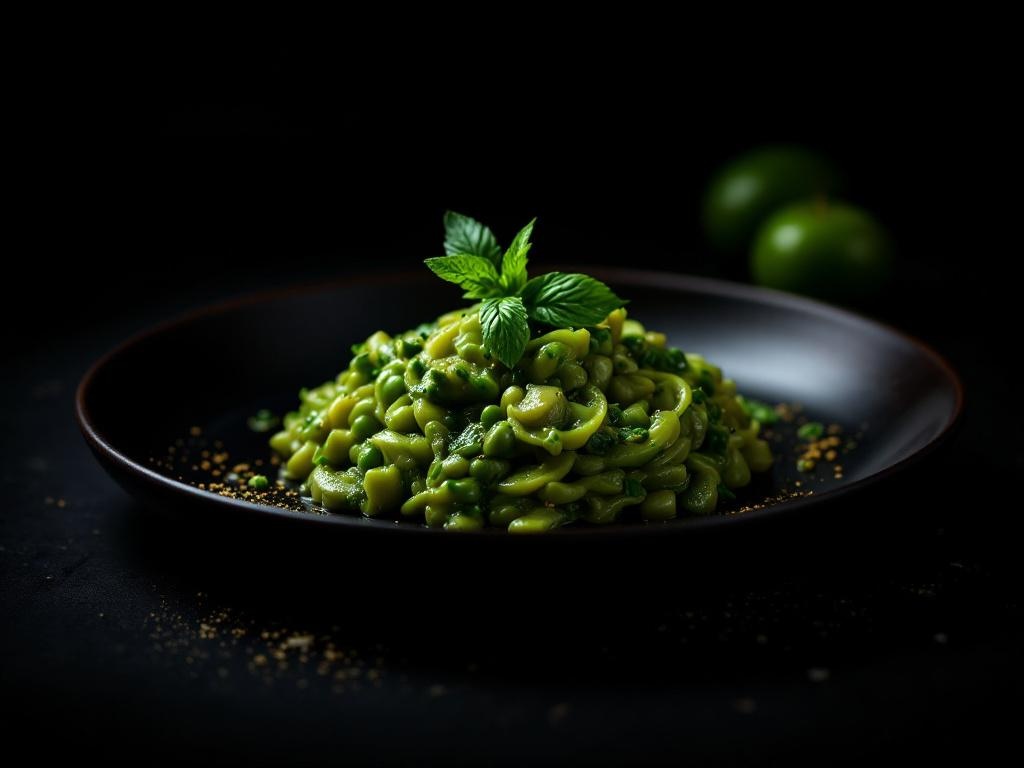
Salsa Verde
Mexico. Salsa verde is pre-Columbian — tomatillos (tomate verde) are native to Mexico and were cultivated by the Aztecs. The tomatillo appears in Aztec market records and in 16th-century Spanish chronicles of New World foods.
Mexican salsa verde (green sauce) is roasted or boiled tomatillos, serrano or jalapeño, garlic, white onion, and coriander — blended to a sauce with a bright, acidic, herbal character. It is one of the two foundational salsas of Mexican cooking (salsa roja is the other). It should be tart from the tomatillo, herbaceous from the coriander, and have moderate heat from the chilli. It is both a table salsa and a cooking sauce.
Applied to tacos, enchiladas, huevos rancheros, or served as a dipping salsa alongside tortilla chips. Salsa verde is a utility ingredient — it appears throughout Mexican cooking rather than in one specific application.
{"Tomatillos: the husked, sticky green fruit is the base. For roasted salsa verde (richer, smokier): char under a broiler or on a comal until blistered and slightly blackened. For boiled (brighter, more acidic): simmer in water until just soft","Serrano chilli: more heat and a brighter flavour than jalapeño — the standard choice for salsa verde. Remove seeds for mild, keep for hot","Garlic: 2 cloves roasted with the tomatillos — raw garlic produces a sharp, harsh note in a fresh salsa","The blend: tomatillos, chilli, garlic, and onion first — blend until almost smooth. Add coriander at the end (it oxidises quickly) and pulse briefly","Season: salt and a small amount of lime juice. Taste — the salsa should be bright, tart, and herbal","Rest: 30 minutes at room temperature before serving — the flavours integrate and mellow"}
RECIPE: Serves: 4 | Prep: 15 min | Total: 15 min Yield: 240 ml --- 300 g fresh tomatillos, husked and rinsed 2 serrano chillies, stemmed 40 g white onion, quartered 1 bunch cilantro (15 g leaves) 2 g kosher salt 1 g cumin seeds 5 ml lime juice --- 1. Char tomatillos and serrano chillies directly over gas flame or under broiler until blackened and blistered, 4–5 minutes; transfer to blender. 2. Add quartered onion, cilantro leaves, salt, and cumin seeds to blender. 3. Pulse until texture reaches coarse purée with visible specks of chilli skin and herb; do not overblend. 4. Transfer to serving bowl; stir in lime juice and adjust salt to balance acidity and heat. The moment where salsa verde lives or dies is the tomatillo roasting — the tomatillos must be charred, not just softened. The char on the skin, when blended in, adds a smoky, bitter note that balances the tartness of the fruit. Under-roasted tomatillos produce a one-dimensional, aggressively tart salsa. A well-roasted tomatillo has black patches, a soft interior, and a complex sweet-sour-smoky flavour.
{"Using raw tomatillos: they are bitter and astringent uncooked — some form of heat (roasting or boiling) is required","Over-blending: a smooth, uniform salsa lacks the texture of a properly made version — some coarseness is correct","Adding too much coriander: it should be a note, not the dominant flavour"}
- Peruvian ají verde (green chilli and herb sauce — the Andean parallel); Italian salsa verde (herb sauce with capers and anchovies — the same name, completely different dish); Argentinian chimichurri (herb sauce for grilled meat — the same colour, different structure).
Common Questions
Why does Salsa Verde taste the way it does?
Applied to tacos, enchiladas, huevos rancheros, or served as a dipping salsa alongside tortilla chips. Salsa verde is a utility ingredient — it appears throughout Mexican cooking rather than in one specific application.
What are common mistakes when making Salsa Verde?
{"Using raw tomatillos: they are bitter and astringent uncooked — some form of heat (roasting or boiling) is required","Over-blending: a smooth, uniform salsa lacks the texture of a properly made version — some coarseness is correct","Adding too much coriander: it should be a note, not the dominant flavour"}
What dishes are similar to Salsa Verde?
Peruvian ají verde (green chilli and herb sauce — the Andean parallel); Italian salsa verde (herb sauce with capers and anchovies — the same name, completely different dish); Argentinian chimichurri (herb sauce for grilled meat — the same colour, different structure).