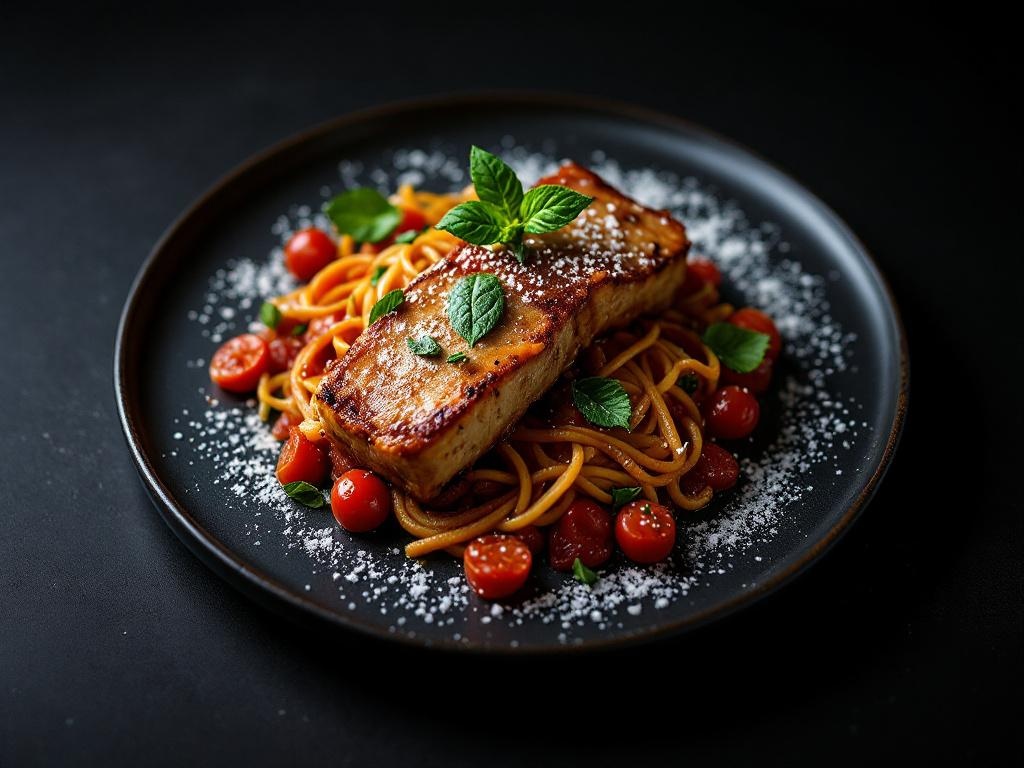
Saltimbocca
Rome, Lazio. Classically made with veal — the most refined and expensive meat in Roman cooking. The combination of sage and prosciutto with veal is documented in Roman cookbooks from the 19th century. The dish's name acknowledges its immediacy.
Saltimbocca alla Romana: thin veal escalope, sage leaf, prosciutto di Parma, sauteed in butter and finished with white wine. The name means jumps in the mouth — referring to the speed with which it should be eaten and the way the flavours arrive simultaneously. The veal, sage, and prosciutto are secured together and cooked as one unified piece, not as separate elements that happen to share a plate.
Frascati Superiore DOCG — the white wine of Rome, dry and mineral, and the same wine used to deglaze the pan. The wine and the dish share a geography and a flavour logic.
{"Veal escalope: cut from the top round (noce), pounded to 3mm — thin enough to cook in 2 minutes per side without the prosciutto burning","One large sage leaf per escalope, pressed firmly onto the veal, then one slice of prosciutto di Parma laid over and secured with a single toothpick","Cook prosciutto-side down first in a hot pan with clarified butter — the prosciutto crisps and adheres to the veal; flip once for 30 seconds on the veal side","Remove the veal, deglaze the pan with dry white wine (Frascati or Pinot Grigio) and reduce by two-thirds to a glaze — this is the sauce","Finish the sauce with cold diced butter swirled off heat — creating a mounted pan sauce, not a gravy","The whole process: 8 minutes from pan to plate"}
RECIPE: Serves: 4 | Prep: 20 min | Total: 25 min --- 4 veal escalopes — 120g each, pounded thin 8 fresh sage leaves — whole 8 slices Speck Alto Adige DOP — thinly sliced 40g unsalted butter — cold, diced 60ml dry white wine — Pinot Grigio 60ml veal or chicken stock 2 tbsp extra-virgin olive oil Coarse sea salt Tellicherry black pepper Lemon — 1, for garnish --- 1. Season veal escalopes on both sides with salt and Tellicherry pepper. 2. Lay 2 sage leaves and 2 Speck slices on each escalope; fold in half and secure with a toothpick. 3. Heat oil and half the butter in a large skillet over medium-high heat; pan-fry saltimbocca 2 minutes per side until Speck crisps and veal is pale, working in two batches. 4. Transfer to a warm plate; deglaze pan with white wine, scraping browned bits, then add stock. 5. Simmer 3 minutes to reduce by one-third; whisk in remaining cold butter off heat to emulsify. 6. Return saltimbocca to pan, coat gently, and plate immediately with pan sauce spooned over. 7. Garnish with lemon wedges and serve at once. The moment where saltimbocca lives or dies is the pan sauce — after removing the veal, the pan contains browned butter, rendered prosciutto fat, and fond (caramelised proteins from the veal). Deglaze with cold wine and let the sizzle subside as the wine lifts the fond. Reduce to 2 tablespoons. Take the pan off heat entirely and whisk in 30g cold diced butter in one go. The residual heat melts the butter into a glossy, silk sauce. Pour over the saltimbocca immediately.
{"Cooking the veal side first: the prosciutto burns in the time it takes the veal to cook through. Prosciutto side down first","Overcooking: veal becomes dry and leathery at 65C — 60C internal temperature is the correct target","Too thick escalope: requires longer cooking, during which the prosciutto overcooks"}
Common Questions
Why does Saltimbocca taste the way it does?
Frascati Superiore DOCG — the white wine of Rome, dry and mineral, and the same wine used to deglaze the pan. The wine and the dish share a geography and a flavour logic.
What are common mistakes when making Saltimbocca?
{"Cooking the veal side first: the prosciutto burns in the time it takes the veal to cook through. Prosciutto side down first","Overcooking: veal becomes dry and leathery at 65C — 60C internal temperature is the correct target","Too thick escalope: requires longer cooking, during which the prosciutto overcooks"}
What dishes are similar to Saltimbocca?
French veal piccata (thin escalope, lemon pan sauce — same speed, same thinness); German Schnitzel Wiener Art (thin veal, pan-fried, lemon garnish); Japanese katsu (pork escalope, panko-crumbed — same thin-escalope-fast-cook logic in a different tradition).