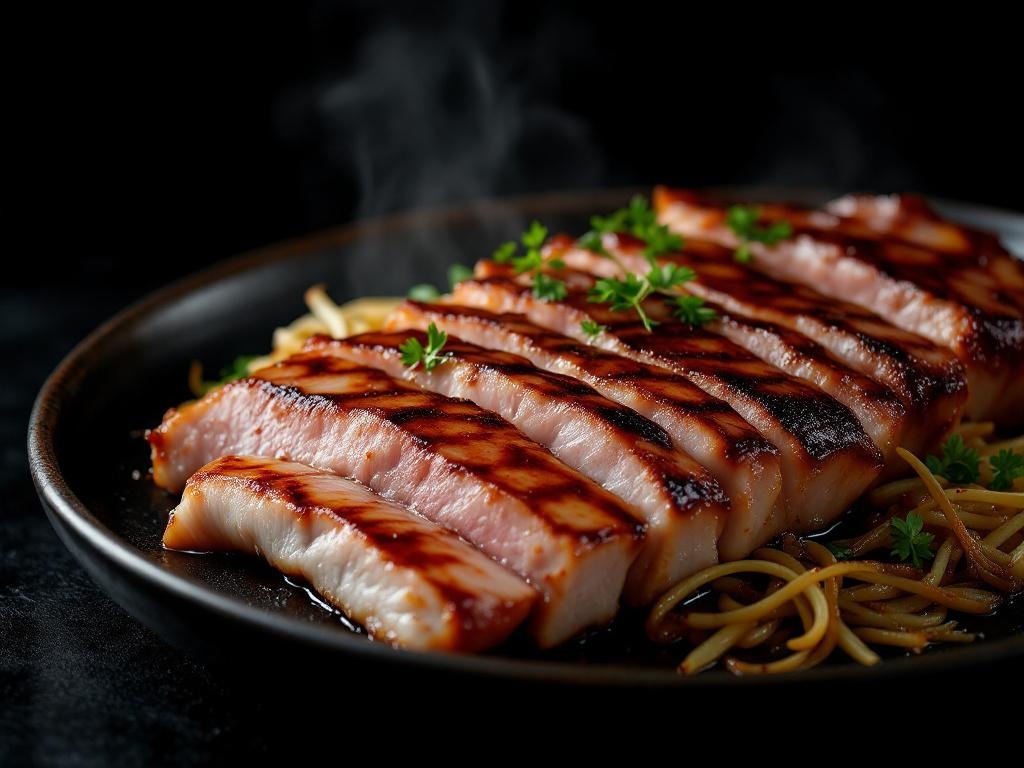
Samgyeopsal
Korea. Samgyeopsal is a post-Korean War phenomenon — pork belly, previously given to foreign workers, became mainstream in Korean cuisine in the 1970s and is now one of the most consumed proteins in South Korea. The communal BBQ format is a specifically Korean social ritual.
Samgyeopsal (three-layered meat — pork belly) is Korean BBQ at its most primal — thick-cut pork belly grilled directly on a tabletop grill, cut into pieces with scissors at the table, then wrapped in perilla leaf or lettuce with garlic, ssamjang, and kimchi. The simplicity is the point: quality pork belly, live-fire cooking, communal eating. No marinade. The fat renders onto the grill and crisps the edges of each slice.
Soju (Chamisul or Jinro) and Korean lager (somaek — soju mixed with beer) — the canonical samgyeopsal combination. The ritual of pouring for others before yourself is an important social dimension of the meal.
{"Pork belly: 1.5cm thick slices, no marinade — the quality of the pork is everything. Korean-style pork belly (samgyeopsal) is specific: equal layers of fat and meat, not excessively fatty","The grill: charcoal is traditional; cast iron plate (samgyeopsal plate) over a gas burner is the common modern version. The grill must be very hot before the pork is placed","Cooking: place the belly slices flat on the grill, cook undisturbed for 2-3 minutes until the fat side begins to render and char, then flip. The pork should have visible caramelisation and slight char","Scissoring: use kitchen scissors to cut the grilled belly into bite-sized pieces directly on the grill — this is the standard Korean BBQ technique","The ssam (wrap): perilla leaf (kkaennip) or butter lettuce, a piece of pork, a slice of raw garlic, a dab of ssamjang (doenjang and gochujang fermented paste), kimchi, and a sliver of green onion","Jeongol (bonus): at the end, remaining garlic, kimchi, and rice can be cooked in the rendered pork fat on the grill"}
RECIPE: Serves: 4 | Prep: 10 min | Total: 20 min --- 800g pork belly — skin on, sliced 5mm thick against the grain 200ml soy sauce 100ml mirin 50ml rice vinegar 3 tbsp sesame seeds — toasted 4 cloves garlic — thinly sliced 2 tsp Tellicherry black pepper — freshly cracked 1 tbsp sesame oil 30g scallions — cut into 3cm batons --- 1. Combine soy sauce, mirin, rice vinegar, and sesame oil in small bowl; set dipping sauce aside. 2. Heat charcoal grill or cast-iron griddle to high heat (until wisps of smoke appear). 3. Arrange pork belly slices directly on grill; cook without moving 3–4 minutes until fat renders and surface chars. 4. Flip each slice; cook 2 minutes until cooked through, fat fully rendered. 5. Transfer to serving platter; immediately sprinkle with cracked pepper, toasted sesame seeds, sliced garlic, and scallion batons. 6. Serve with dipping sauce, steamed rice, and fresh lettuce leaves for wrapping. The moment where samgyeopsal lives or dies is when the rendered pork fat begins to smoke on the hot grill — this is the moment to stop cooking on that side and flip. The fat should have golden, slightly crisped edges; the meat visible between fat layers should be white and set. Flip once and cook the meat side for 90 seconds. The finished slice should have a rendered, golden fat cap and a moist, just-cooked interior.
{"Thin slices: they cook too quickly and become dry rather than developing the characteristic fat-rendered, slightly charred exterior","No ssamjang: ssamjang is the binding condiment of the ssam — soy sauce is not a substitute","Not wrapping: eating the pork without the ssam misses the purpose of the dish — the wrap balances the rich fat with the fresh, acidic components"}
- Chinese hong shao rou (braised pork belly — the Chinese slow-braised equivalent); Japanese yakibuta (grilled pork belly for ramen — the Japanese grilled belly tradition); Vietnamese thit nuong (grilled lemongrass pork — the Vietnamese marinated pork belly equivalent).
Common Questions
Why does Samgyeopsal taste the way it does?
Soju (Chamisul or Jinro) and Korean lager (somaek — soju mixed with beer) — the canonical samgyeopsal combination. The ritual of pouring for others before yourself is an important social dimension of the meal.
What are common mistakes when making Samgyeopsal?
{"Thin slices: they cook too quickly and become dry rather than developing the characteristic fat-rendered, slightly charred exterior","No ssamjang: ssamjang is the binding condiment of the ssam — soy sauce is not a substitute","Not wrapping: eating the pork without the ssam misses the purpose of the dish — the wrap balances the rich fat with the fresh, acidic components"}
What dishes are similar to Samgyeopsal?
Chinese hong shao rou (braised pork belly — the Chinese slow-braised equivalent); Japanese yakibuta (grilled pork belly for ramen — the Japanese grilled belly tradition); Vietnamese thit nuong (grilled lemongrass pork — the Vietnamese marinated pork belly equivalent).