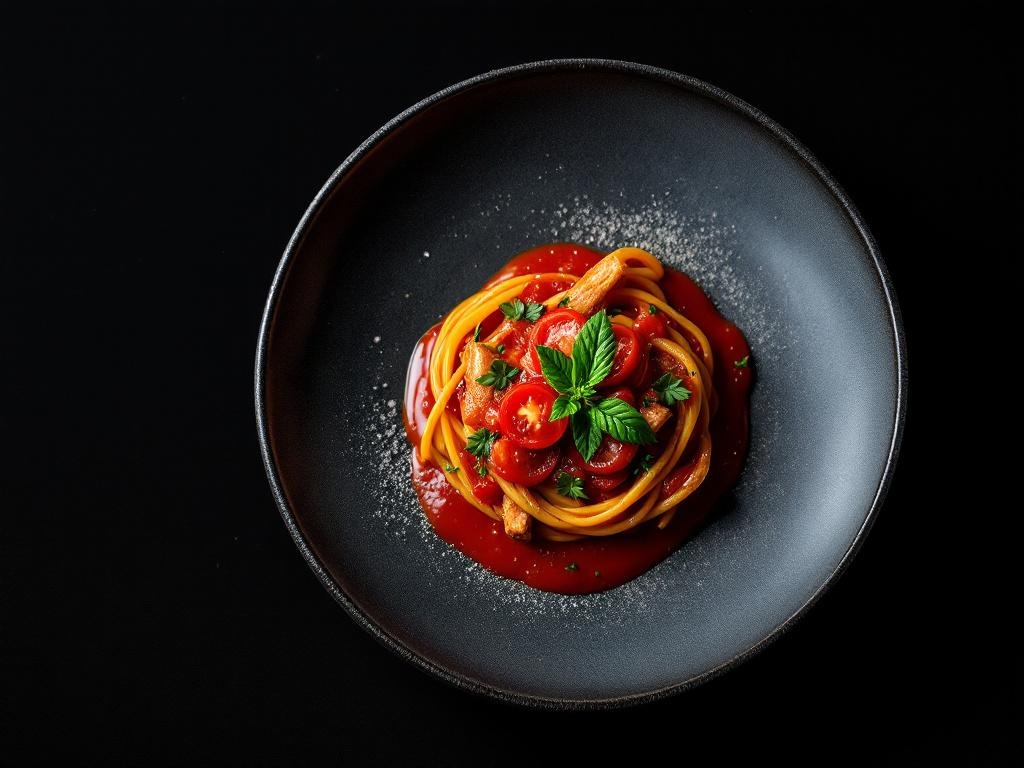
Sauce Tomate (Classical French — Not Italian — Stock and Pork)
Codified by Escoffier as the fifth mother sauce in the late 19th century. The preparation reflects the French classical tradition of enriching vegetables with animal fats and stocks — distinct from Mediterranean approaches to tomato.
The fifth French mother sauce is often misunderstood because it shares a name with what most people think of as Italian tomato sauce. Classical sauce tomate, however, is a distinctly French preparation — it includes pork fat (salt pork or lard), a mirepoix, and a veal or pork stock that gives it body and a meaty depth entirely absent from a Neapolitan salsa di pomodoro. The French version is thickened, almost velvety, and deeply savoury rather than bright and acidic. The classical recipe begins with rendering salt pork in a heavy pan, then sweating a mirepoix of carrot, onion, and celery with a bouquet garni until softened. A roux is sometimes added at this stage, though many modern versions omit it. Tomatoes — fresh, tinned, or a combination — are added with stock and the mixture is simmered for 45–60 minutes before being passed through a fine sieve. The result is a sauce of deep colour, substantial body, and savoury richness that tastes unlike any standard tomato sauce. In modern restaurant practice, sauce tomate has largely been replaced by more direct tomato preparations — reduced passata, slow-cooked fresh tomato with aromatics, or San Marzano concassée. But understanding the classical version matters because it reveals a fundamental principle: tomato is a vehicle for depth, not just acidity, and the addition of animal fats and stock transforms it into something with real backbone. Derivative sauces in the classical canon include Sauce Portugaise (with onion, garlic, and concassée), Sauce Américaine (lobster-flavoured), and various regional tomato variations. The principle of enriching tomato with stock and fat applies equally to modern tomato braises, shakshuka, and ragù preparations.
Rich, savoury, meaty-tomato — deeper and more structured than Italian tomato sauce, built on animal fat and stock
Render pork fat first — it flavours the base and distinguishes this from Italian tomato preparations Sweat the mirepoix fully before adding tomatoes — rushing this step loses sweetness and body Use a combination of fresh and passata tomatoes for balance of freshness and depth Simmer for at least 45 minutes — the sauce needs time to meld flavours and concentrate Pass through a fine sieve for the classical smooth finish
RECIPE: Yield: 600 ml | Prep: 15 min | Total: 90 min --- 200 g pork shoulder, cut into 2 cm dice 30 ml neutral oil 100 g onion, roughly chopped 50 g carrot, roughly chopped 50 g celery, roughly chopped 2 garlic cloves, crushed 30 g tomato paste 400 g San Marzano DOP canned tomatoes, crushed 400 ml light veal or chicken stock 1 bay leaf 1 thyme sprig Salt and black pepper to taste --- 1. Heat oil in a heavy-bottomed pot over medium-high heat and render pork pieces, stirring occasionally, until golden on all sides (6–8 minutes); remove and set aside. 2. In the same pot, sweat onion, carrot, and celery over medium heat for 5 minutes until softened but not coloured; add garlic and cook for 1 minute. 3. Stir in tomato paste and cook for 2 minutes to caramelize slightly, stirring constantly. 4. Return pork to the pot, add crushed tomatoes and stock, then add bay leaf and thyme. 5. Bring to a simmer, skim surface, then reduce heat to low and simmer gently for 50 minutes, stirring occasionally. 6. Remove bay leaf and thyme; pass sauce through a food mill or fine sieve into a clean pot. 7. Simmer for 10 minutes to concentrate; season with salt and black pepper. 8. Hold at 65–70°C until service. A spoonful of sauce tomate added to a braising liquid deepens flavour remarkably — the pork-tomato-stock combination is a classic building block For a modern interpretation, add a parmesan rind to the simmering sauce Sauce tomate can replace demi-glace in lighter dishes as a savoury, glossy finish Freezes beautifully — make large batches and freeze in portions For the Italian comparison: San Marzano, olive oil, garlic, basil — entirely different object; know both
Confusing sauce tomate with Italian tomato sauce — they are different preparations with different purposes Skipping the salt pork — without the animal fat, the sauce lacks depth and becomes one-dimensional Not cooking the tomatoes long enough — acidity dominates underdeveloped sauce Omitting the stock — it is what gives the sauce body and distinguishes it from passata Serving it chunky — the classical sauce is smooth and refined, not rustic
Common Questions
Why does Sauce Tomate (Classical French — Not Italian — Stock and Pork) taste the way it does?
Rich, savoury, meaty-tomato — deeper and more structured than Italian tomato sauce, built on animal fat and stock
What are common mistakes when making Sauce Tomate (Classical French — Not Italian — Stock and Pork)?
Confusing sauce tomate with Italian tomato sauce — they are different preparations with different purposes Skipping the salt pork — without the animal fat, the sauce lacks depth and becomes one-dimensional Not cooking the tomatoes long enough — acidity dominates underdeveloped sauce Omitting the stock — it is what gives the sauce body and distinguishes it from passata Serving it chunky — the class