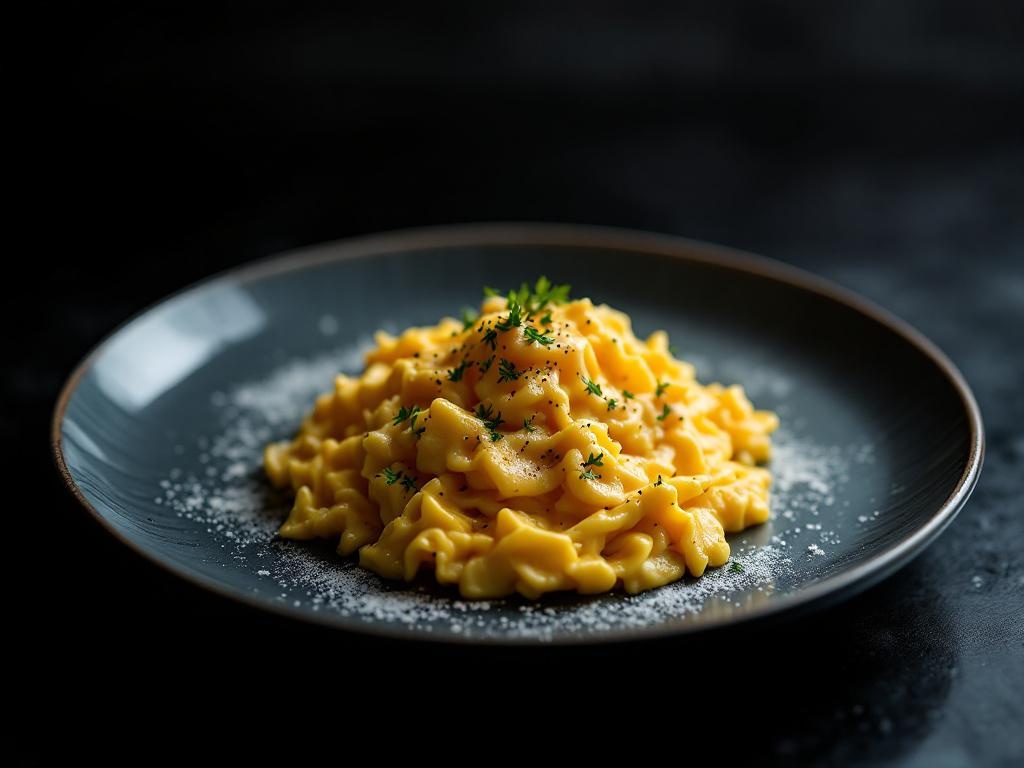
Scrambled Eggs
Universal. Scrambled eggs are made in every culture that keeps chickens. The specific technique of low-and-slow for large, custardy curds is a European (particularly French and British) refinement that contrasts with the East Asian tradition of rapid-heat egg preparations (Chinese egg stir-fry, Japanese tamagoyaki).
Perfect scrambled eggs are the most misunderstood preparation in the Western breakfast canon — they should be barely set, forming large, glossy, custardy curds that flow slightly on the plate. They are not dry, rubbery, or pale. The Gordon Ramsay method (off heat, low heat, off heat, repeated) and the French baveuse method both produce the correct result through the same principle: slow, interrupted heat prevents the proteins from fully coagulating. The only acceptable version on toast. Cold eggs become tough — warm plate, serve immediately.
Sourdough toast and good coffee (a well-made flat white or pour-over) — scrambled eggs on toast is the great British-Australian breakfast. The quality of the toast (proper sourdough, well-buttered, still hot) is as important as the eggs.
{"The eggs: 3 eggs per person, cracked directly into a cold pan with a knob of butter (cold) and a pinch of salt. No milk, no cream — added dairy dilutes the egg custard","Cold pan start: place the pan on medium-low heat. The eggs and butter warm simultaneously — starting in a hot pan instantly sets the base and produces small, rubbery curds","The stir: constant, slow stirring with a spatula (not a whisk), folding the setting edges toward the centre","Off-heat intervals: when the eggs begin to set in places, remove from heat entirely and continue stirring for 20-30 seconds, then return. The off-heat stirring continues the cooking without overheating","The finish: remove from heat while the eggs still appear slightly underdone. A small knob of cold butter stirred in at this point stops the cooking and adds gloss","Season: salt and white pepper added just before serving, not during cooking (salt added during cooking draws out moisture)"}
RECIPE: Serves: 2 | Prep: 5 min | Total: 8 min --- 4 large eggs (room temperature, preferably from pastured hens) 30g butter, cubed 15ml whole milk or crème fraîche 3g Maldon sea salt 2g white pepper, freshly ground 5g fresh chives, minced --- 1. Whisk eggs, milk, salt, and white pepper in a bowl until just combined; do not overbeat. 2. Melt half the butter in a non-stick pan over medium-low heat, swirling to coat evenly. 3. Pour egg mixture in and let sit undisturbed 20 seconds, then gently push cooked curds from edge toward center using a rubber spatula, tilting pan to allow uncooked egg to flow to edges. 4. When eggs are still slightly underdone (soft, glossy curds, about 3–4 minutes), remove from heat and fold in remaining butter until fully incorporated. 5. Plate immediately, garnish with chives and a pinch of sea salt; serve at once. The moment where scrambled eggs live or die is the final off-heat rest — remove the pan from heat when the eggs look 30% underdone. Stir for 30 seconds off heat; the eggs will arrive at the correct consistency from residual heat. If you wait until they look correct in the pan, they will be over-cooked on the plate. The target: large, glossy curds that pile softly and hold their shape on the toast without spreading into a puddle.
{"High heat: instantly produces small, dry, rubbery curds — the protein coagulates too rapidly","Constant stirring with a whisk: produces very fine, uniform curds rather than the large, flowing curds of great scrambled eggs","Over-cooking to dryness: the eggs should still flow slightly on the plate — they will continue setting from residual heat"}
Common Questions
Why does Scrambled Eggs taste the way it does?
Sourdough toast and good coffee (a well-made flat white or pour-over) — scrambled eggs on toast is the great British-Australian breakfast. The quality of the toast (proper sourdough, well-buttered, still hot) is as important as the eggs.
What are common mistakes when making Scrambled Eggs?
{"High heat: instantly produces small, dry, rubbery curds — the protein coagulates too rapidly","Constant stirring with a whisk: produces very fine, uniform curds rather than the large, flowing curds of great scrambled eggs","Over-cooking to dryness: the eggs should still flow slightly on the plate — they will continue setting from residual heat"}
What dishes are similar to Scrambled Eggs?
French omelette baveuse (wet-style French omelette — the same principle of barely set egg); Taiwanese oyster omelette (egg and oyster on a hot griddle — the East Asian egg-on-heat tradition); Yemeni bint al-sahn (eggs baked with honey in pastry — the Middle Eastern egg pastry parallel).