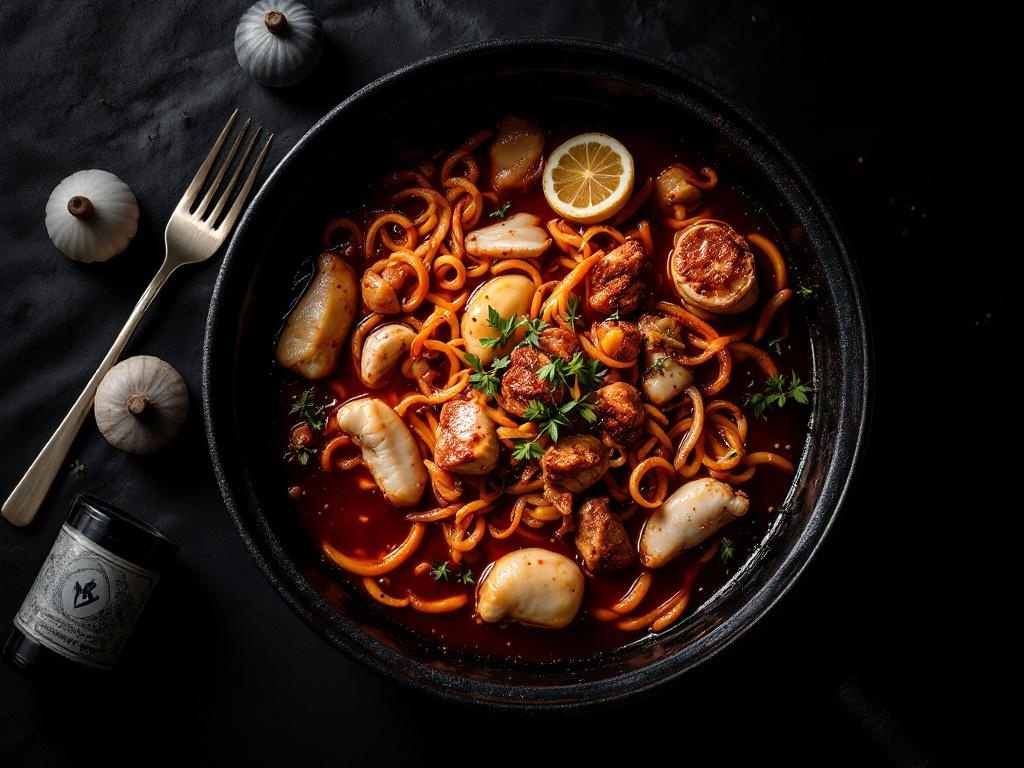
Sichuan Hot Pot
Chongqing and Sichuan province, China. Hot pot (huo guo — fire pot) has roots in Mongolian and Northern Chinese cooking, but the Sichuan mala version with its tallow-based chilli broth is a specifically Chongqing innovation from the 19th century.
Sichuan hot pot (mala huo guo) is a communal cooking experience — a divided pot of bone-based broth in two styles (mala red broth and clear mild broth) maintained at a rolling boil, into which diners cook thin slices of beef, lamb, vegetables, tofu, and various offal. The experience is as much social ritual as it is food. The dipping sauce (sesame paste with fermented tofu, soy, and green onion) is made per person at the table.
Tsingtao or Chongqing lager — cold beer consumed continuously during hot pot to buffer the escalating mala heat. Ice cream afterwards is the Chongqing tradition — the cold sweet disrupts the Sichuan peppercorn numbing.
{"The mala broth base: beef tallow rendered, then doubanjiang, whole dried red chillies, Sichuan peppercorns, star anise, black cardamom, and ginger bloomed in the fat — then beef bone broth added","Mise en place: all proteins and vegetables pre-sliced (paper-thin for beef, thicker for vegetables), arranged on plates before seating","Thin-sliced meats: beef fatty brisket and lamb shoulder, frozen briefly and sliced on a meat slicer to 2mm — cook in 15-30 seconds in the boiling broth","The dipping sauce: sesame paste thinned with broth, fermented red tofu (nan ru), soy sauce, chilli oil, chopped garlic chive, spring onion","Cooking sequence: dense vegetables first (lotus root, potato), then proteins, then leafy vegetables last","The numbing-heat (mala) accumulates as the meal progresses — this is intentional and desirable"}
RECIPE: Serves: 4 | Prep: 35 min | Total: 50 min --- 200 g Sichuan peppercorns (huajiao), divided 15 g dried red chilies (chilhuacle or similar), seeded 60 ml vegetable oil 6 garlic cloves, smashed 30 g fresh ginger, sliced 4 scallions, white parts only, cut into 3 cm lengths 1 star anise 2 bay leaves 5 g cumin seeds 1.5 L high-quality chicken or pork stock, brought to a boil 100 ml Sichuan chili oil (doubanjiang base) 30 ml soy sauce 15 ml rice vinegar 10 g caster sugar 8 g sea salt 400 g protein variety (beef, lamb, pork belly, shrimp): thinly sliced 300 g leafy greens (bok choy, spinach): separated into leaves 150 g mushrooms (shiitake, oyster): sliced 200 g napa cabbage: cut into 3 cm pieces 100 g silken tofu: cubed --- 1. Toast 100 g Sichuan peppercorns in a dry wok over medium heat for 3 minutes until fragrant; grind coarsely and set aside. 2. Toast dried chilies and cumin seeds in the same dry wok for 1 minute until darkened; set aside. 3. Heat 60 ml vegetable oil in a large hot pot or shallow braiser over medium heat; add garlic, ginger, scallion whites, star anise, and bay leaves; stir-fry for 2 minutes until deeply fragrant. 4. Add toasted chilies and cumin; stir for 30 seconds, then deglaze with soy sauce and rice vinegar. 5. Pour in boiling stock and Sichuan chili oil; bring to a rolling boil, add sugar and salt, adjust heat to maintain an active simmer. 6. Arrange all proteins, vegetables, and tofu around the hot pot in separate clusters; place a small strainer at each place setting. 7. Diners cook their chosen ingredients in the broth (10–30 seconds for protein slices, 2–3 minutes for vegetables), dip in a sauce of ground Sichuan pepper, sesame oil, soy, and cilantro. 8. Top broth with remaining whole Sichuan peppercorns and finish with a drizzle of chili oil just before serving. The moment where Sichuan hot pot lives or dies is the personal dipping sauce construction — each diner should be provided with the ingredients to build their own sauce. The ratio of sesame paste to chilli oil is personal; some want heat, some want the sesame to balance the broth's heat. The sauce makes every bite different.
{"Boiling everything simultaneously: the broth becomes cloudy and the flavour muddied — cook in small batches","Weak broth: the mala broth must be deeply flavoured before service — taste and adjust","Wrong dipping sauce: the sesame-fermented tofu sauce is characteristic of Chongqing hot pot — do not use straight chilli oil"}
- Mongolian hot pot (the ancestor — clear broth with lamb); Japanese shabu shabu (the Japanese refinement — dashi broth, paper-thin wagyu, ponzu and sesame dipping sauces); Vietnamese lau (Vietnamese hot pot — similar communal boiling concept with a clearer, more delicately spiced broth).
Common Questions
Why does Sichuan Hot Pot taste the way it does?
Tsingtao or Chongqing lager — cold beer consumed continuously during hot pot to buffer the escalating mala heat. Ice cream afterwards is the Chongqing tradition — the cold sweet disrupts the Sichuan peppercorn numbing.
What are common mistakes when making Sichuan Hot Pot?
{"Boiling everything simultaneously: the broth becomes cloudy and the flavour muddied — cook in small batches","Weak broth: the mala broth must be deeply flavoured before service — taste and adjust","Wrong dipping sauce: the sesame-fermented tofu sauce is characteristic of Chongqing hot pot — do not use straight chilli oil"}
What dishes are similar to Sichuan Hot Pot?
Mongolian hot pot (the ancestor — clear broth with lamb); Japanese shabu shabu (the Japanese refinement — dashi broth, paper-thin wagyu, ponzu and sesame dipping sauces); Vietnamese lau (Vietnamese hot pot — similar communal boiling concept with a clearer, more delicately spiced broth).