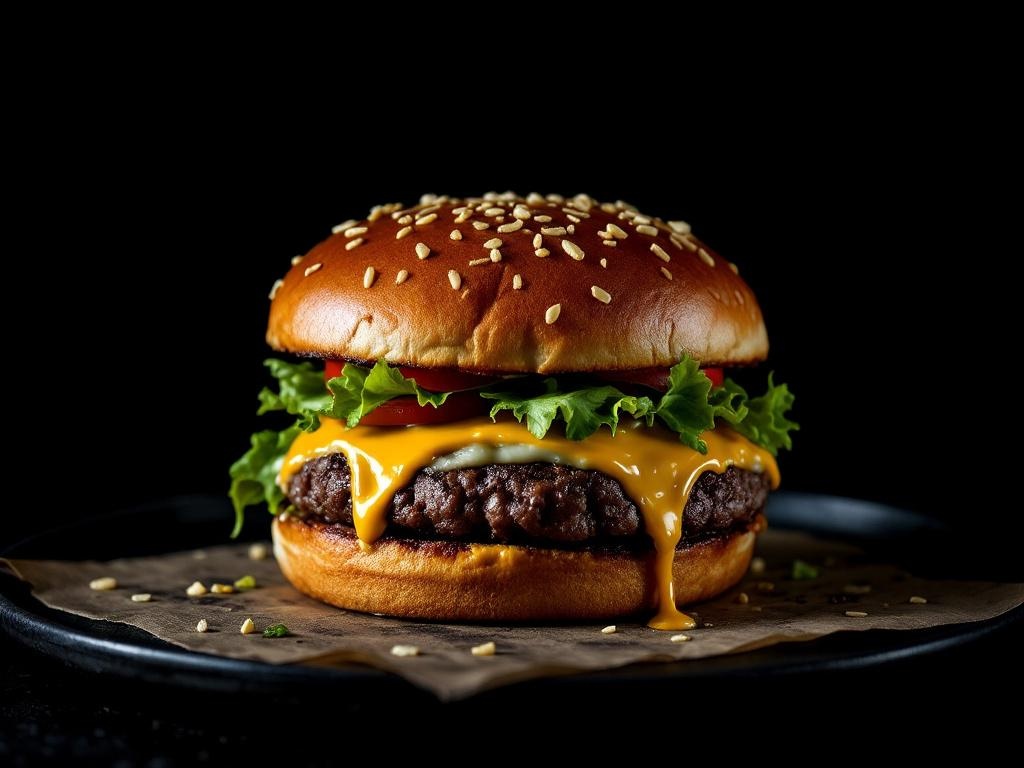
Smash Burger (Griddle vs Cast Iron — Crust Science)
American Midwest flat-top diner tradition; Steak 'n Shake 1930s; viral resurgence via YouTube and TikTok 2018–2022
The smash burger went viral multiple times across the 2010s and again in the early 2020s, but its origins predate social media. Steak 'n Shake is credited with popularising the smash-on-griddle technique in the American Midwest from the 1930s onward. The core principle is the Maillard reaction taken to its maximum: by smashing a loose ball of ground beef hard and fast onto a screaming-hot flat surface, you maximise the contact area between meat and metal, producing a deeply browned, lacy-edged crust in under two minutes per side. The beef must be 80/20 lean-to-fat. Leaner beef produces a dry puck that tears rather than crisps. The balls should weigh 2–3 ounces — smaller than a standard burger — because the smash flattens them to a thin patty, and two thin patties with cheese between them is the canonical double smash. Do not season the beef before forming the balls; season only the face that will hit the griddle, immediately before smashing. The smash itself must happen within the first 30 seconds of the ball touching the surface — before the proteins set. A stiff spatula or burger press is pushed firmly and held for 10–15 seconds. The sizzle will be aggressive. Once smashed, do not move the patty. Let the crust develop fully — 90 seconds to 2 minutes — before scraping under with the spatula. The cheese goes on immediately after flipping; it should melt over the patty in the 60 seconds before removal. A flat-top griddle is ideal because it retains heat across a large surface without hot spots. Cast iron in a home kitchen works well but can create slightly uneven results. Avoid nonstick pans — they cannot be heated to the required temperature safely. The bun must be toasted on the same griddle in the beef fat.
Deep beef crust, melted cheese, pickled acid, sweet-rich toasted bun and fat
Use 80/20 beef — fat is essential for crust formation and flavour Smash within the first 30 seconds before protein sets — apply firm, even pressure Do not move the patty after smashing — let the crust develop fully before scraping Season only the griddle-facing side immediately before smashing Toast the bun in the beef fat remaining on the griddle — not separately
RECIPE: Serves: 2 | Prep: 15 min | Total: 12 min --- 200 g ground chuck (80/20), divided into 2 × 100 g portions, loosely formed into discs 5 g fleur de sel per patty 3 g Tellicherry black pepper, cracked 30 ml neutral oil (avocado or grapeseed), divided 15 g unsalted butter 2 American cheese slices 4 brioche slider buns, split 15 g dill pickle chips 15 g yellow mustard 20 g iceberg lettuce, shredded --- 1. Preheat cast iron griddle or heavy steel plate to 200°C; verify surface temperature with infrared thermometer. 2. Place first beef portion on dry, screaming-hot griddle; immediately apply firm downward pressure with spatula for 15 continuous seconds, holding steady to maximize surface contact and meat-to-iron adhesion. 3. Flip patty; season exposed side immediately with 2.5 g fleur de sel and 1.5 g black pepper; press again for 10 seconds; add 7.5 ml oil around edges to baste edges and promote crust. 4. At 45-second total cook time, top patty with cheese; allow 15 more seconds until cheese begins to melt; transfer to plate. 5. Repeat steps 2–4 with second patty using remaining 7.5 ml oil and second cheese slice. 6. Quickly butter cut sides of buns; place face-down on griddle for 30 seconds until golden and crisp. 7. Build each slider: base bun, mustard, lettuce, pickles, patty with cheese, top bun; serve immediately. For maximum lace crust, use a metal ring mould to contain the smash slightly and get extra-thin edges A knob of butter added to the griddle just before smashing adds milk solid browning to the crust Double patties with American cheese between them is the canonical format — do not go single on a smash burger For the sauce, Duke's mayo thinned with yellow mustard and a dash of pickle brine is the classic The griddle temperature should register 400–450°F before the beef goes on — test with a drop of water
Using lean beef (90/10 or higher) which produces a dry, tearable patty without crust Smashing too late — the proteins have already set and the patty will not flatten evenly Using a nonstick pan at inadequate temperature — the Maillard reaction cannot occur properly Pressing the patty after the initial smash — this squeezes out the juices Using thick slices of cheese that will not melt in the brief flip time — use American or thin-sliced cheddar
Common Questions
Why does Smash Burger (Griddle vs Cast Iron — Crust Science) taste the way it does?
Deep beef crust, melted cheese, pickled acid, sweet-rich toasted bun and fat
What are common mistakes when making Smash Burger (Griddle vs Cast Iron — Crust Science)?
Using lean beef (90/10 or higher) which produces a dry, tearable patty without crust Smashing too late — the proteins have already set and the patty will not flatten evenly Using a nonstick pan at inadequate temperature — the Maillard reaction cannot occur properly Pressing the patty after the initial smash — this squeezes out the juices Using thick slices of cheese that will not melt in the brief