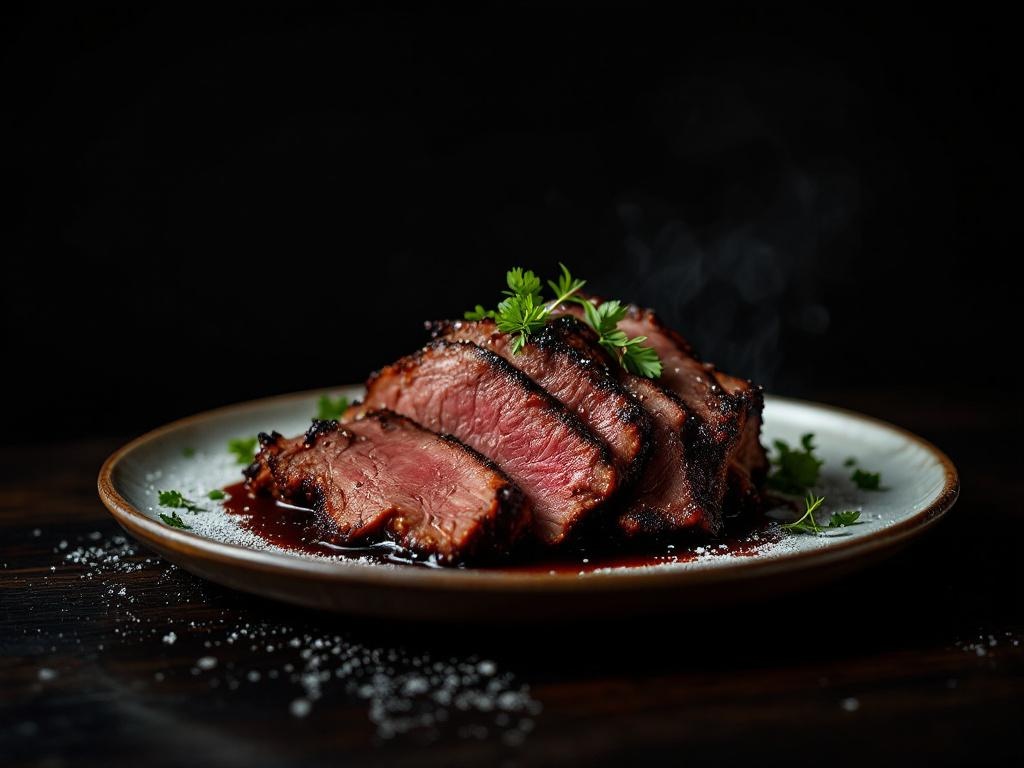
Smoked Brisket
Central Texas, United States. Texas BBQ brisket developed from German and Czech immigrant butcher traditions in Central Texas in the 19th century. The practice of smoking the tougher, cheaper cuts of beef (brisket, ribs) over post oak became the Texas BBQ canon. Franklin Barbecue in Austin is the contemporary standard for the tradition.
Texas-style smoked beef brisket is the summit of American BBQ — a whole packer brisket (flat and point) rubbed with only salt and black pepper, smoked over post oak wood for 12-18 hours at 225-250F until the collagen has converted to gelatin and the fat cap has rendered to a glossy, yielding surface. The bark (the crust formed from the rub, smoke, and rendered fat) should be dark, firm, and deeply flavoured. The interior should be moist, pulling into long muscle fibres, and have a visible pink smoke ring.
Lone Star lager or Shiner Bock (Texas beers) — the regional lagers of Central Texas alongside brisket at a picnic table. White bread, pickled jalapeños, raw onion, and dill pickles are the canonical accompaniments in the Texas BBQ tradition — no sauce.
{"Whole packer brisket (point and flat together): the point has more intramuscular fat (critical for moisture during the long cook); the flat has the uniform, sliceable muscle that is served as the primary cut","The rub: salt and coarse black pepper in equal parts, applied generously. Texas BBQ uses no other seasoning — the smoke and beef are the flavour","Post oak wood: the traditional Texas smoking wood. Hickory is too strong for brisket; fruit woods are too mild. Post oak produces a medium smoke that complements beef","225-250F for 12-18 hours: the collagen in brisket (abundant in this working muscle) must convert to gelatin over an extended cook. This conversion happens between 160-185F internal temperature — a process that takes many hours","The stall: at 155-165F internal, the evaporative cooling plateaus the temperature for 2-4 hours. Wrap in butcher paper (not foil) at the stall — the paper allows moisture to escape, preserving the bark while helping through the stall","Rest: a minimum 1-2 hours wrapped in butcher paper, placed in a cooler — ideally 4 hours. The rest allows juices to redistribute"}
RECIPE: Serves: 8 | Prep: 20 min | Total: 840 min --- 3000g beef brisket — untrimmed point and flat 30g kosher salt 15g Tellicherry black pepper 15g smoked paprika 10g garlic powder 10g onion powder 5g cayenne pepper --- 1. Trim fat cap to 6mm thickness; pat brisket dry with paper towels. 2. Combine salt, pepper, paprika, garlic powder, onion powder, and cayenne; massage evenly across entire surface, working rub into muscle fibers. 3. Place brisket fat-side up on smoker grate; maintain 225°C (225°F) temperature throughout cook. 4. Smoke for 5 hours over oak or hickory, maintaining steady thin blue smoke. 5. Wrap brisket tightly in butcher paper when internal temperature reaches 68°C; continue smoking until flat reaches 88°C internal temperature (approximately 4 more hours). 6. Remove from smoker and rest wrapped in towels for 20 minutes. 7. Slice against the grain into 6mm strips; serve with drippings on the side. The moment where smoked brisket lives or dies is the probe test at the end — when the brisket reaches around 195-205F internal and you insert a temperature probe, it should slide in and out with no resistance, like inserting it into warm butter. If it resists, cook longer. Temperature is a guide; the probe feel is the definitive test. A brisket that probes like butter will be moist and yielding when sliced.
{"Trimming too little fat: more than 1cm of fat cap insulates the meat and prevents bark formation on the fat side","Too-high temperature: accelerating the cook above 275F prevents proper collagen conversion and produces dry, tough brisket","Not resting: cutting a brisket immediately after smoking causes all the juices to run out — the rest is critical"}
Common Questions
Why does Smoked Brisket taste the way it does?
Lone Star lager or Shiner Bock (Texas beers) — the regional lagers of Central Texas alongside brisket at a picnic table. White bread, pickled jalapeños, raw onion, and dill pickles are the canonical accompaniments in the Texas BBQ tradition — no sauce.
What are common mistakes when making Smoked Brisket?
{"Trimming too little fat: more than 1cm of fat cap insulates the meat and prevents bark formation on the fat side","Too-high temperature: accelerating the cook above 275F prevents proper collagen conversion and produces dry, tough brisket","Not resting: cutting a brisket immediately after smoking causes all the juices to run out — the rest is critical"}
What dishes are similar to Smoked Brisket?
Jewish braised brisket (oven-braised with onions — the Ashkenazi Jewish slow-cooked brisket tradition); Argentine asado (slow-cooked beef over hardwood — the South American parallel); Korean galbi jjim (braised short ribs — the Korean slow-cooked beef tradition).