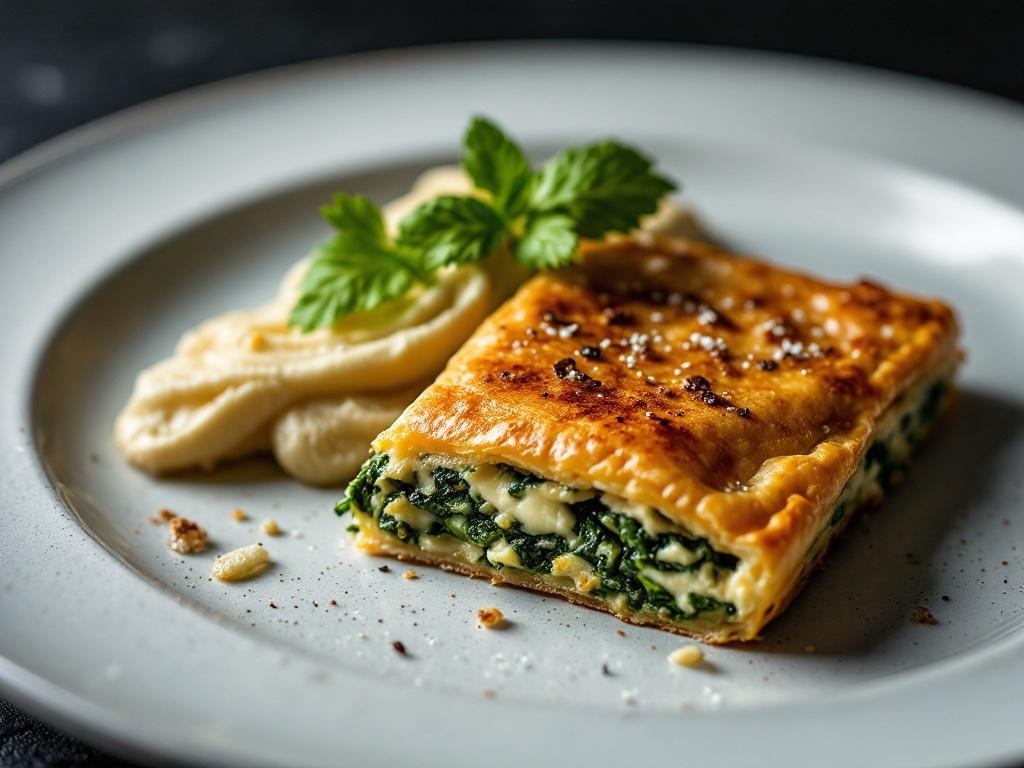
Spanakopita
Greece, Balkan region, and the Ottoman Empire. Phyllo-based pies (pita in Greek) are the great preparation tradition of Greek and Balkan cooking. The spanakopita specifically is documented in Greek cookbooks from the 18th century, though phyllo pies with herbs and cheese are far older.
Spanakopita (spinach and feta pie) is crispy phyllo pastry filled with spinach, feta, eggs, and herbs, baked until the pastry shatters and the filling is set. The filling must be completely dry — any residual moisture from the spinach turns the pastry soggy. The phyllo must be brushed generously with butter or olive oil between each layer. Served as a main course cut in rectangles or as individual triangular hand pies (tiropites).
Served with a simple tomato salad and a glass of cold retsina (pine-resin-flavoured Greek white wine — an acquired taste but the traditional pairing) or a cold Mythos lager.
{"Spinach: fresh (preferably) or frozen. If frozen, thaw completely and squeeze in a clean cloth until bone dry. If fresh, wilt briefly in a pan, cool, and squeeze dry — the amount of liquid that comes out is significant","The filling: wilted spinach, crumbled feta (genuine PDO Greek feta), beaten eggs, spring onions, fresh dill, and a pinch of nutmeg. The eggs bind the filling and firm it during baking","Phyllo preparation: thawed fully, covered with a damp cloth to prevent drying out. Work quickly — exposed phyllo dries in minutes","Fat between layers: clarified butter or good olive oil, brushed between every layer. 6-8 layers of phyllo on the base; 6-8 on top","Score before baking: cut through the top layers only (not through to the filling) to allow steam to escape and create pre-cut portion lines","Bake at 180C for 40-45 minutes until deeply golden on top"}
RECIPE: Serves: 4 | Prep: 20 min | Total: 45 min --- 400g fresh spinach, roughly chopped 250g Feta DOP cheese, crumbled 40g onion, diced small 30g fresh dill, finely chopped 2 cloves garlic, minced 15ml olive oil 2 eggs 3g sea salt 1g white pepper 0.5g grated nutmeg 8 sheets phyllo dough (thawed if frozen) 80g unsalted butter, melted --- 1. Heat 15ml olive oil in large sauté pan over medium-high heat, wilt chopped spinach for 2 minutes, squeeze out excess moisture using clean kitchen towel, transfer to bowl. 2. Fold Feta, diced onion, dill, and minced garlic into wilted spinach; beat in eggs, season with sea salt, white pepper, and nutmeg. 3. Layer 4 phyllo sheets in 9-inch springform pan, brushing each sheet lightly with melted butter as you layer; allow sheets to overhang edges slightly. 4. Spread spinach-Feta mixture evenly into phyllo-lined pan, fold overhanging phyllo sheets inward, layer remaining 4 phyllo sheets on top, brushing each with melted butter. 5. Fold down edges to create neat border, brush top generously with remaining melted butter, score into 4 or 8 portions with sharp knife, bake at 190°C for 20–25 minutes until deep golden brown. 6. Cool for 5 minutes, slice along scored lines, serve warm or at room temperature. The moment where spanakopita lives or dies is the spinach drying — take the cooked, cooled spinach and place it in the centre of a clean kitchen towel. Bring the corners together and twist, wringing the cloth tighter and tighter. The amount of liquid that emerges is extraordinary — up to 200ml from 500g of fresh spinach. Continue until no more liquid can be extracted. Only then is the spinach ready for the filling.
{"Wet spinach filling: produces a soggy, structurally failed spanakopita — squeeze aggressively","Under-buttering the phyllo: dry phyllo layers do not fuse during baking and the pie falls apart","Not resting after baking: the filling needs 15 minutes to set before cutting"}
- Turkish börek (phyllo filled with cheese or meat — the same Ottoman phyllo tradition); Middle Eastern fatayer (folded pastries filled with spinach and sumac — the Levantine phyllo pastry parallel); Moroccan pastilla (phyllo filled with pigeon and almond — the North African phyllo pie tradition).
Common Questions
Why does Spanakopita taste the way it does?
Served with a simple tomato salad and a glass of cold retsina (pine-resin-flavoured Greek white wine — an acquired taste but the traditional pairing) or a cold Mythos lager.
What are common mistakes when making Spanakopita?
{"Wet spinach filling: produces a soggy, structurally failed spanakopita — squeeze aggressively","Under-buttering the phyllo: dry phyllo layers do not fuse during baking and the pie falls apart","Not resting after baking: the filling needs 15 minutes to set before cutting"}
What dishes are similar to Spanakopita?
Turkish börek (phyllo filled with cheese or meat — the same Ottoman phyllo tradition); Middle Eastern fatayer (folded pastries filled with spinach and sumac — the Levantine phyllo pastry parallel); Moroccan pastilla (phyllo filled with pigeon and almond — the North African phyllo pie tradition).