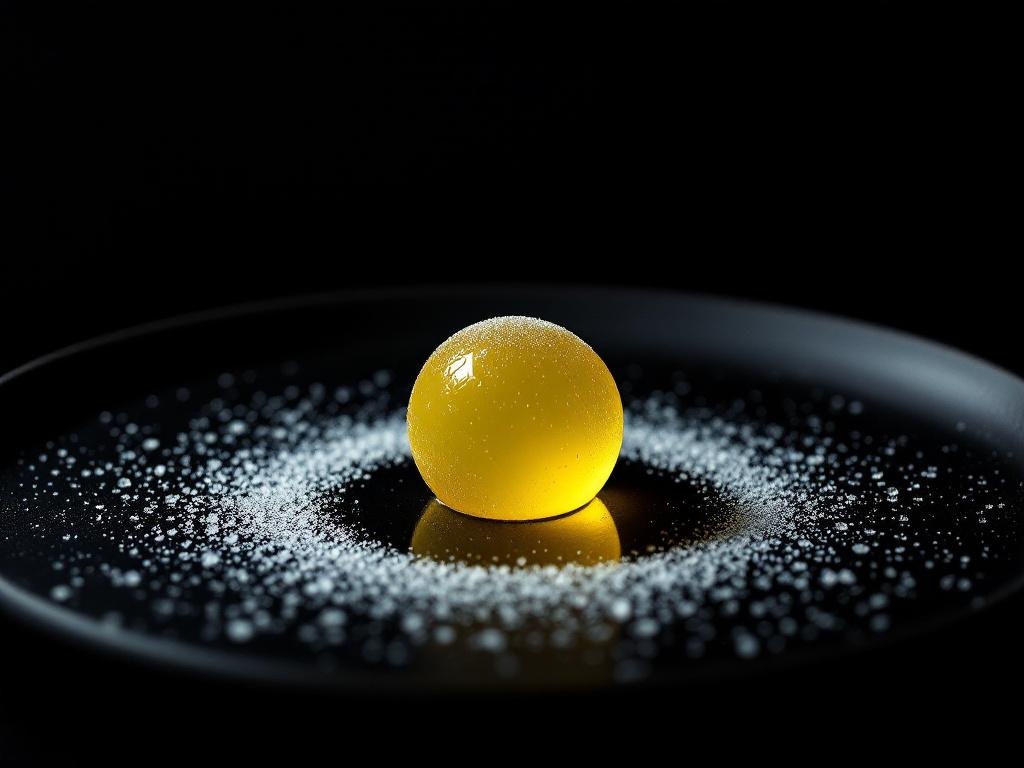
Spherification — Basic (Sodium Alginate + Calcium Chloride)
Developed by Ferran Adrià and the elBulli team, Roses, Spain, 2003; drawing on industrial encapsulation chemistry established in the 1940s
Basic spherification is a modernist culinary technique that creates liquid-filled spheres with a thin gel membrane by exploiting the ionic cross-linking reaction between sodium alginate and calcium chloride. Sodium alginate, extracted from brown seaweed, is a polysaccharide that gels in the presence of divalent calcium ions. When an alginate-containing liquid is dropped into a calcium chloride bath, calcium ions diffuse inward and trigger instantaneous gelation at the contact surface, forming a thin, elastic membrane around a still-liquid core. The process begins by blending sodium alginate (typically 0.5–1% by weight) into the flavoured liquid using an immersion blender, then degassing under vacuum or allowing the mixture to rest for 30–60 minutes to eliminate air bubbles, which cause pockmarked spheres. The calcium chloride bath is prepared at 0.5–1% concentration. Controlled dropping — using a syringe, hemisphere mould, or caviar spoon — determines sphere size. Spheres are rinsed in clean water immediately after forming to halt further gelation. The critical limitation of basic spherification is that gelation continues after removal from the bath. If spheres sit too long, they solidify completely, losing their burst-of-liquid character. This makes it unsuitable for advance preparation. Acidic liquids (below pH 4) inhibit alginate hydration; sodium citrate added at 0.5% can raise pH without affecting flavour significantly. Calcium-rich liquids such as dairy also cause premature gelation in the base — for these, reverse spherification is the appropriate method. The technique was pioneered by Ferran Adrià at elBulli in 2003 as part of the broader textures cuisine movement, drawing on decades-old food industry encapsulation technology. Today it appears across fine dining as olive oil caviar, juice pearls, and flavoured 'yolks' that mimic egg structure — exploiting the theatrical moment of rupture to deliver concentrated flavour directly to the palate.
Delivers a burst of pure, concentrated liquid flavour at the moment of rupture — intensity depends entirely on the quality of the base liquid
Sodium alginate hydrates fully before use — blend then rest or vacuum degas to remove air bubbles Alginate concentration 0.5–1% controls membrane thickness; higher ratios yield thicker, tougher skins Calcium chloride bath at 0.5–1% — stronger baths accelerate gelation and thicken walls faster Acidic liquids require pH adjustment with sodium citrate before alginate will disperse properly Rinse spheres in clean water immediately after setting to stop continued gelation Serve quickly — basic spherification spheres continue to gel and will solidify within 30–60 minutes
RECIPE: Spherification — Basic Technique Yield: 40-50 spheres | Prep: 15 min | Total: 20 min --- 500 ml flavoured liquid (fruit juice, consommé, or purée) 2.5 g sodium alginate 1 l water 5 g calcium chloride 1 l additional water (for rinsing) --- 1. Blend sodium alginate into your chosen liquid using an immersion blender on high speed for 2 minutes until fully dissolved and bubbles subside (rest 15 minutes if foam appears). 2. Dissolve calcium chloride in 1 l water, stirring until clear; pour into a shallow bowl. 3. Fill a second bowl with 1 l plain water for rinsing spheres. 4. Draw sodium alginate liquid into a 10 ml pipette or spherification spoon; hold 2 cm above the calcium chloride bath and release drops slowly. 5. Allow each sphere to sit in the calcium bath for 45–60 seconds (longer for thicker membrane); gently stir occasionally. 6. Use a slotted spoon to transfer spheres to the rinse water; agitate gently for 30 seconds to remove excess calcium chloride. 7. Drain on a clean cloth or consume immediately. Spheres hold for 4 hours refrigerated. RECIPE (Technique Showcase): Yield: 40–50 pearls | Prep: 10 min | Total: 20 min --- 200ml fruit juice or flavored liquid (e.g., passion fruit, apple, or vegetable broth) 2g sodium alginate (premium culinary grade) 500ml water 2.5g calcium chloride (food grade) --- 1. Combine sodium alginate with fruit juice using an immersion blender on high speed for 2 minutes until fully hydrated; let rest 10 minutes to allow air bubbles to settle. 2. Prepare calcium chloride bath by dissolving in 500ml water, stirring until fully dissolved; transfer to a shallow bowl or spherification spoon. 3. Fill a spherification spoon (5ml capacity) with alginate mixture, carefully lower into calcium chloride bath and hold for 20–30 seconds to allow a thin membrane to form around the outside of the liquid. 4. Using a slotted spoon, gently remove sphere and transfer to a clean water bath to rinse; agitate gently to remove excess calcium chloride solution. 5. Drain spheres on a paper towel-lined tray; serve immediately as garnish or use within 4 hours for optimal texture (spheres may continue to gel if left longer). Use a squeeze bottle with a precision tip or a hemisphere silicone mould for uniform sphere size and shape Chill the alginate base before dropping — colder liquid forms a tighter initial membrane and produces rounder spheres Add a small amount of xanthan gum (0.1%) to thicken the base and slow spreading on contact For caviar-scale pearls, use a multi-hole dropper or caviar box device to produce dozens simultaneously Store the calcium bath separately and prep spheres to order during service — never pre-make and hold
Failing to degas the alginate base, resulting in air bubbles and pockmarked or broken spheres Using acidic bases (citrus juice, vinegar) without first adjusting pH with sodium citrate Dropping spheres from too great a height, causing teardrop shapes or splashing deformation Leaving spheres in the calcium bath too long, producing a thick rubbery skin instead of a delicate membrane Attempting to make spheres in advance — basic spherification must be served within minutes of production
Common Questions
Why does Spherification — Basic (Sodium Alginate + Calcium Chloride) taste the way it does?
Delivers a burst of pure, concentrated liquid flavour at the moment of rupture — intensity depends entirely on the quality of the base liquid
What are common mistakes when making Spherification — Basic (Sodium Alginate + Calcium Chloride)?
Failing to degas the alginate base, resulting in air bubbles and pockmarked or broken spheres Using acidic bases (citrus juice, vinegar) without first adjusting pH with sodium citrate Dropping spheres from too great a height, causing teardrop shapes or splashing deformation Leaving spheres in the calcium bath too long, producing a thick rubbery skin instead of a delicate membrane Attempting to mak