Spring Rolls
Fujian province, China. The spring roll (chun juan) is associated with the Lunar New Year — eaten at the spring festival because the gold colour and cylindrical shape resemble gold ingots. Spring roll traditions vary regionally; Shanghainese spring rolls are thinner and more delicate; Cantonese spring rolls have a different filling.
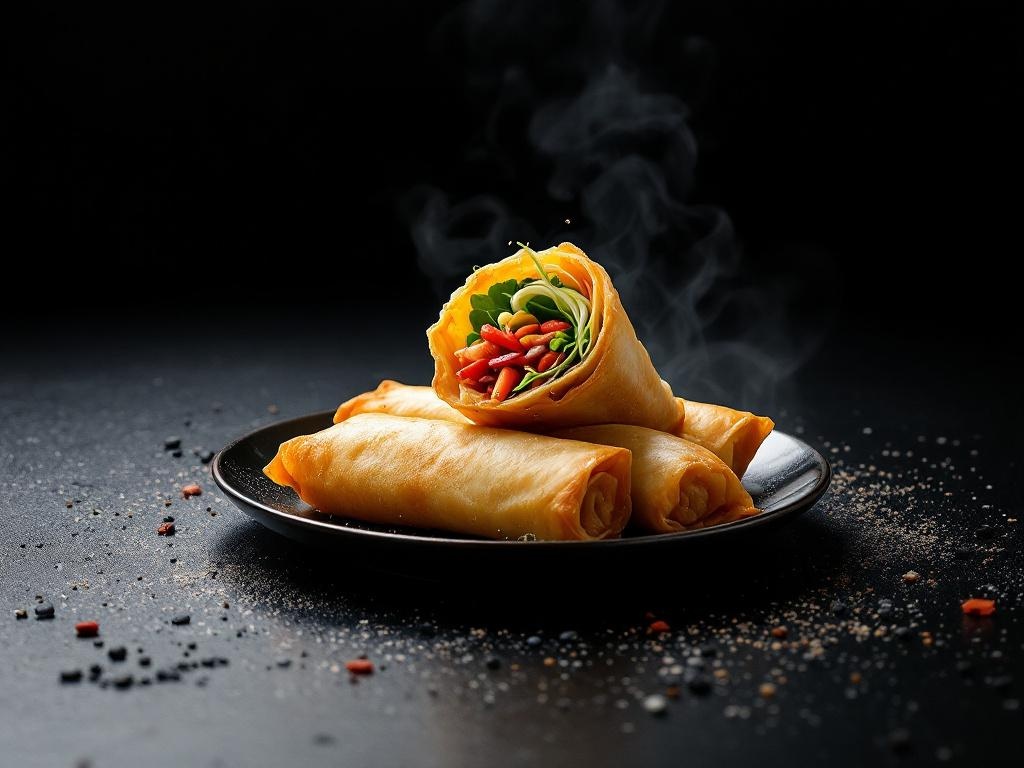
Chinese spring rolls (chun juan) — thin, wheat-flour wrappers filled with a seasoned mixture of pork, cabbage, and glass noodles, deep-fried until the wrapper is paper-thin, shatteringly crisp, and pale golden. The wrapper should be almost translucent, delicate enough to shatter at a bite. The filling should be dry, not wet — a moist filling steams the wrapper from within, preventing the crisp that is the dish.
Tsingtao lager — spring rolls are a shared starter and the lager accompanies naturally. Or a cold Jinro Korean soju if the context is pan-Asian.
{"Spring roll wrappers: wheat-flour spring roll skins (not Vietnamese rice paper, not egg roll wrappers). Available frozen in Asian grocers — use immediately after thawing, covered with a damp cloth","Filling: pork shoulder minced, nappa cabbage (salted, pressed, dried), glass noodles soaked and cut, bamboo shoots, shiitake mushrooms — all cooked together in a wok, seasoned with soy, sesame, and white pepper, then cooled completely","Filling must be dry: squeeze excess liquid out before filling. Wet filling produces wet spring rolls","Rolling technique: place 2 tablespoons of filling near one corner of the wrapper, fold the corner over, roll once, fold in the sides, continue rolling — seal the final flap with a thin paste of flour and water","Fry at 180C in deep oil: the spring rolls should be submerged. Cook 3-4 minutes until pale golden — the full colour develops from the retained heat after removal","Drain on a wire rack immediately"}
RECIPE: Serves: 4 | Prep: 25 min | Total: 35 min --- 8 rice paper wrappers 100 g cooked shrimp, halved lengthwise 80 g rice vermicelli, cooked and cooled 60 g fresh mint leaves 60 g fresh cilantro leaves 40 g roasted peanuts, crushed 4 leaves butter lettuce, halved --- 1. Soak rice paper wrappers in warm water for 30 seconds until pliable; lay flat on damp cloth. 2. Layer lettuce, vermicelli, mint, cilantro, and 2 shrimp halves on lower third of each wrapper. 3. Fold sides inward, then roll tightly away from you until sealed. 4. Arrange on serving platter and garnish with crushed peanuts. 5. Serve immediately with hoisin-peanut dipping sauce (equal parts hoisin and water, with 2 tbsp peanut butter whisked in). The moment where spring rolls live or die is the rolling seal — the flap of the wrapper must be sealed firmly with the flour-water paste. An unsealed spring roll opens in the oil and the filling disperses. Test each spring roll by pressing the sealed edge firmly with your finger after rolling — it should feel tight and secure.
{"Wet filling: the wrapper steams from the inside, preventing crispness","Overfilling: the wrapper tears, filling escapes into the oil","Frying too many at once: the oil temperature drops, the wrappers absorb oil"}
- Vietnamese cha gio (fried spring rolls — the Vietnamese version using rice paper, different filling); Indonesian lumpia (filled fried rolls from the Chinese Indonesian tradition); Filipino lumpiang shanghai (small deep-fried pork rolls — the Filipino evolution of the spring roll).
Common Questions
Why does Spring Rolls taste the way it does?
Tsingtao lager — spring rolls are a shared starter and the lager accompanies naturally. Or a cold Jinro Korean soju if the context is pan-Asian.
What are common mistakes when making Spring Rolls?
{"Wet filling: the wrapper steams from the inside, preventing crispness","Overfilling: the wrapper tears, filling escapes into the oil","Frying too many at once: the oil temperature drops, the wrappers absorb oil"}
What dishes are similar to Spring Rolls?
Vietnamese cha gio (fried spring rolls — the Vietnamese version using rice paper, different filling); Indonesian lumpia (filled fried rolls from the Chinese Indonesian tradition); Filipino lumpiang shanghai (small deep-fried pork rolls — the Filipino evolution of the spring roll).