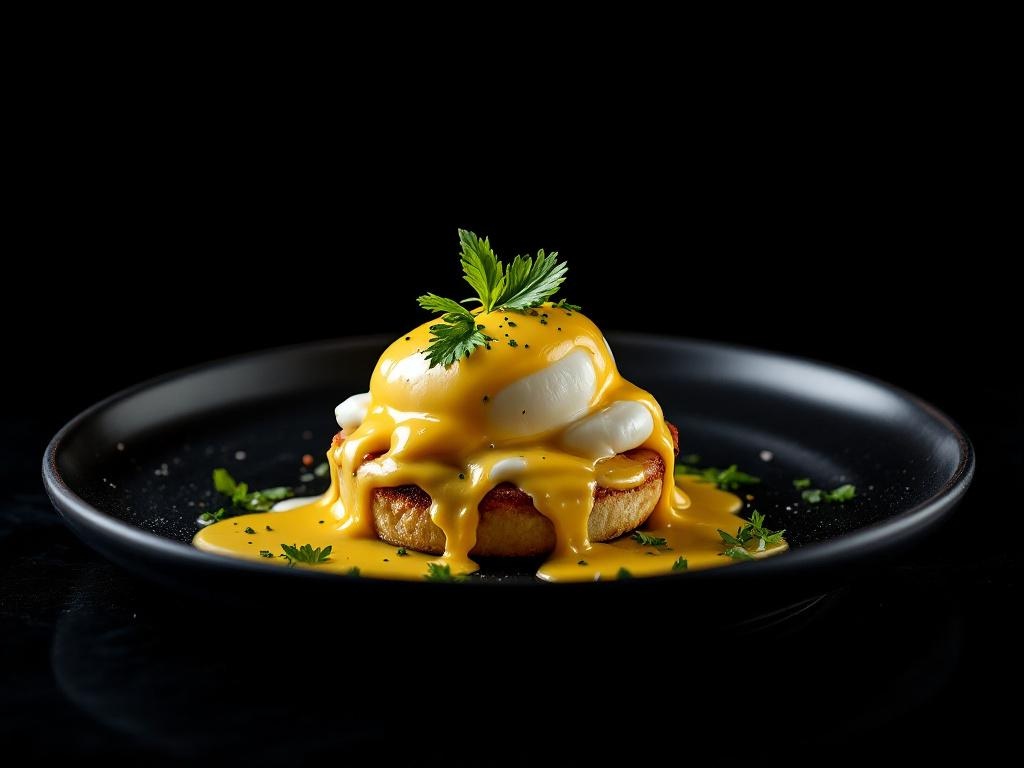
Hollandaise — Temperature Control and Double Boiler
Classical French cuisine, 19th century — named for the Dutch province of Holland, possibly referencing Dutch butter quality; codified in Escoffier's Guide Culinaire (1903)
Hollandaise is a classical French warm emulsified butter sauce produced by whisking reduced wine and vinegar into egg yolks over gentle heat to form a sabayon — a thick, airy, cooked egg foam — then mounting clarified or whole butter into the cooked yolks. It is technically a warm oil-in-water emulsion stabilised by heat-set egg yolk proteins, requiring precise temperature management throughout. The double boiler (bain-marie) method places the bowl over simmering — never boiling — water. The indirect heat allows the egg yolks to cook gently and evenly without scrambling. The target is to bring the yolks from a loose liquid to a thick, ribbon-dropping sabayon — a stage at which the proteins have partially denatured enough to coat and emulsify butter droplets but have not coagulated into scrambled curds. This occurs in the range of 60–65°C. Above 70°C, the yolks scramble rapidly and the sauce is ruined. Clarified butter (ghee) is the traditional choice for hollandaise because removing the water and milk solids from butter eliminates variables in the emulsion and produces a more stable result that withstands slightly higher temperatures. Whole butter produces a richer, more complex sauce but one that is more delicate and prone to breaking under heat stress. The finished hollandaise must be held at exactly 60–65°C — warm enough to remain liquid and safe, but not so hot as to continue cooking the yolks or melt the emulsion. Hollandaise cannot be refrigerated and rewarmed without breaking; it must be made and held for service at the correct temperature. A warm bain-marie or double boiler kept at 60°C is the traditional holding method. Lemon juice added after mounting brightens the sauce, adds acidity, and slightly thins the texture. White pepper is the traditional seasoning — black pepper's specks are considered aesthetically inappropriate in a classical white sauce.
Rich, buttery, and lemony with an eggy creaminess — a delicate sauce that amplifies butter quality; pale and golden, its flavour is the essence of refined French sauce cookery
Sabayon stage (65°C) must be reached before mounting butter — undercooked yolks produce a thin, unstable sauce that breaks easily Never allow the bain-marie water to boil — rolling water creates too much heat for the yolk proteins to cook evenly without scrambling Clarity of butter (clarified) produces a more stable hollandaise; whole butter produces more flavour complexity but greater fragility Hold finished hollandaise at 60–65°C — it cannot be refrigerated and must be served the day of production If the sauce becomes too thick during holding, add a few drops of warm water and whisk to restore consistency Season with lemon juice last — it brightens the sauce and tightens the emulsion slightly through increased acidity
RECIPE: HOLLANDAISE — Temperature Control and Double Boiler Yield: 300 ml | Prep: 5 min | Total: 12 min --- 150 g unsalted butter (European style, 82%+ fat) — cubed 3 egg yolks — room temperature 15 ml water 10 ml lemon juice (fresh) 2 g sea salt white pepper — pinch Cayenne pepper — pinch (optional) --- 1. Fill a large saucepan with 5 cm water; bring to a bare simmer (surface should shimmer, not boil); temperature must stay 50–60°C throughout — use instant thermometer to monitor. 2. Set a heatproof bowl (stainless steel or glass) over the simmering water, ensuring bottom does not touch water (double boiler setup); add egg yolks and water to the bowl. 3. Whisk egg yolks and water constantly for 3–4 minutes; mixture will thicken and become pale as yolk proteins denature gently — do not let temperature exceed 65°C or yolks will scramble. 4. Remove bowl from heat briefly; begin whisking in cubed butter, a few pieces at a time, waiting for each addition to fully incorporate — if sauce looks thin, return bowl to heat briefly and whisk (do not leave unattended). 5. Continue whisking in all butter; sauce should become thick, glossy, and pale (sabayon stage + mounted butter = emulsion suspended over gentle heat). 6. Remove bowl from heat; whisk in lemon juice, salt, white pepper, and Cayenne if using; taste and adjust seasoning. 7. Serve immediately at 50–55°C; if sauce breaks or becomes too thick, whisk in 5 ml warm water (or drop of lemon juice) to restore fluidity. --- KEY: Double boiler + whisking creates sabayon (thickened yolk foam); slow butter mounting emulsifies into it. Temperature must stay 50–65°C to prevent scrambling or breaking. Hold maximum 1 hour. HOLLANDAISE — Temperature Control and Double Boiler Yield: 250 ml | Prep: 8 min | Total: 12 min --- 3 egg yolks (room temperature) 150 g unsalted butter (cold, cubed) 30 ml lemon juice (fresh, strained) 15 ml water Pinch of cayenne pepper (Cayenne, not paprika) Sea salt and white pepper (to taste) --- 1. Fill bottom of double boiler with water; bring to gentle simmer (steam should be barely visible); water should not touch bowl above. 2. Place egg yolks and water in upper bowl; whisk constantly over simmering water until yolks are pale, slightly thickened, and reach 65°C (149°F) on instant-read thermometer (sabayon stage — approximately 3–4 minutes). 3. Remove upper bowl from heat; allow yolks to cool to 55°C (131°F) while whisking (approximately 1 minute); this prevents butter from melting too quickly and breaking emulsion. 4. Add cold butter cubes one at a time, whisking constantly; each cube should be mostly incorporated before next is added; maintain temperature between 48–52°C (118–125°F) using double boiler as needed. 5. Once all butter is incorporated and sauce is creamy and homogeneous, remove from heat; whisk in lemon juice, cayenne, sea salt, and white pepper. 6. Pass through fine mesh strainer; serve immediately or hold in warm (not hot) water bath at 48–52°C (118–125°F) for up to 30 minutes. KEY PRINCIPLE: Double boiler provides gentle, consistent heat below 70°C (158°F); temperature control prevents egg scrambling and butter separation. Hollandaise is unstable — serve as soon as possible. Use a metal bowl rather than glass for the bain-marie — metal conducts heat more evenly and reduces the risk of hot spots forming against the bowl surface For a cheat's hollandaise using a blender: blend the sabayon briefly at low speed, then pour warm clarified butter in a thin stream — the blender emulsifies in under 60 seconds For service stability, add 1 tablespoon of crème fraîche to the reduction before mounting butter — the extra proteins significantly improve holding time Whisk vigorously and continuously during the sabayon stage — the incorporation of air creates volume that later helps butter droplets remain dispersed For a Maltaise variation, replace lemon juice with blood orange juice and add blood orange zest — a classical variation that works beautifully with asparagus
Overheating the yolks in the sabayon stage above 70°C, producing scrambled curd-filled sauce that cannot be rescued Using cold butter, which shocks the warm emulsion and can cause the sauce to break on contact Making hollandaise in advance and attempting to reheat it, which breaks the emulsion — it must be made and held on the day Adding butter too fast, exhausting the emulsifying capacity of the yolk proteins before all butter is incorporated Using the sauce at temperatures below 60°C, which creates a food safety risk as yolks are only partially cooked
Common Questions
Why does Hollandaise — Temperature Control and Double Boiler taste the way it does?
Rich, buttery, and lemony with an eggy creaminess — a delicate sauce that amplifies butter quality; pale and golden, its flavour is the essence of refined French sauce cookery
What are common mistakes when making Hollandaise — Temperature Control and Double Boiler?
Overheating the yolks in the sabayon stage above 70°C, producing scrambled curd-filled sauce that cannot be rescued Using cold butter, which shocks the warm emulsion and can cause the sauce to break on contact Making hollandaise in advance and attempting to reheat it, which breaks the emulsion — it must be made and held on the day Adding butter too fast, exhausting the emulsifying capacity of the