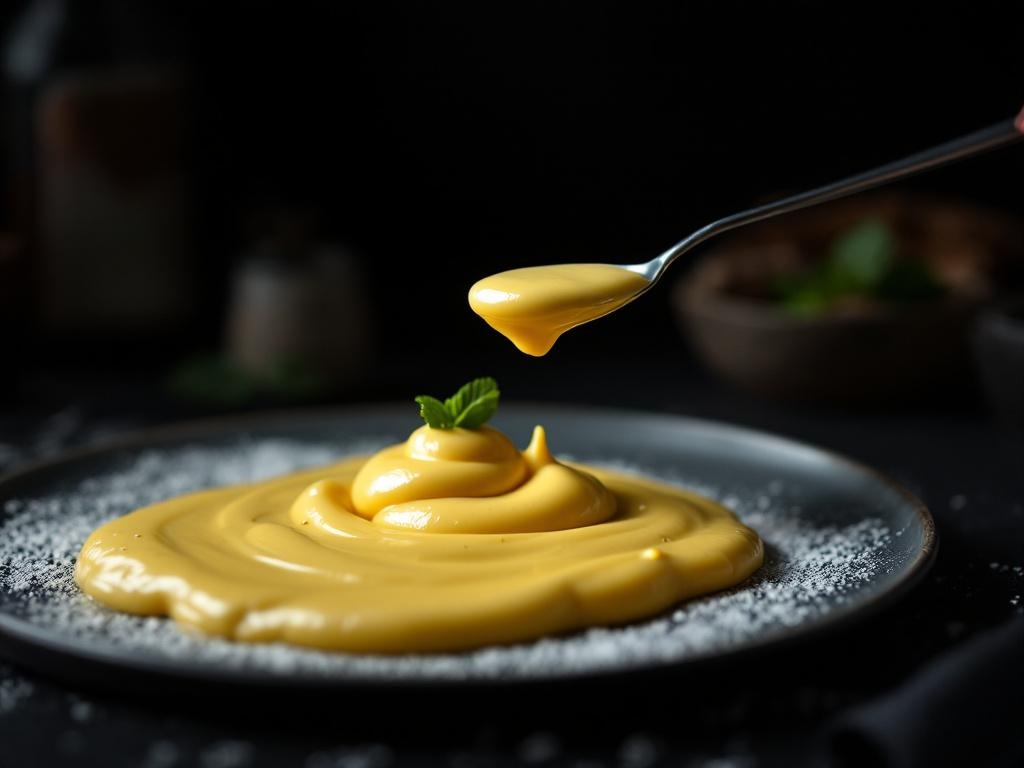
Mayonnaise — Hand Method and Emulsion Science
Origin debated — likely Mahon, Menorca (captured by French forces in 1756) or southern French Languedoc tradition; adopted into French haute cuisine and spread globally through the 19th century
Mayonnaise is a stable oil-in-water emulsion in which fine droplets of oil are dispersed within a water phase composed of egg yolk, acid (lemon juice or vinegar), mustard, and salt. The emulsification is stabilised by lecithin and proteins in the egg yolk, which migrate to the oil-water interface and prevent coalescence of the oil droplets. Understanding the science enables consistent production and diagnosis of emulsion failures. Egg yolk contains approximately 30% dry weight as lecithin (primarily phosphatidylcholine) — the principal emulsifier. When egg yolk is beaten with acid and salt and oil is added slowly, the mechanical energy of beating breaks oil into increasingly fine droplets while the yolk emulsifiers coat each droplet's surface, preventing re-coalescence. The maximum oil-to-yolk ratio is approximately 200–250ml oil per large egg yolk — exceeding this exhausts the available emulsifier and the emulsion breaks. Acid serves two roles: flavouring and emulsion stability. Acidic pH causes egg yolk proteins to unfold partially, exposing more hydrophobic regions that preferentially migrate to the oil-water interface and improve emulsification effectiveness. Mustard contributes mucilage (a complex polysaccharide) that acts as an additional emulsifier and thickener, as well as flavour. The hand method — whisking by hand rather than using a blender — demonstrates emulsion science most clearly. Oil must be added in an extremely thin, slow stream at the beginning when the ratio of oil to emulsifier is high — even a small excess of oil at this critical stage can break the emulsion. Once the emulsion begins to thicken and stabilise (typically after the first 30–50ml of oil is incorporated), oil can be added in a thin stream with less precision. A room-temperature egg yolk and room-temperature oil emulsify more readily than cold ingredients. Broken mayonnaise can be rescued: start with a clean bowl, a fresh egg yolk, a small amount of acid, and slowly whisk the broken mixture into the new yolk — the emulsifier in the new yolk absorbs and stabilises the broken droplets.
Neutral and rich with bright acid balance — flavour character is determined entirely by the quality of the oil, acid, and aromatics; emulsion stability determines texture quality
Add oil drop by drop at the beginning — the critical period when oil-to-emulsifier ratio is highest and emulsion is most fragile Maximum oil per egg yolk is approximately 200–250ml — exceeding this breaks the emulsion regardless of technique Room temperature ingredients emulsify more readily than cold — remove egg yolk from fridge 30 minutes before use Mustard provides additional emulsification and is important for emulsion stability, not just flavour Acid (vinegar or lemon juice) unfolds yolk proteins to expose emulsifying surfaces — always add acid before the oil Broken mayonnaise is rescued by whisking slowly into a fresh yolk — the new yolk's emulsifiers absorb and stabilise the broken mixture
RECIPE: MAYONNAISE — Hand Method and Emulsion Science Yield: 300 ml | Prep: 10 min | Total: 10 min --- 2 egg yolks — room temperature (20°C), from pasteurised or very fresh eggs 10 ml white wine vinegar or lemon juice (room temperature) 5 g Dijon mustard 3 g sea salt white pepper — pinch 250 ml neutral oil (grapeseed, light olive, or sunflower) — room temperature 15 ml warm water (reserve for rescue) --- 1. Combine egg yolks, vinegar, mustard, salt, and white pepper in a medium bowl; whisk vigorously for 10 seconds until pale and foamy. 2. Begin adding oil one drop at a time (literally: drop from a spoon), whisking constantly and vigorously — this is critical for the first 30 ml; emulsion forms when oil droplets suspend in egg yolk lecithin matrix. 3. After 30 ml oil is incorporated and mixture is thick, add oil in a slow steady stream (2 mm diameter) while whisking continuously; whisk must never stop. 4. Halfway through oil addition (around 120 ml total), mixture will reach peak thickness and become difficult to whisk — this is normal and means emulsion is stable. 5. Continue adding remaining oil slowly; texture will loosen slightly as more oil is incorporated — you are now just whisking faster oil-to-egg ratio. 6. When all oil is incorporated, taste and adjust with additional vinegar, salt, or pepper; if consistency is too thick, whisk in warm water (5 ml at a time). 7. If emulsion breaks (looks curdled/separated), start fresh yolk in clean bowl, whisk with mustard and salt, then slowly whisk in broken mayo as if it were oil — re-emulsifies instantly. --- KEY PRINCIPLE: Oil droplets suspend in yolk lecithin (an emulsifier); whisking provides energy for dispersion. Room-temperature ingredients and slow addition at start ensure stable emulsion that holds 80%+ oil. MAYONNAISE — Hand Method and Emulsion Science Yield: 250 ml | Prep: 10 min | Total: 10 min --- 1 egg yolk (room temperature — crucial) 5 ml Dijon mustard (acts as emulsifier) 10 ml white wine vinegar or lemon juice (acid stabilizes emulsion) 175 ml neutral oil (light olive, peanut, or sunflower — room temperature) Sea salt and white pepper (to taste) 5 ml warm water (if emulsion threatens to break) --- 1. Whisk egg yolk with Dijon mustard and sea salt in medium bowl until pale and slightly thickened (1 minute); this activates lecithin in yolk. 2. Add half the vinegar or lemon juice; whisk to combine; acid helps stabilize emulsion by lowering pH. 3. Begin adding oil drop by drop (literally — 1 ml at a time) while whisking constantly and vigorously; oil droplets must be surrounded by lecithin-water mixture before more oil is added. 4. After approximately 60 ml oil is incorporated and sauce visibly thickens, oil can be added in thin, steady stream (3–5 ml at a time) while whisking; ratio shifts toward oil-continuous emulsion. 5. If emulsion breaks (becomes grainy or separates), immediately stop whisking; begin fresh with new yolk in clean bowl, whisk with mustard and acid, then slowly whisk broken mixture into fresh yolk (recovers 90% of broken batch). 6. Once all oil is incorporated, whisk in remaining vinegar, warm water if needed for consistency, and season with sea salt and white pepper. EMULSION SCIENCE: Egg yolk contains 35% lecithin; each molecule has hydrophilic (water-loving) head and lipophilic (fat-loving) tail. Lecithin surrounds oil droplets, allowing up to 4× volume of oil to water. Break emulsion by whisking too fast, adding cold oil, or adding oil too quickly. For foolproof blender mayonnaise, use an immersion blender with the egg yolk and acid in the bottom of a narrow jar — pour all the oil on top and plunge the blender, then raise slowly as it emulsifies For aioli (Provençal garlic mayonnaise), begin with roasted garlic paste in the bowl before the yolk — the roasted garlic provides additional emulsification surface For stable mayonnaise that holds on buffets or in warm environments, add 0.3% xanthan gum to the water phase — it dramatically increases viscosity and prevents weeping A clean resting bowl, no oil residue, and a room-temperature yolk are the three most important preparation steps for a beginner learning hand mayonnaise For a lighter result, replace 30% of the oil with a light flavoured broth or cold reduction — the result is a semi-emulsion with dramatically reduced fat content
Adding oil too fast at the beginning, before sufficient emulsifier is present to coat the droplets — this is the most common cause of breaking Using cold oil directly from the refrigerator — cold oil is more viscous and breaks into larger, harder-to-emulsify droplets under mixing Exceeding the emulsifier capacity of the yolk by adding too much oil, resulting in a grainy, broken mass that cannot be incorporated Not adding all the acid at the beginning — adding vinegar or lemon juice at the end after the emulsion has formed can cause it to break Using light olive oil expecting a neutral result — even light olive oil has enough phenolic bitterness to produce unpleasant flavour
Common Questions
Why does Mayonnaise — Hand Method and Emulsion Science taste the way it does?
Neutral and rich with bright acid balance — flavour character is determined entirely by the quality of the oil, acid, and aromatics; emulsion stability determines texture quality
What are common mistakes when making Mayonnaise — Hand Method and Emulsion Science?
Adding oil too fast at the beginning, before sufficient emulsifier is present to coat the droplets — this is the most common cause of breaking Using cold oil directly from the refrigerator — cold oil is more viscous and breaks into larger, harder-to-emulsify droplets under mixing Exceeding the emulsifier capacity of the yolk by adding too much oil, resulting in a grainy, broken mass that cannot be