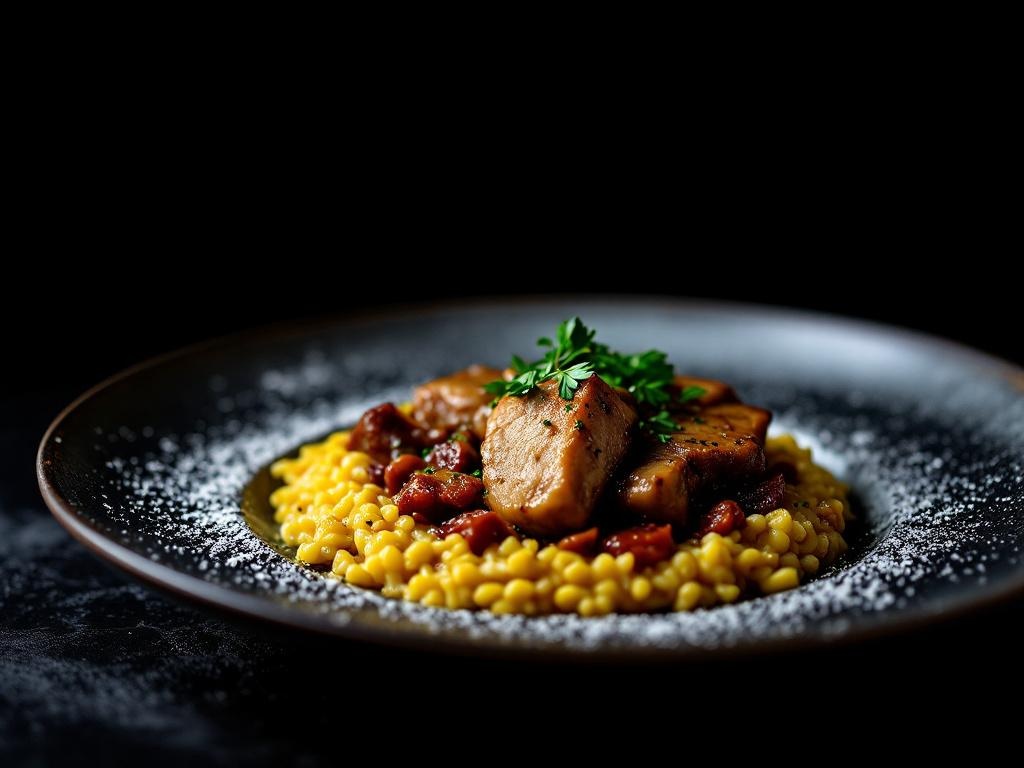
Ossobuco alla Milanese (Lombardian — Marrow Bone, Gremolata, Saffron Risotto)
Milan, Lombardy — 19th century Milanese bourgeois cooking; documented by Pellegrino Artusi in 1891; inseparable from Milanese saffron risotto tradition
Ossobuco alla Milanese is the great Lombardian braised preparation — cross-cut veal shin, braised until the collagen dissolves and the marrow in the central bone cavity becomes molten and spreadable, served atop a saffron risotto (risotto alla Milanese) and finished with gremolata — a mixture of finely chopped lemon zest, garlic, and flat parsley that cuts through the richness with bright, aromatic clarity. The combination of the silky braise, the golden risotto, and the herbal freshness of the gremolata is one of the most complete flavour assemblies in Italian cuisine. The dish belongs to 19th-century Milanese bourgeois cooking — it appears in the first comprehensive Italian cookbook, Pellegrino Artusi's La Scienza in Cucina e l'Arte di Mangiar Bene (1891) — and has been the benchmark Lombardian first course ever since. The name means 'bone with a hole' — the hollow bone that runs through the centre of the veal shin cross-section. The marrow inside is considered the greatest prize of the dish, traditionally eaten with a small spoon and spread on bread or stirred into the risotto. The veal shin is cut into sections 4–5cm thick, tied around the circumference to prevent the meat from falling away from the bone during braising. It is seasoned, lightly floured, and browned in butter and olive oil until deeply golden on both sides — the browning of the floured surface creates the fond that gives the braise its body. A soffritto of onion, carrot, and celery follows, then white wine, then veal or chicken stock. The braise proceeds in the oven at 160°C for 90–120 minutes, basting occasionally. The risotto alla Milanese — saffron-scented, butter-mounted — is prepared separately and timed to coincide with the braising completion. The gremolata is made fresh and scattered over the ossobuco just before service.
Silky braised veal and melting marrow on golden saffron risotto, brightened by lemon-garlic-parsley gremolata — opulent and complete
Tie the veal shin before braising — the meat contracts and detaches from the bone without this support Flour lightly before browning — the flour creates a crust and thickens the braising liquid naturally Brown deeply on both sides before adding liquid — the Maillard reaction on the floured surface is the flavour foundation Add gremolata only at service — it is always fresh; heat destroys the volatile aromatics of the lemon zest The risotto and braise must finish simultaneously — this requires careful timing in professional and home kitchens alike
RECIPE: Serves: 4 | Prep: 30 min | Total: 180 min --- For Ossobuco: 4 veal shanks (ossobuco), 5–6 cm thick, tied with string 60 ml extra-virgin olive oil 1 medium carrot, finely diced 1 medium celery stalk, finely diced 1 medium onion, finely diced 200 ml dry white wine (Vermentino or Pinot Grigio) 300 ml veal or chicken stock 2 canned San Marzano DOP tomatoes, crushed by hand 3 fresh bay leaves 4 fresh thyme sprigs 10 g sea salt 5 g black pepper (Tellicherry) For Gremolata: 20 g fresh flat-leaf parsley, finely chopped 2 lemons, zest only (finely minced) 3 garlic cloves, minced to paste For Risotto alla Milanese: 300 g Carnaroli rice (Piedmont preferred) 1 litre chicken or veal stock, held at simmer 100 ml dry white wine 1 medium onion, finely minced 60 g unsalted butter (divided: 30 g + 30 g) 0.5 g saffron threads, bloomed in 30 ml warm stock 60 ml whole milk 80 g Parmigiano Reggiano DOP, finely grated 8 g sea salt --- 1. Heat olive oil in a heavy braising pot over medium-high heat until smoking; pat veal shanks dry, season with salt and pepper, and sear on cut faces for 3 minutes per side until golden, transfer to plate. 2. Add diced carrot, celery, and onion to pot; sauté for 5 minutes until softened, then deglaze with white wine, scraping fond, and reduce by half (approximately 3 minutes). 3. Return veal shanks to pot standing upright, add crushed tomatoes, stock, bay leaves, and thyme; bring to gentle simmer, cover with parchment and lid, and braise at 160°C in oven for 2 hours, turning shanks halfway through. 4. Combine parsley, lemon zest, and garlic paste in a small bowl for gremolata; set aside until service. 5. For risotto: heat 30 g butter in a wide, heavy-bottomed pot over medium heat; add minced onion and sauté for 2 minutes until translucent, then add Carnaroli rice and toast for 2 minutes, stirring constantly. 6. Deglaze with white wine, stirring until absorbed; add saffron and blooming liquid, then begin adding warm stock one ladle at a time (approximately 120 ml), stirring frequently, allowing each addition to be absorbed before adding next; continue for 16–18 minutes until rice is al dente with a slight flow to the risotto. 7. Remove from heat, fold in remaining 30 g butter, milk, and Parmigiano Reggiano until creamy; season to taste with salt. 8. Arrange risotto on warm plates, top with one upright ossobuco shank, spoon braising jus around, and finish with a pinch of gremolata on the marrow bone. --- Bloom the saffron for the risotto in warm stock for 15 minutes — crumbled saffron added directly to the risotto releases less colour and flavour A marrow spoon (cucchiaino da midollo) should be set at each place — the marrow is the prize and deserves its own implement For restaurant service, braise the ossobuco to completion, cool, and reheat in the braise liquid — it is actually more tender and cohesive served this way Add a small amount of anchovy paste to the soffritto — it dissolves completely and adds an umami depth that is practically undetectable but significant The correct accompaniment debate is settled: only saffron risotto (risotto alla Milanese) is canonical; polenta is used in rural Lombardy but not in Milanese tradition
Skipping the tying of the veal — the meat falls into the sauce and the presentation is lost Braising at too high a temperature — 180°C causes the connective tissue to tighten before it dissolves Pre-making the gremolata and losing its freshness — it must be made and applied at the moment of service Using chicken broth for the risotto instead of proper veal or chicken stock — the richness of the braise deserves an equally flavoured risotto Not basting during braising — the top of the ossobuco dries without regular basting
Common Questions
Why does Ossobuco alla Milanese (Lombardian — Marrow Bone, Gremolata, Saffron Risotto) taste the way it does?
Silky braised veal and melting marrow on golden saffron risotto, brightened by lemon-garlic-parsley gremolata — opulent and complete
What are common mistakes when making Ossobuco alla Milanese (Lombardian — Marrow Bone, Gremolata, Saffron Risotto)?
Skipping the tying of the veal — the meat falls into the sauce and the presentation is lost Braising at too high a temperature — 180°C causes the connective tissue to tighten before it dissolves Pre-making the gremolata and losing its freshness — it must be made and applied at the moment of service Using chicken broth for the risotto instead of proper veal or chicken stock — the richness of the br