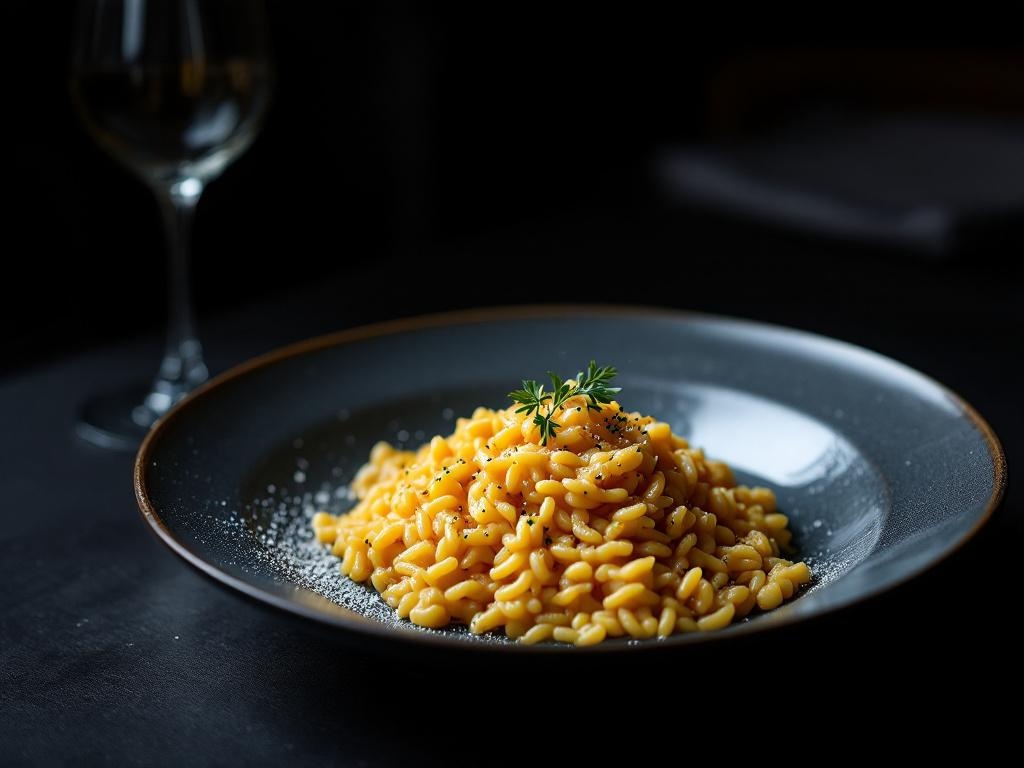
Risotto alla Milanese
Milan, Lombardy. A glassworker's assistant legend holds that saffron — used to gild the Duomo's windows — was added to a master's risotto as a prank, producing the golden dish now synonymous with the city. Documented in Milanese cookbooks from the 16th century.
The risotto of Milan: bone marrow, Carnaroli rice, white wine, saffron, and Parmigiano-Reggiano aged 36 months. Gold in a bowl — the colour of the Duomo's facade in afternoon light. The texture is all'onda (wave-like) — loose enough to flow when the plate is tapped, never stiff, never dry.
A young Nebbiolo from Piedmont — Langhe Nebbiolo or village-level Barolo — where cherry and tar structure cuts through the fatty richness of bone marrow and aged Parmigiano. For white: Arneis from Roero, dry and nutty with enough body to match the richness.
{"Carnaroli over Arborio: Carnaroli has a firmer grain and higher starch output — it holds al dente texture better during stirring and releases more creamy starch into the broth","Bone marrow as the fat: authentic Milanese uses marrow from cross-cut veal or beef femur. Render the marrow in the pan before adding onion — it provides depth that butter alone cannot replicate","Saffron: Abruzzo or Spanish Mancha saffron, dissolved in warm broth and added in the final third of cooking — adding early causes bitterness","Stock temperature: keep broth simmering in a separate pan and add hot, ladle by ladle — cold broth shocks the starch and interrupts the slow gelatinisation that creates creamy risotto","Mantecatura: remove from heat. Add 80g cold diced butter and 60g finely grated Parmigiano-Reggiano. Stir vigorously with simultaneous pan-shaking for 90 seconds","All'onda test: the finished risotto should flow like slow lava when the pan is tipped — if it holds its shape, it is overcooked. Plate immediately"}
RECIPE: Serves: 4 | Prep: 10 min | Total: 35 min --- 320 g Carnaroli rice 1 g saffron threads (0.1 g per serving) 120 ml dry white wine 900 ml vegetable or chicken stock, simmering 100 g yellow onion, minced 50 g Parmigiano Reggiano DOP aged 24 months, grated 80 ml whole milk 60 g unsalted butter 40 ml extra virgin olive oil 3 g sea salt --- 1. Bloom saffron in 60 ml warm stock off heat for 5 minutes. 2. Heat olive oil in a heavy-bottomed pot over medium; add minced onion and sauté until translucent (3 minutes). 3. Add rice and toast for 2 minutes, stirring constantly, until grains are opaque at edges but translucent in center. 4. Deglaze with white wine; simmer until nearly absorbed, then add saffron stock and bloom color into rice. 5. Add simmering stock 150 ml at a time, stirring frequently; each addition absorbs in 3–4 minutes. Continue for 18 minutes total until rice is al dente with slight bite. 6. Remove from heat; stir in butter, milk, and Parmigiano Reggiano until creamy. Season with sea salt; serve at once in warm bowls. The moment where Milanese lives or dies is the mantecatura. Pull the pan off heat before the rice seems fully done — it continues cooking in the pan. The cold butter must be genuinely cold, in small dice, added all at once. Vigorous stirring while shaking the pan creates rapid emulsification — from starchy to glossy in 90 seconds. Rest covered for 2 minutes. Plate in warm, shallow bowls — a ladle of risotto tapped flat with the ladle underside so it spreads to the edges. Finish with a shaving of Parmigiano, never grated.
{"Using Arborio: it overcooks quickly and turns mushy before the exterior starch has fully released","Adding all the broth at once: the slow ladle-by-ladle addition allows each addition to absorb fully, building the creamy sauce incrementally","Skipping the mantecatura: the cold butter hitting hot rice creates an emulsion — without this step, the risotto is starchy rather than silky","Adding saffron too early: it becomes bitter and the colour muddies to orange-brown rather than bright gold"}
- Spanish paella (short-grain rice, hot stock added incrementally); Turkish pilav enriched with bone marrow; Persian chelow where saffron dissolved in liquid is the defining flavour compound.
Common Questions
Why does Risotto alla Milanese taste the way it does?
A young Nebbiolo from Piedmont — Langhe Nebbiolo or village-level Barolo — where cherry and tar structure cuts through the fatty richness of bone marrow and aged Parmigiano. For white: Arneis from Roero, dry and nutty with enough body to match the richness.
What are common mistakes when making Risotto alla Milanese?
{"Using Arborio: it overcooks quickly and turns mushy before the exterior starch has fully released","Adding all the broth at once: the slow ladle-by-ladle addition allows each addition to absorb fully, building the creamy sauce incrementally","Skipping the mantecatura: the cold butter hitting hot rice creates an emulsion — without this step, the risotto is starchy rather than silky","Adding saffr
What dishes are similar to Risotto alla Milanese?
Spanish paella (short-grain rice, hot stock added incrementally); Turkish pilav enriched with bone marrow; Persian chelow where saffron dissolved in liquid is the defining flavour compound.